The Water Lilies
by Claude Monet
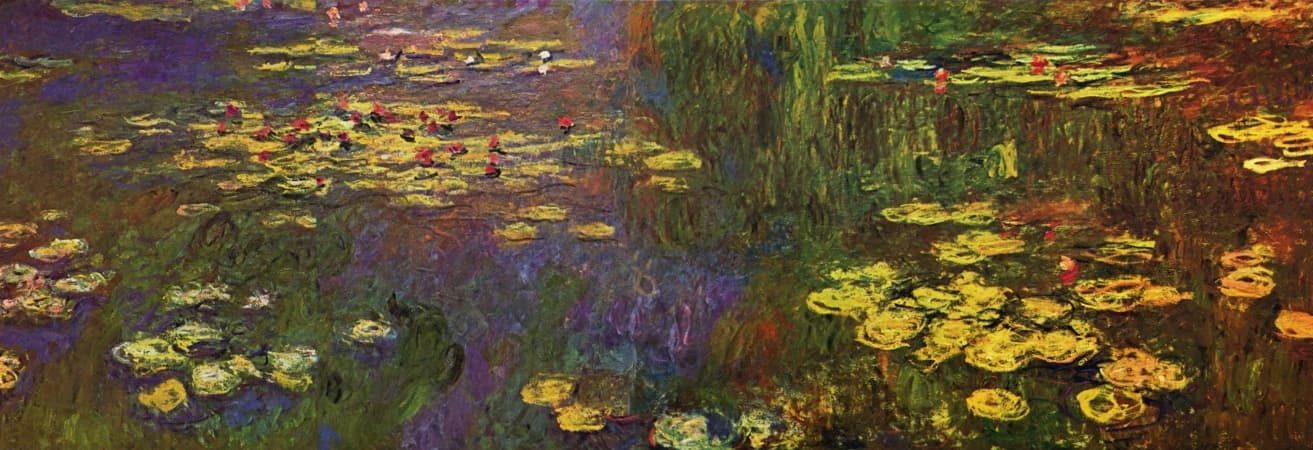
Eight enormous curved paintings of Monet's lily pond at Giverny, hung in two oval rooms built to hold them at the Musée de l'Orangerie. Monet gave them to France the day after the Armistice of 11 November 1918, worked on them until he died, and never saw them installed. The rooms opened in May 1927, and the eight panels have been there ever since.
- Painted c. 1914–1926; installed 1927
- Oil on canvas, in eight compositions
About Claude Monet
What you walk into
Two white oval rooms, one after the other. There are no pictures hanging on the walls in the ordinary sense — the walls themselves are the paintings. Eight canvases, each two metres tall, curve continuously around the rooms for a combined length of 91 metres, and the light comes from above, diffused, with no lamps in view.
The subject is a pond. Specifically the water-lily pond in Claude Monet's garden at Giverny, about seventy-five kilometres north-west of Paris, which he had built and planted himself and painted for the last thirty years of his life.
There is no horizon in any of them. Monet cropped out the bank, the sky and any sense of where you would be standing, so what you get is water seen straight down, with clouds and willow branches reflected in it and lilies floating on the surface. The absence of a horizon is the whole trick: with nothing to orient you, the rooms stop reading as pictures of a pond and start reading as the pond.
The two ovals are laid out end to end so that together they trace the shape of the infinity symbol. That was Monet's own conception, not a later curatorial idea.
A gift made the day after the war ended
The Armistice ending the First World War was signed on 11 November 1918. The following day Monet offered the panels to the French state.
The timing was the point. He was seventy-eight, France had lost around 1.4 million men, and he framed the gift as a monument to peace rather than a donation of decoration. The man who made it happen was Georges Clemenceau — Prime Minister of France, the politician most identified with seeing the war through, and Monet's close friend for decades. The Water Lilies exist as a public monument because those two knew each other.
The contract was signed on 12 April 1922, covering nineteen panels. Monet then did something that must have been agonising for everyone waiting: he kept them. He went on reworking the canvases in his studio at Giverny for another four years, refusing to release work he did not consider finished, while his eyesight failed from cataracts.
He never saw them hung
Monet died in December 1926 with the panels still at Giverny. Clemenceau then took over the execution of his friend's wishes and pushed the installation through.
The building chosen was the Orangerie in the Tuileries Gardens — literally an orangery, a long glasshouse built in 1852 to overwinter the garden's orange trees. The architect Camille Lefèvre adapted it between 1922 and 1927, building the two oval rooms to Monet's specifications: curved walls, canvases following the curve, and daylight from above rather than from windows.
The rooms opened on 17 May 1927, a few months after the painter's death, inaugurated by Clemenceau. The condition Monet had insisted on — natural light — is the reason the rooms still feel different at different hours and in different weather, and it is worth choosing a bright day if you can.
Why they were then ignored for decades
The Water Lilies were not an instant monument. When they opened in 1927 Monet's reputation was at a low point: Impressionism looked finished, Cubism and abstraction had moved the argument elsewhere, and the enormous late panels struck many critics as a great painter's overreach. For roughly thirty years the rooms were a quiet corner of Paris that visitors walked past.
What changed was American abstraction. When large-scale abstract painting arrived in the 1950s, painters and critics looked again at these vast fields of colour with no horizon and no subject you could name, and found something that looked less like the end of Impressionism than the start of something else. The rooms have been full ever since.
It is a reversal worth knowing before you go in, because it tells you what to look at. Stand close to any panel and the lilies dissolve into loose strokes of colour that describe nothing at all.
Seeing them
The eight panels are the permanent, unmovable core of the Musée de l'Orangerie, in the Tuileries Gardens at the Place de la Concorde end. They are not lent out and they do not travel, because they were built into the rooms.
The museum below the Water Lilies rooms holds a second collection worth the visit on its own — the Walter-Guillaume collection of Renoir, Cézanne, Matisse, Modigliani, Derain, Rousseau, Utrillo and the largest group of Soutines in Europe. The building is small enough to do properly in a couple of hours, which is not something you can say about the Louvre.
Close reading
Reading the work, detail by detail
The Orangerie cycle was designed to surround the viewer, so a single reduced panorama inevitably flattens its experience. These close views restore something of its lateral movement: no privileged center, only one passage opening into the next.
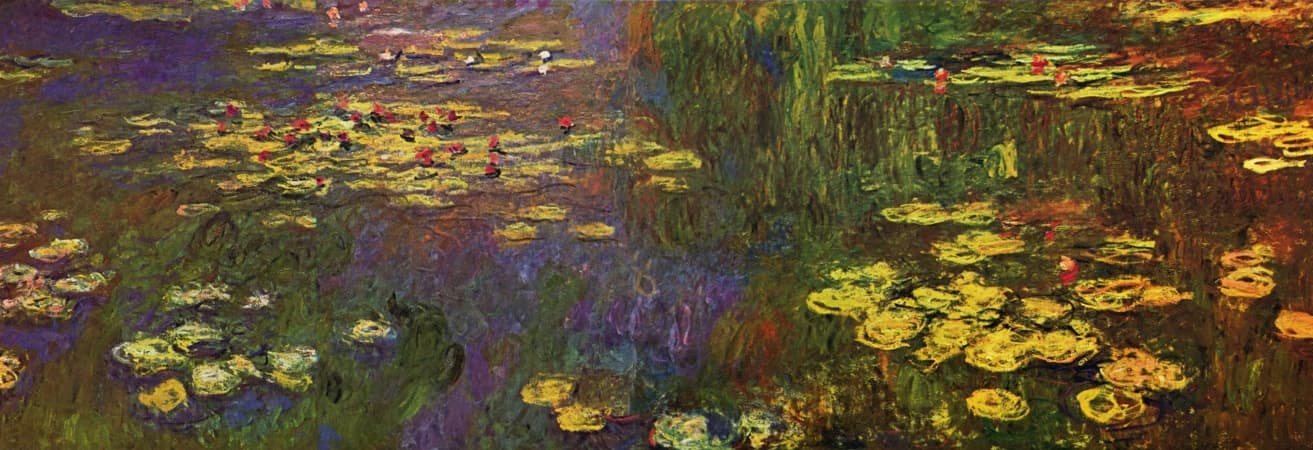
1.The pond begins without a bank
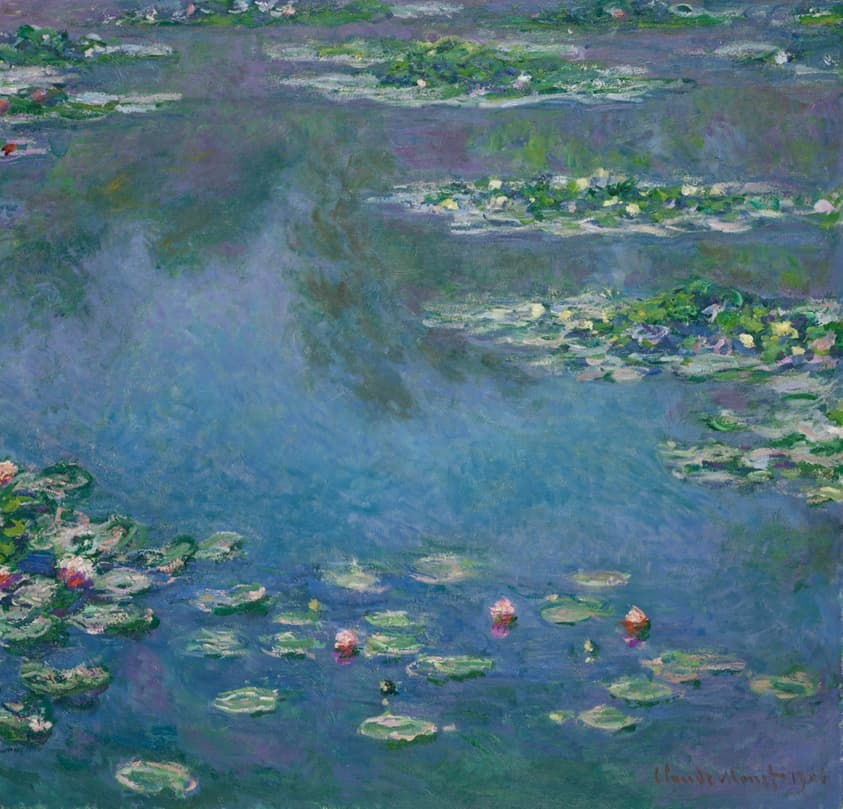
There is no shore to stand on and almost no horizon to steady the space. Pads float across blue-violet water while reflected willow strokes descend through them. The viewer is placed inside a field rather than in front of a view.
2.Lily pads provide the only punctuation
The pads are small, relatively solid intervals in paint that otherwise streams and blurs. They keep the eye moving sideways in uneven steps—the visual rhythm that replaces a conventional foreground and distance.
3.Reflections become hanging curtains
Long vertical strokes can be read as reflected trees, but they also behave like curtains of paint. Monet lets recognition arrive and then loosen again. The mural stays a pond and approaches abstraction at the same time.
4.Separated pads open the left edge
Small yellow-green pads lie apart on dark violet water at the far left. Some are no more than curved strokes around a darker center. The spaces between them remain prominent, giving this edge a more open pattern than the dense clusters farther across the painting.
5.Overlapping pads crowd the right edge
Yellow and green pads overlap near the right edge, where several shapes are cut off by the frame. Dark gaps separate their rounded outlines. The abrupt cropping makes the cluster seem to continue beyond the picture, extending the painting's sideways movement.
6.Blue water opens beneath the central reflections
A patch of blue-violet water opens beneath the darker central reflections. The strokes vary in direction and leave only a few compact leaf shapes. This quieter area gives the surrounding clusters more definition by separating them with a stretch of relatively open water.
Timeline
1893
Monet buys the land beside his house at Giverny and begins building the water garden and lily pond he will paint for the rest of his life.
12 November 1918
The day after the Armistice, Monet offers the Water Lilies panels to the French state as a monument to peace.
12 April 1922
The contract of donation is signed, covering nineteen panels. Monet keeps them and goes on reworking the canvases.
December 1926
Monet dies at Giverny with the panels still in his studio, having never seen them installed.
17 May 1927
Clemenceau inaugurates the two oval rooms at the Orangerie, built to Monet's specifications by the architect Camille Lefèvre.
1950s
American abstract painting prompts a reassessment; the long-neglected rooms are recognised as a precursor rather than a coda.
Where to see it
A viewing location has not yet been listed for this work.
Frequently asked questions
What are Monet's Water Lilies at the Orangerie?
Eight very large curved oil paintings of the lily pond in Monet's garden at Giverny, installed in two purpose-built oval rooms at the Musée de l'Orangerie in Paris. Each panel is two metres high and together they run to 91 metres of canvas. They opened to the public on 17 May 1927.
Why did Monet give them to France?
He offered them to the French state on 12 November 1918, the day after the Armistice ended the First World War, as a monument to peace. The gift was arranged with his friend Georges Clemenceau, the wartime Prime Minister. The contract was signed on 12 April 1922.
Did Monet ever see the Water Lilies installed?
No. He kept reworking the canvases at Giverny and died in December 1926 with them still in his studio. Clemenceau carried out the installation, and the rooms opened in May 1927, a few months after the painter's death.
Where are the Water Lilies in Paris?
At the Musée de l'Orangerie, in the Tuileries Gardens at the Place de la Concorde end of the park. The building was originally a real orangery, built in 1852 to shelter the garden's orange trees over winter, and was adapted for the paintings by the architect Camille Lefèvre.
Why are the rooms oval?
Because Monet specified it. He designed the presentation as two oval rooms placed one after the other, together tracing the shape of the infinity symbol, with the canvases curving around the walls and daylight coming from above. The architecture was built for the paintings rather than the paintings hung in an existing room.
Are there other Water Lilies paintings elsewhere?
Yes — Monet painted around 250 water-lily canvases over roughly thirty years, and they are in museums worldwide. The Orangerie cycle is different in kind: eight monumental panels conceived as a single installation for two specific rooms, given to the nation, and fixed in place rather than hung.
How long do you need at the Orangerie?
About two hours is comfortable for both the Water Lilies rooms and the Walter-Guillaume collection downstairs, which holds Renoir, Cézanne, Matisse, Modigliani, Derain and the largest group of Soutine paintings in Europe. It is a small museum, and it rewards sitting still in the oval rooms rather than moving through them.
More by Claude Monet
If you like Claude Monet
Explore painters from the same movements and circles.

Édouard Manet
The admired elder of the independents — he painted beside Monet, befriended Morisot, and refused to show in all eight of the group's exhibitions.
View artist
Tarsila do Amaral
Brazilian painter who spent the 1920s moving between São Paulo and Paris, studied Cubism under André Lhote, Albert Gleizes and Fernand Léger, and used what she learned to paint Brazilian towns, railways, plants and bodies. Her 1928 painting Abaporu prompted the manifesto that gave the Anthropophagic movement its name.
View artist
Gustave Caillebotte
Painter of Haussmann's geometry and the group's organizer-financier; his bequest of Impressionist paintings forced the French state to take the movement in.
View artist
References
The sources below include collection records, catalogues, scholarly research, and primary materials that informed this page. They document The Water Lilies, its making, and its place in cultural history.


1History of the Water Lilies cycle — Musée de l'Orangerie
WebsiteMusée de l'OrangerieUsed forThe museum's history of the cycle: the gift after the Armistice, the 12 April 1922 contract, the 17 May 1927 inauguration, and Clemenceau's part in it.
2Musée de l'Orangerie — official site
WebsiteUsed forThe museum's own description of the installation — eight compositions, two metres high, 91 metres of canvas, two oval rooms laid out as the infinity symbol under diffused daylight.
3Timeline — Maison et jardins de Claude Monet, Giverny
WebsiteFondation Claude MonetUsed forThe Fondation Claude Monet chronology supplies independent context for the artist's Giverny years and the long development of the Water Lilies cycle.
4Claude Monet — Musée Marmottan Monet
WebsiteMusée Marmottan MonetUsed forThe Musée Marmottan Monet collection provides additional museum context for Monet's late work and the preservation of his studio holdings.
These references provide the documented foundation for this work's history and interpretation. Claim-level citations remain attached to the specific claims they support.
 Explore more resources