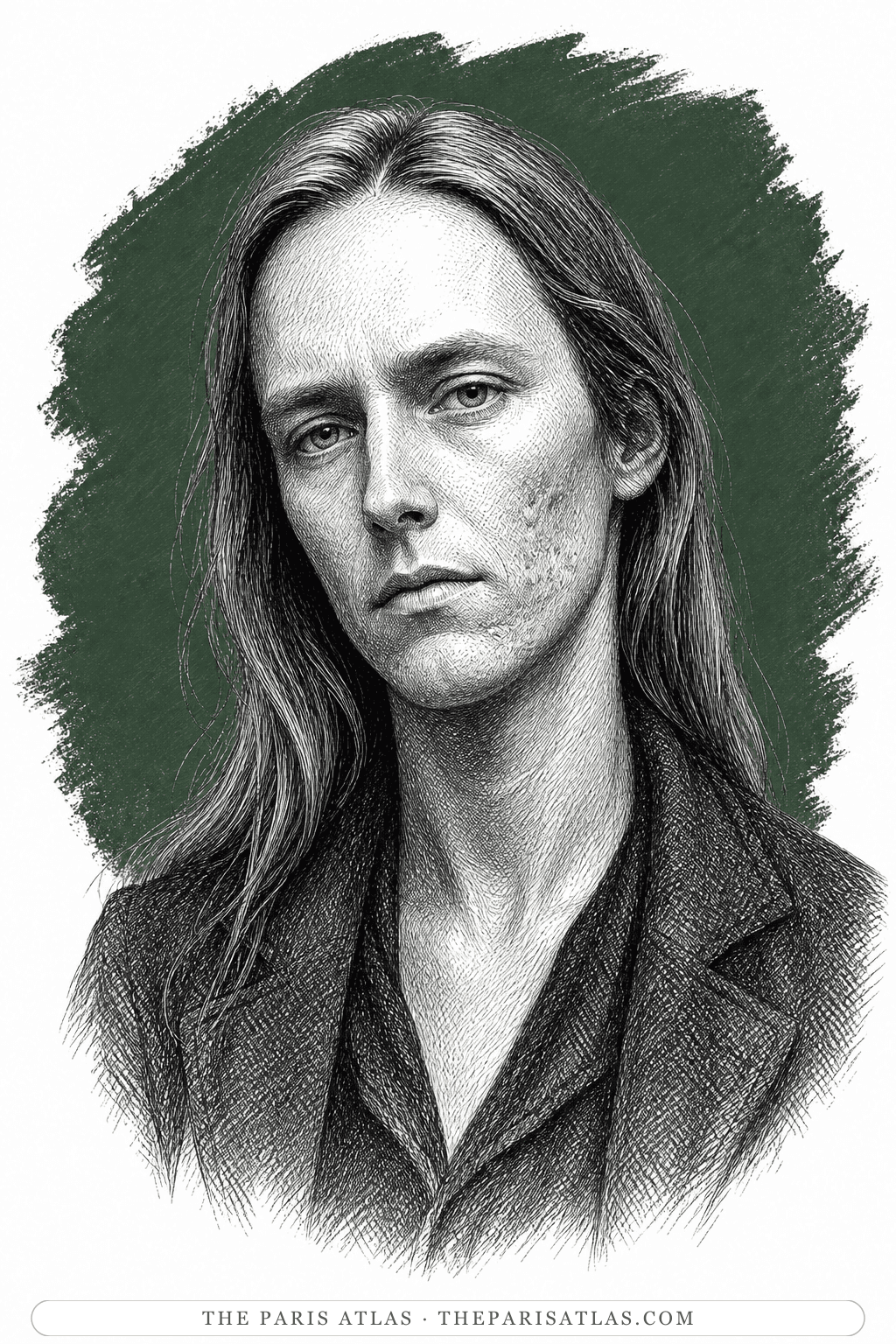
Jean Carteret
A young French visionary and traveller Nin met in 1937, one of the few people in the volume whose photograph the book prints.
The book

At a glance
- “Jean” — a young Frenchman living on symbols, astrology and travel
- 1937, in Paris
- One of the book's photographic portraits, captioned “Jean Carteret, in the late 1930s”
- Jean Carteret
Who they are in the book
Spoiler-freeJean Carteret was a young Frenchman with no settled profession who lived on symbols, astrology and travel, and who turns up in the volume's later Paris chapters. Nin met him in 1937 and he understood her, or claimed to, before she had said anything: within moments of the door opening he told her she was a figure out of a myth. He is one of the handful of people whose photograph the book prints, captioned simply “Jean Carteret, in the late 1930s.”
He is also the figure Nin uses to test her own attraction to magic. She files him with the astrologer Conrad Moricand and the analyst Otto Rank as the nearest thing the West has to it, and then, later and more coolly, works out that he is free in his imagination and in chains everywhere else.
How Jean Carteret Is Portrayed
- The meetingShe describes a tall, thin man with pale-blue eyes and long straight light-brown hair, whose face divides in two: a poet's high forehead above, a heavier pockmarked half below. He saw her instantly, she writes, and she felt unveiled. Then he said it out loud: “You are a personage out of a myth, you live in the myth.”
- The visit to the asylumCarteret takes her to the place where newly committed patients are questioned by a psychiatrist in front of a small audience of students and friends of the doctors. It is one of the strangest outings in the volume, and she goes because he asks.
- Moricand's verdictThe astrologer Conrad Moricand summed him up in three words at a dinner, comparing him to the poet Arthur Rimbaud in a good mood: “You are Rimbaud gai.”
- The wooden objectsWalking past a shop with Nin and Moricand, he and Nin fall into a duel of possessions — wooden spoons from Lapland against wooden glasses from the Philippines, a pitcher from Panama against soup bowls from Japan — and end it by saying the same joke at the same moment: they had better set up house together.
- LaplandHe goes north and sends back reports. He is living in a wooden house and working like a farmer; when he got toothache the Laplanders gathered round, made him drunk and pulled the tooth out; and he watched them throw a blessed cross into the frozen river and dive in after it to earn privileges in heaven.
- What she finally decides about himLater she writes that he is untrammelled and magical only in spirit. In every other way he is blocked: he cannot be an artist, a lover, a husband, a lecturer or a traveller, and only plays at each of them.
If you like The Diary of Anaïs Nin, 1934–1939


If you like Anaïs Nin
Explore authors with a similar voice, perspective, and influence.

Henry Miller
The entangled careers of the Villa Seurat: she financed and prefaced his scandal, he detonated her prose — and each wrote the other into the century's record.
View author
Louis-Ferdinand Céline
The doctor of the Paris slums who wrote the century's blackest, funniest novel — and changed the sound of French prose.
View author
Martha Gellhorn
War correspondent who covered the Spanish Civil War, D-Day, and conflicts across five more decades; Hemingway's third wife, 1940–1945.
View author