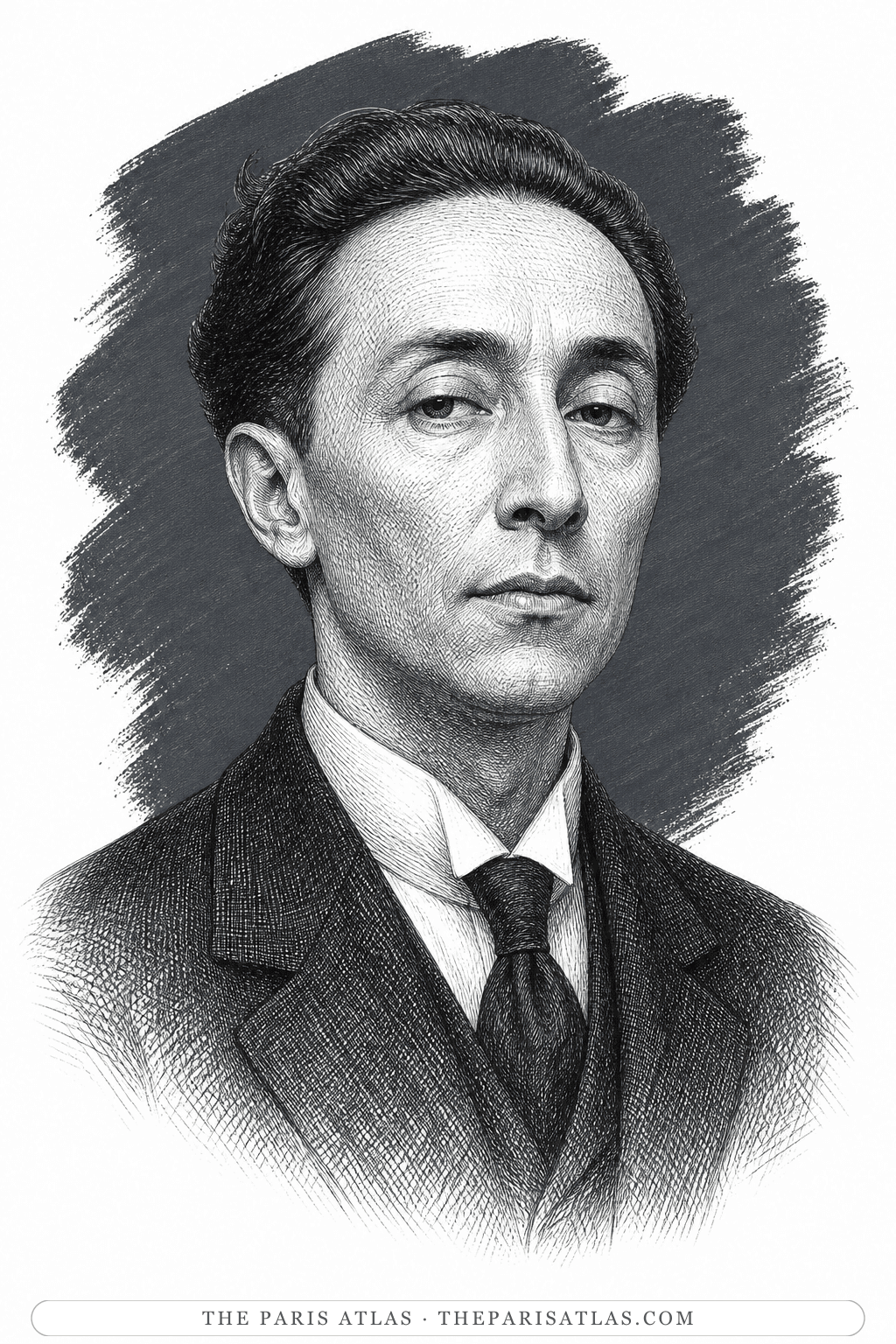
Conrad Moricand
A poet and professional astrologer who had known Picasso and Max Jacob, and who reads the coming war in everybody's chart. He is the most immaculately dressed of Nin's visitors and one of the poorest.
The book

At a glance
- “Moricand” — a poet who earned his living as an astrologer
- About forty
- The reading room of the Bibliothèque Nationale, on esoteric texts
- Picasso, Louis Jouvet, Max Jacob and Blaise Cendrars
- Conrad Moricand
Who they are in the book
Spoiler-freeConrad Moricand was a poet who made his living casting horoscopes, and who had written about Picasso, the actor Louis Jouvet, the poet Max Jacob and the writer Blaise Cendrars. A friend recommends him and Nin invites him to dinner; he turns up pale and formal and opens with a compliment on her telephone voice: “When I heard your voice over the telephone I thought it was a voice from another planet.”
He is about forty, and Nin's portrait of him is one of the sharpest in the volume. He has spent years in the reading room of the Bibliothèque Nationale among esoteric books, and everything he calculates comes out the same way: catastrophe. Around him the other people in the diary argue, work and shout; Moricand walks slowly, dresses immaculately, and waits for the world to end. He was right about the date, which is part of why he stays in the book.
How Conrad Moricand Is Portrayed
- The portraitNin describes a man who looks like a white Indian with narrow eyes and high cheekbones, and who believes himself the last of the Mohicans, bleached by long research in the Bibliothèque Nationale. He has a slow walk like a somnambulist, caught in the past and unable to step into the present.
- What his charts always sayOut of all his calculations, Nin writes, he extracts nothing but the poison of fatality. He sees only the madness of the world and a great catastrophe coming to engulf it, and he says so at dinner tables through the late 1930s.
- The revolverWhen Nin moves onto a barge on the Seine he decides she needs a weapon and brings her a revolver. To demonstrate how it works, he fires a shot into the river.
- The best-dressed man on the quayThe barge's captain is more afraid of Moré, in battered corduroys, than of any of Nin's better-dressed callers — of whom Moricand is the immaculate example. The contrast between the two men runs through the houseboat chapters.
- BlanchetteHe brings around a young woman he had met on the Rue Godot-de-Mauroy, where she picked up clients: pale, silent, expressionless, with badly home-dyed hair worn in 1920s bangs and a white dog that was never white. Nin wonders in the diary whether he wanted protection from his own patronesses, or cover for an interest in boys.
- Miller cannot read him at allNin writes that Miller was completely mystified by Moricand's bearing, which he took for artificial pride. Her own view is that it was natural, and that Miller would have made the same mistake about a Japanese, Spanish or Indian peasant.
- One of her orphansIn the last weeks before the war Nin is working through currency controls to get money out to three men — Miller, Moré and Moricand — until, she writes, the police know her and her tricks run out.
If you like The Diary of Anaïs Nin, 1934–1939


If you like Anaïs Nin
Explore authors with a similar voice, perspective, and influence.

Henry Miller
The entangled careers of the Villa Seurat: she financed and prefaced his scandal, he detonated her prose — and each wrote the other into the century's record.
View author
Louis-Ferdinand Céline
The doctor of the Paris slums who wrote the century's blackest, funniest novel — and changed the sound of French prose.
View author
Martha Gellhorn
War correspondent who covered the Spanish Civil War, D-Day, and conflicts across five more decades; Hemingway's third wife, 1940–1945.
View author