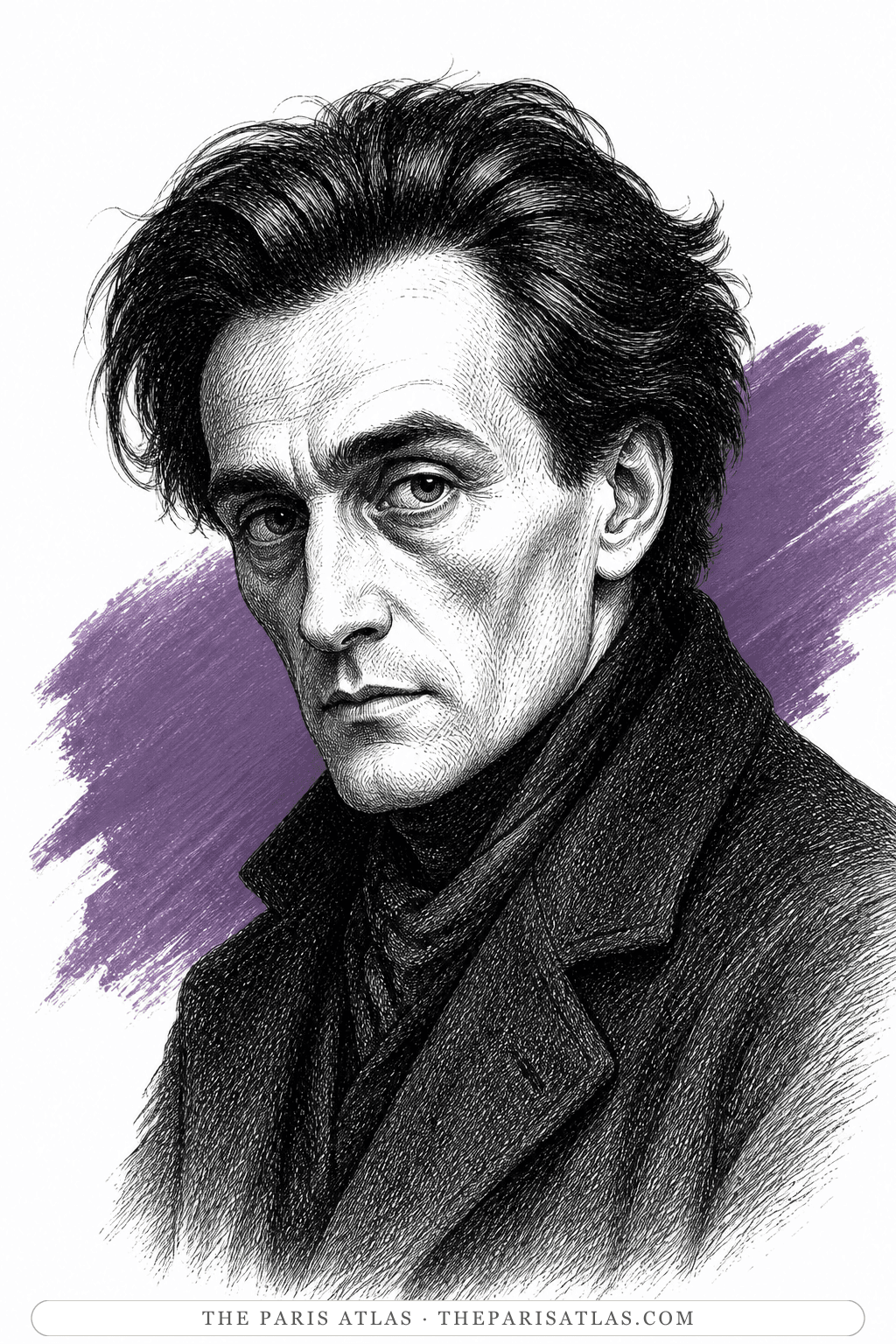
Antonin Artaud
The French poet and theatre theorist Nin had known in the previous volume. He is glimpsed in the street here, and then committed — and she defends him in a café to a stranger.
Antonin Artaud — books, places, and lifeThe book

At a glance
- “Artaud” — the poet and theatre theorist she had known before these years
- The Sainte-Anne psychiatric hospital, Paris
- In passing, and in her judgements — never in a scene with her
- Antonin Artaud · 1896–1948
Who they are in the book
Spoiler-freeAntonin Artaud was a French poet, actor and theatre theorist who wanted to strip realism out of the theatre and put ritual back into it. Nin had known him closely in the years covered by the first volume of the diary; in this one he is mostly at a distance, and by the end of it he is in an asylum. He never sits down with her in these pages, but she keeps returning to him, and her judgements about him are among the firmest in the book.
He matters here partly because of what he lets her say about other people. Measured against Artaud, whose suffering she took to be real, the theorists around the Villa Seurat look to her like men playing at anguish.
How Antonin Artaud Is Portrayed
- Seen from a caféThe only glimpse of him in Paris is nine in the morning at the Dôme: “Antonin Artaud passes by. He is waving his magic Mexican cane and shouting.”
- The Mexican bookGonzalo Moré is helping him translate a book on the rituals of the Tarahumara people of northern Mexico, and leaves Nin one evening to go and work on it with him.
- Her verdict on his theatreShe credits him with trying to recover symbolism and ritual and to break the theatre away from realism, and then says what she thinks went wrong: he had too much anger. “He was insane with anger.” She wonders on the page whether all insanity is anger.
- The café defenceAt the next table a man is mocking Artaud's madness — imitating his speech, his fears, his persecution mania — while Artaud is locked up in the Sainte-Anne hospital. Nin turns round and tells him: “It is you who should be locked up and not Artaud.”
- The measure she uses him asExplaining why she cannot take Michael Fraenkel's despair seriously, she says his madness is intellectual and Artaud's was rooted in real emotional pain — and that Artaud, besides, is a great poet.
If you like The Diary of Anaïs Nin, 1934–1939


If you like Anaïs Nin
Explore authors with a similar voice, perspective, and influence.

Henry Miller
The entangled careers of the Villa Seurat: she financed and prefaced his scandal, he detonated her prose — and each wrote the other into the century's record.
View author
Louis-Ferdinand Céline
The doctor of the Paris slums who wrote the century's blackest, funniest novel — and changed the sound of French prose.
View author
Martha Gellhorn
War correspondent who covered the Spanish Civil War, D-Day, and conflicts across five more decades; Hemingway's third wife, 1940–1945.
View author