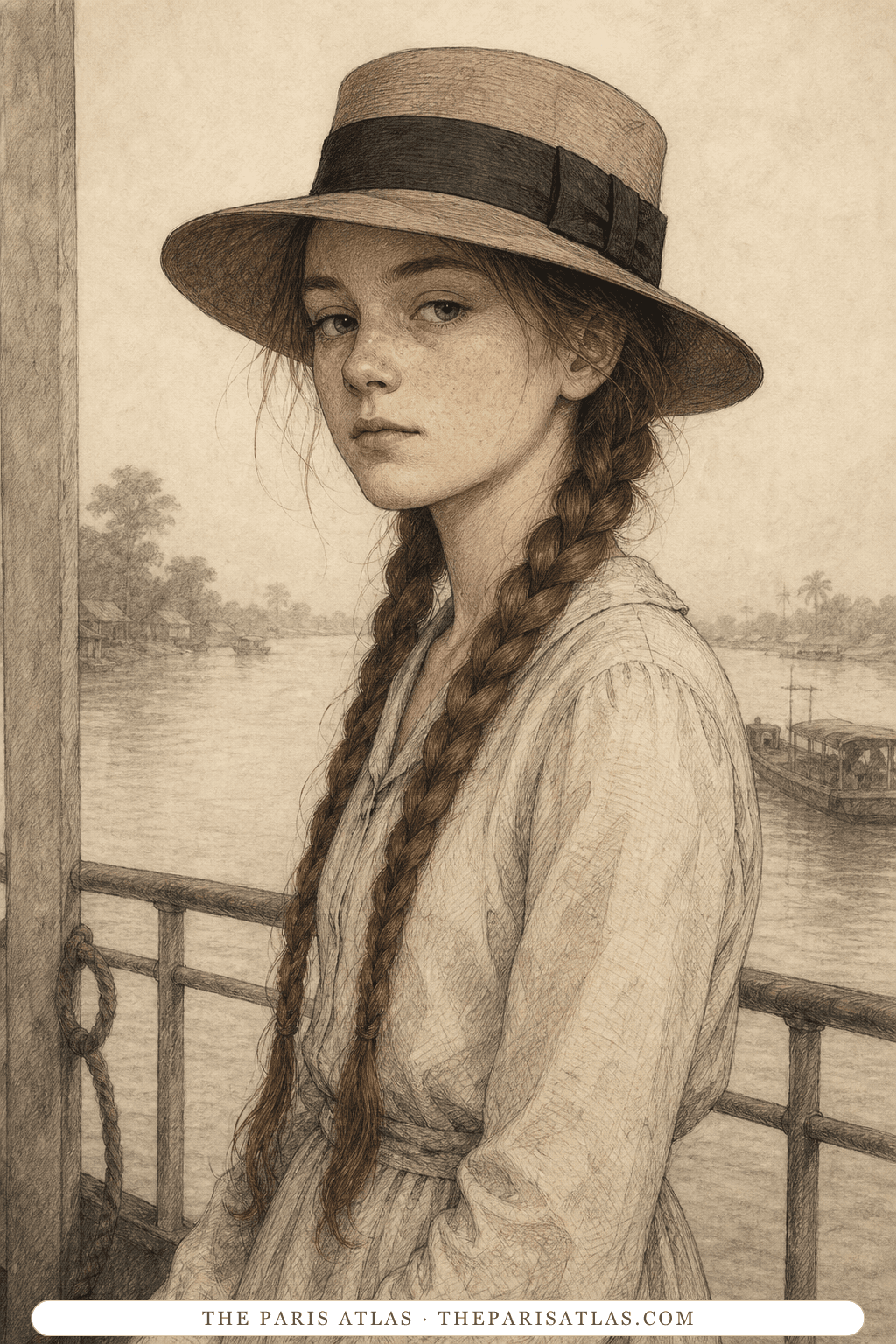
The girl / the narrator
The unnamed French schoolgirl who enters the affair at fifteen and a half, then retells it decades later as a writer.
In the narrator’s account, to leave the family’s fear and poverty, become a writer, and decide for herself what her life will mean.
The book

At a glance
- Fifteen and a half
- Unnamed white French schoolgirl and later writer
- State boarding school and French high school in Saigon
- Southern French Indochina, including Sadec and Saigon
- To write books
Who they are in the book
Spoiler-freeThe narrator is an older French writer looking back on herself at fifteen and a half in colonial Indochina. She lives at a state boarding school in Saigon and attends the French high school. Her mother expects her to earn a mathematics degree, but the girl already knows she wants to write books.
Her family is white and French but nearly broke. She understands that being French gives them status in the colony even when they sell furniture and live on a teacher’s salary. She also understands that her unusual clothes and her relationship with a rich man attract attention. The book does not present her as unaware of money or of how other people see her.
The older narrator keeps revising the girl’s certainty. At fifteen, she says she does not love the Chinese man. On the ship to France, music makes her recognize a love she may not have seen while living it. Decades later, she still refuses to give the affair one final, simple meaning.
How The girl / the narrator Is Portrayed
- Fifteen and a halfShe is a minor and a boarding-school student when the relationship begins. The book repeats her age because it shapes the risk and imbalance of the affair.
- Dressed to be noticedThe worn silk dress, gold evening shoes, and man’s felt hat do not match ordinary school clothes. She chooses the combination and likes the person it lets her imagine becoming.
- Direct about moneyShe asks about the man’s wealth and does not pretend that money has nothing to do with her attraction or her family’s willingness to see him.
- Protective of the younger brotherShe calls him her child and wants to save him from the elder brother, even though the brother she calls younger is actually two years older than she is.
- Already planning to writeShe tells her mother she wants to write novels. The mother insists on practical study first, but the girl sees writing as the life beyond the family.
- Both participant and authorThe older woman can describe what the girl did, doubt why she did it, and change from first to third person. The distance is part of the story, not a claim to perfect objectivity.
The girl leaves for France with her mother and younger brother. She hides her tears while the Chinese man watches the ship from his black car. During the voyage, a Chopin waltz makes her question her repeated claim that she never loved him.
Years later, after war, marriages, children, divorces, and books, he calls her in Paris. She recognizes his voice immediately. His declaration of lasting love closes the novel, but she does not announce a matching final verdict. Her book is the fuller answer.
If you like The Lover


If you like Marguerite Duras
Explore authors with a similar voice, perspective, and influence.

Martha Gellhorn
War correspondent who covered the Spanish Civil War, D-Day, and conflicts across five more decades; Hemingway's third wife, 1940–1945.
View author
Ernest Hemingway
Author of The Sun Also Rises and A Moveable Feast; his pared-down style, developed in 1920s Paris, became the most imitated in American prose.
View author
Louis-Ferdinand Céline
The doctor of the Paris slums who wrote the century's blackest, funniest novel — and changed the sound of French prose.
View author