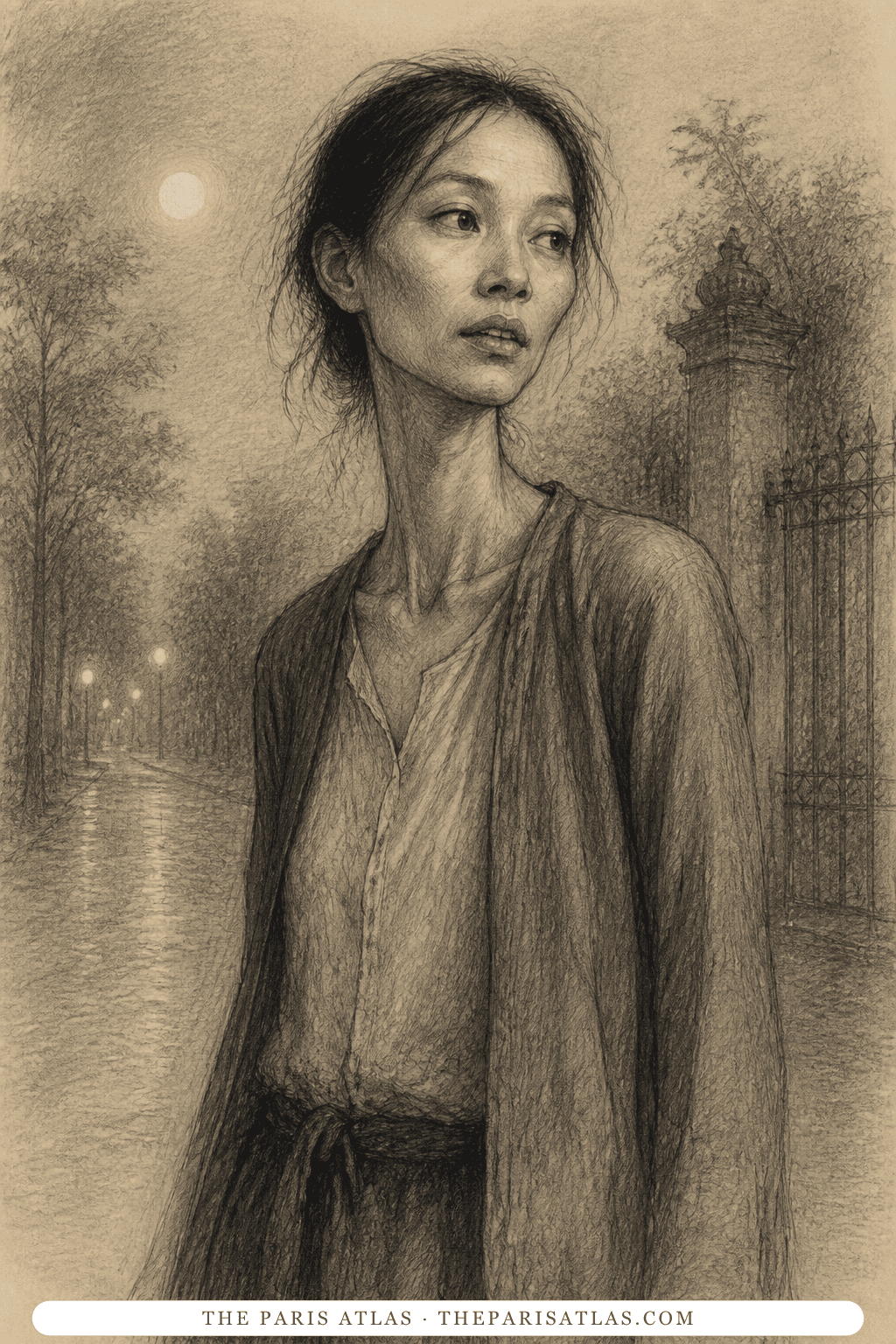
The “madwoman” of Vinh Long
An unnamed local woman whose nighttime pursuit becomes the child narrator’s lasting image of fear and mental collapse.
The novel does not reveal the woman’s intention; the adult narrator allows that what terrified the child may have been play.
The book

At a glance
- An avenue in Vinh Long
- About eight
- A nighttime pursuit during a power failure
- A childhood image of fear later linked to the mother
Who they are in the book
Spoiler-freeThe woman appears in a memory from when the narrator is about eight. The town calls her the madwoman of Vinh Long. She sleeps during the day and talks at night in a language the French child does not understand.
During a power failure, the child sees the woman running behind her, laughing and shouting. The narrator later admits that the woman may have been playing, but the child experiences the pursuit as absolute danger and runs into a neighbor’s house.
The memory becomes connected to the narrator’s fear that her mother may one day lose contact with the family and have to be taken away. The book tells us much more about the child’s fear than about the local woman’s actual condition, history, or intention.
How The “madwoman” of Vinh Long Is Portrayed
- Seen through a child’s panicThe scene is organized by darkness, running, laughter, and the child’s belief that a touch would transmit madness.
- Speaks an unknown languageBecause the narrator cannot understand her words, sound becomes part of the fear instead of a source of explanation.
- Possibly playingThe older narrator includes this possibility, preventing the child’s terror from becoming a complete statement about the woman.
- A limited portraitNo name, diagnosis, home, or private history is given. The label records the town’s view and the narrator’s memory, not a verified medical fact.
The child escapes into a neighbor’s garden and cannot speak about the event for several days. The older narrator still remembers it as one of her most complete experiences of fear.
Immediately afterward, the book turns to a moment when the narrator looks at her mother and briefly cannot recognize her. The connection belongs to the narrator’s fear of losing her mother, not to evidence that the two women share the same condition.
If you like The Lover


If you like Marguerite Duras
Explore authors with a similar voice, perspective, and influence.
Martha Gellhorn
War correspondent who covered the Spanish Civil War, D-Day, and conflicts across five more decades; Hemingway's third wife, 1940–1945.
View author
Ernest Hemingway
Author of The Sun Also Rises and A Moveable Feast; his pared-down style, developed in 1920s Paris, became the most imitated in American prose.
View author
Louis-Ferdinand Céline
The doctor of the Paris slums who wrote the century's blackest, funniest novel — and changed the sound of French prose.
View author