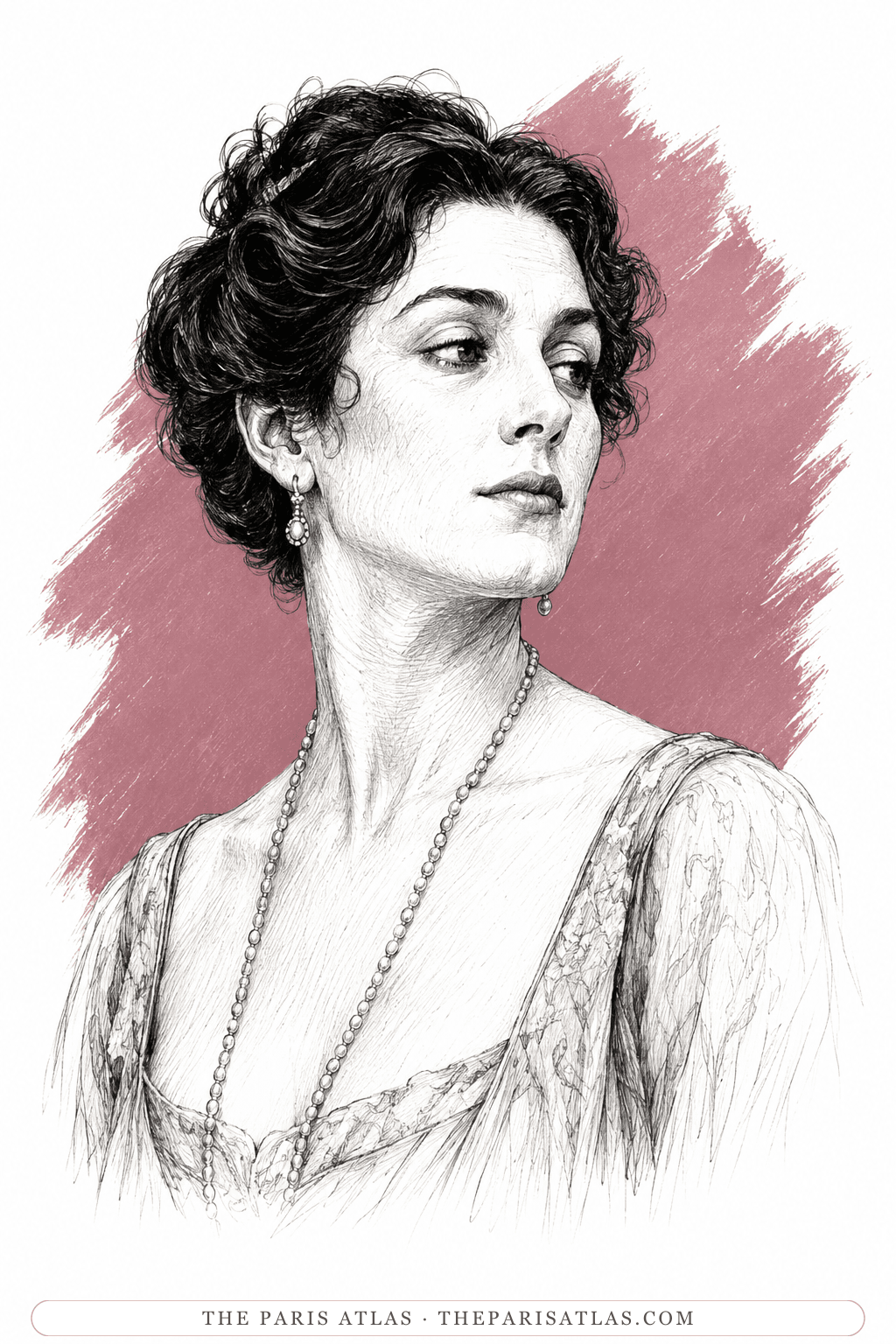
Beatrice Blaine
Amory's mother: rich, elegant, theatrically fragile, and the person the novel's first sentence says he inherited every trait from.
To be attended to. 'I am not understood, Amory,' she tells him on a moonlit path at Lake Geneva, saying it twice in the same breath, and she keeps a standing supply of doctors and clergymen who will take her seriously.
The book

At a glance
- Book One, Chapter 1, which is titled 'Amory, Son of Beatrice'; after that she appears mainly in letters
- Beatrice O'Hara, of a wealthy family with an estate at Lake Geneva, Wisconsin; convent-educated in Rome
- Stephen Blaine, who grew rich at thirty when two older brothers, Chicago stockbrokers, died, and who spends the novel hovering in the background of his own house
- Before her marriage she nearly attached herself to a young man in Asheville, North Carolina, who later joined the Catholic Church and became the priest who advises her son
- By Amory's Princeton years the Blaine and O'Hara fortunes are down to the Lake Geneva house and roughly half a million dollars
Who they are in the book
Spoiler-freeBeatrice Blaine is the mother of Amory Blaine, the young man this novel is about, and the first sentence of the book gives her all the credit for him: he 'inherited from his mother every trait, except the stray inexpressible few, that made him worth while.' She was born Beatrice O'Hara, daughter of a rich American family with a sixty-acre estate at Lake Geneva, Wisconsin, and she was educated in Rome at the Sacred Heart Convent, which the narrator calls 'an educational extravagance that in her youth was only for the daughters of the exceptionally wealthy.' She came home, met a mild rich man named Stephen Blaine and married him, the book says, 'almost entirely because she was a little bit weary, a little bit sad.'
She then raised her only child on the move. From his fourth year to his tenth, Amory toured America with her in her father's private railway car, with two maids and often a doctor along. She had him call her Beatrice rather than Mother. She kept him in bed late in the mornings on the theory that early rising makes a person nervous, fed him French poetry before he was ten, and by eleven he could talk about Brahms, Mozart and Beethoven.
The comedy of the character is that she treats her own ill health as her best material. She drinks heavily, has breakdowns in good hotels, collects doctors and priests, and tells the story of each collapse to new acquaintances because the old ones have heard it. Fitzgerald plays all of this for laughs and never quite lets her become a joke: she is genuinely clever, genuinely unwell, and the only person in the book Amory never manages to see straight.
How Beatrice Blaine Is Portrayed
- The first sentence of the book is about herThe novel opens by handing its hero to his mother: Amory Blaine 'inherited from his mother every trait, except the stray inexpressible few, that made him worth while.' His father contributes a height of just under six feet and a tendency to waver at important moments.
- Educated in RomeThe convent in Rome, the Older Roman Families, an acquaintance with Cardinal Vitori and Queen Margherita, and a year in England where she learned to prefer whiskey and soda to wine. The narrator's summary is the novel's most quoted line about her: 'a culture rich in all arts and traditions, barren of all ideas.'
- A childhood spent on trainsShe took Amory around the country in her father's private railway car from his fourth year to his tenth, travelling with two maids and frequently a physician. When he caught scarlet fever the doctors and nurses in attendance came to fourteen.
- 'Yes, Beatrice'Her son calls her by her first name, and the narrator notes in brackets that she encouraged it. Her morning instructions to him are to stay in bed, since 'early rising in early life makes one nervous,' and to take a bath as hot as he can bear.
- Her illnesses are part of the actShe had a nervous breakdown in a fashionable hotel at Coronado because she was bored, and picked up a mild consumption in Mexico City. That one, the book says, 'pleased her, and later she made use of it as an intrinsic part of her atmosphere.'
- The apricot cordialLeft alone in a hotel at Hot Springs, the boy drank his mother's apricot cordial, got drunk, tried a cigarette and was sick. The incident horrified her and secretly delighted her, and she was soon telling it in a whisper to a roomful of admiring women, who went home and locked their own sideboards.
- Priests and doctorsShe had been raised Catholic and found that priests paid much closer attention to a woman in the middle of losing or regaining her faith, so she kept up 'an enchantingly wavering attitude.' The narrator's verdict: 'next to doctors, priests were her favorite sport.'
- What she tells her fifteen-year-old about her drinkingOn the walk at Lake Geneva she reports the doctors' opinion with some pride: 'if any man alive had done the consistent drinking that I have, he would have been physically shattered, my dear, and in his grave—long in his grave.' The narration has already said her latest breakdown 'bore a suspicious resemblance to delirium tremens.'
- A careful driverShe meets Amory's train in an early gray electric car and drives it home at two miles an hour, making him lean out as a lookout and then get out and wave her across a busy crossing on foot.
- The money runs outAfter Stephen Blaine dies, the family ledgers show over $110,000 spent in 1906, $40,000 of it hers with no attempt to account for it, and a doctor's bill of more than $9,000 for 1913 alone. She writes to Amory that the Lake Geneva place and about half a million dollars are all that is left, and that she is moving it into railroad and street-car bonds: 'I shall never forgive myself for not buying Bethlehem Steel.'
Beatrice Blaine quotes
All in all Beatrice O’Hara absorbed the sort of education that will be quite impossible ever again; a tutelage measured by the number of things and people one could be contemptuous of and charming about; a culture rich in all arts and traditions, barren of all ideas, in the last of those days when the great gardener clipped the inferior roses to produce one perfect bud.
Amory Blaine inherited from his mother every trait, except the stray inexpressible few, that made him worth while.
She dies during the First World War, while Amory is in the army, and the novel does not show it. The reader learns of it inside a chatty letter he writes from Brest in March 1919: 'Since poor Beatrice died I'll probably have a little money, but very darn little.' In the same sentence he explains why there is so little. She had a late religious turn and left half of what remained for stained-glass windows and seminary endowments, which he says he cannot forgive.
She stays in his head anyway. Riding a bus up Riverside Drive near the end of the book, his thoughts run through her voice and her lawsuits and arrive at a question he answers himself: 'did Beatrice go to heaven?... probably not.' A few lines later he sorts his own love affairs against her, deciding that Rosalind Connage was nothing like his mother and that Eleanor Savage was exactly like her, 'only wilder and brainier.'
If you like This Side of Paradise


If you like F. Scott Fitzgerald
Explore authors with a similar voice, perspective, and influence.
Ernest Hemingway
Fitzgerald vouched for him to Scribner's before they had met, then edited him better than he edited himself; the friendship's five rounds are chronicled in our journal.
View author
Henry Miller
The Brooklyn dropout who arrived in Paris broke at thirty-eight and wrote the exuberant, banned books that ended American censorship.
View author
Louis-Ferdinand Céline
The doctor of the Paris slums who wrote the century's blackest, funniest novel — and changed the sound of French prose.
View author