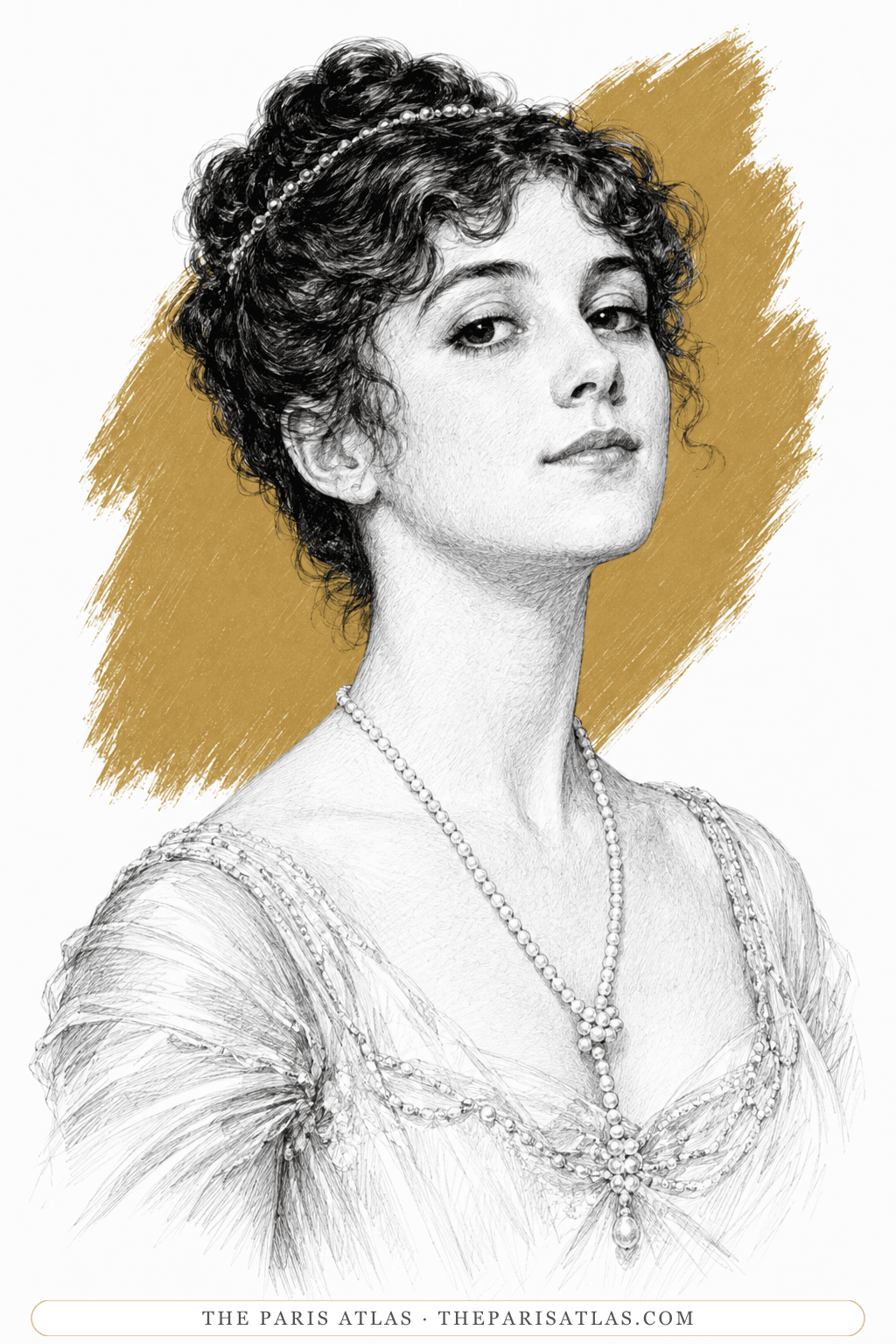
Isabelle Borgé
Amory's first real romance: a debutante he wins at a Minneapolis dance and loses months later in a quarrel at her family's house, with both of them performing throughout.
More evenings like the one in the den. Sitting on the couch in the dark at the Minnehaha Club she pictures her future as 'an unending succession of scenes like this: under moonlight and pale starlight, and in the backs of warm limousines'—the boy changing each time, and this one being very nice.
The book

At a glance
- Book One, from the Minneapolis dance in Chapter 2 to the quarrel that opens Chapter 3; she is named in passing for the rest of the novel
- Sixteen; Amory is eighteen and a Princeton sophomore
- Baltimore, with a family summer place on Long Island; she is visiting her cousin Sally Weatherby in Minneapolis when they meet
- A dinner and dance at the Minnehaha Club, Minneapolis, in December
Who they are in the book
Spoiler-freeIsabelle Borgé is the first girl Amory Blaine, the young man the novel follows, falls in love with as an adult. She is sixteen, from Baltimore, and she arrives in Minneapolis in midwinter to stay with her cousin Sally Weatherby. Amory has stayed over a day from Princeton to meet her. Neither of them has seen the other since childhood, and both have been told all week how much they are going to like each other.
What makes her interesting is that Fitzgerald writes the evening from her side. The reader gets her nerves at the top of the staircase, her disappointment that Amory turns out to have auburn hair rather than dark, her private plan to be liked, and her calculation about what her own reputation is worth in a town where nobody knows her. She is described as having the mixture of temperaments found in society women and actresses, and the narrator is clear that her sophistication came from the boys who had been chasing her.
The romance runs from that December to the following June. It ends in a corridor at her family's summer house on Long Island, over an injury the size of a pea, in the flattest and funniest quarrel in the book.
How Isabelle Borgé Is Portrayed
- Sixteen and a halfThe novel gives her age exactly, in one of its best lines about being young: 'She had been sixteen years old for six months.' She stands at the top of the stairs at a Minneapolis country club feeling what divers on spring-boards and leading ladies on opening nights are supposed to feel.
- Her reputation gets there firstHer cousin has told everyone Amory Blaine will fall for her, and tells her in the same breath what he has been told about her: 'I guess he knows you've been kissed.' Her fist clenches under the fur robe in the car. Being known as a 'Speed' annoys her, and she notes that in a strange town it is useful.
- How she is drawnLarge black-brown eyes, high color she is glad of that night, and a contralto voice with a trace of a Southern accent. The narration says she had 'that curious mixture of the social and the artistic temperaments found often in two classes, society women and actresses,' and that she had already been walking with an artificial gait at nine and a half.
- She works a room on purposePlaced on the stairs with a boy called Froggy Parker, she takes a single joke about their childhood and repeats it, holds it at arm's length, smiles at it and hands it back in variations until he is fascinated. He does not notice that the performance is aimed past him at Amory, who is standing a little to her left, watching.
- Where her education came fromThe book is direct about this: her sophistication 'had been absorbed from the boys who had dangled on her favor', her tact was instinctive, and 'her capacity for love-affairs was limited only by the number of the susceptible within telephone distance.'
- The den at eleven o'clockShe and Amory end up alone in a little room off the reading-room. He turns out the light. A couple next door play 'Babes in the Woods' on the piano, she drops her handkerchief on purpose, and when he asks she says only, 'Close the door....' Three boys burst in before he can kiss her, and she greets them with a welcoming smile.
- What she tells her cousin afterwardAt two in the morning Sally asks whether anything happened in the den. Isabelle answers, with 'the light of the idealist' in her eyes, 'No. I don't do that sort of thing any more; he asked me to, but I said no.' Then she gets into bed, wonders what he will write to her tomorrow, punches the pillow and says 'Damn!'
- A bad correspondentThrough the spring Amory writes her thirty-page letters almost nightly, mailing them in envelopes marked 'Part I' and 'Part II', with her photograph propped in an old watch on his desk. She writes back, the narration says, 'discreetly and aggravatingly unsentimental'.
- The quarrel over a shirt studAt her family's summer house on Long Island in June he hugs her too hard and his shirt stud leaves a blue mark the size of a pea on her neck. She panics about it, he quotes Macbeth at her and laughs, and the weekend collapses. 'I hate to be laughed at,' she says.
- Her verdict on himIn the car afterward she tells him what is wrong with him, and the novel treats her as correct: 'you're always talking about yourself and I used to like it; now I don't.' She calls him a nervous strain, and says that when he analyzes every little emotion and instinct, she finds she does not have any. He takes the 9:11 train in the morning.
Isabelle Borgé quotes
He wanted to kiss her, kiss her a lot, because then he knew he could leave in the morning and not care.
Amory takes the break badly enough that it costs him his standing at Princeton. He fails the make-up examination in conic sections that week, which removes him from the student newspaper and ends his run at the Senior Council, and the narration ties the two together: with Isabelle gone, undergraduate success had 'loosed its grasp on his imagination.' His parting line about her is 'Damn her! she's spoiled my year!'
Two years later, at a stock-company revival of a play in New York, a line from the stage brings her voice back and he writes a poem about her on his programme. By the time he meets Rosalind Connage he has settled on a summary of the whole affair: 'her name was Isabelle—nothing at all to her except what I read into her.' Whether that is fair to her is a question the book leaves open, having already shown the reader her side of the evening.
If you like This Side of Paradise


If you like F. Scott Fitzgerald
Explore authors with a similar voice, perspective, and influence.

Ernest Hemingway
Fitzgerald vouched for him to Scribner's before they had met, then edited him better than he edited himself; the friendship's five rounds are chronicled in our journal.
View author
Henry Miller
The Brooklyn dropout who arrived in Paris broke at thirty-eight and wrote the exuberant, banned books that ended American censorship.
View author
Louis-Ferdinand Céline
The doctor of the Paris slums who wrote the century's blackest, funniest novel — and changed the sound of French prose.
View author