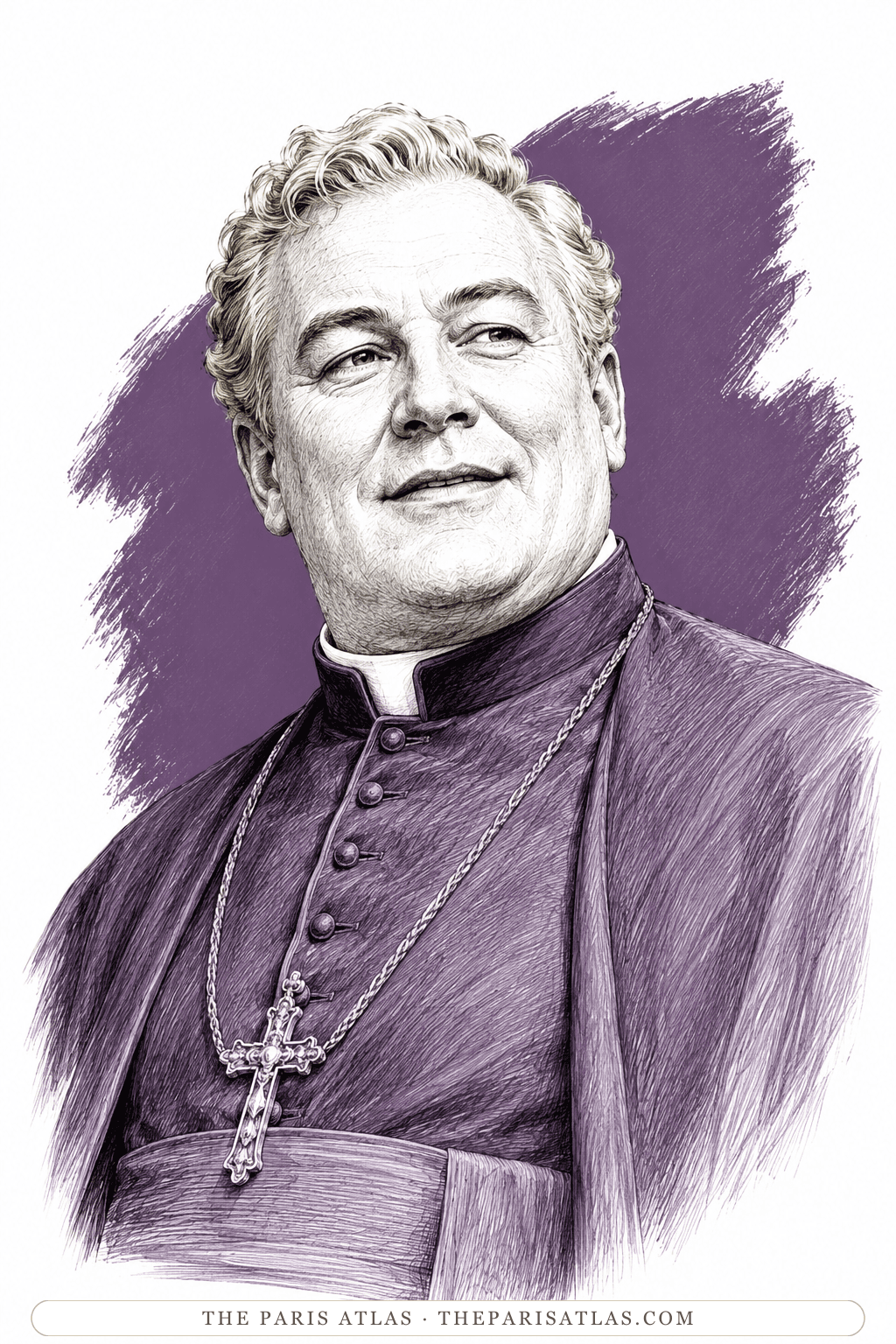
Monsignor Darcy
The Catholic priest who nearly married Amory's mother in her youth and becomes his adviser, and who gives the book its idea of the 'personage'.
A son. He says so plainly in his wartime letter to Amory: 'it's the paternal instinct, Amory—celibacy goes deeper than the flesh....'
The book

At a glance
- Amory's adviser from boyhood to the end, through a few visits and a long stream of letters
- Monsignor Darcy in the narration; his letters are signed THAYER DARCY
- Beatrice Blaine nearly married him in Asheville, before he joined the Church; educated at Harrow, then Yale
- Personality against personage, the distinction that gives Book Two its title
- Monsignor Sigourney Webster Fay — the priest the novel is dedicated to · died January 1919
Who they are in the book
Spoiler-freeMonsignor Darcy belongs to Beatrice Blaine's past before he belongs to her son's future. He is the 'young pagan from Asheville' she nearly loved as a girl, who then 'had gone through a spiritual crisis, joined the Catholic Church, and was now—Monsignor Darcy.' He was educated at Harrow in England and then at Yale, and wrote two novels, one of them, before his conversion, 'violently anti-Catholic'. He receives Amory, a boy 'in his first long trousers', in full purple robes so splendid that the narration says 'he resembled a Turner sunset', after the English painter J. M. W. Turner. Within half an hour of meeting, the two have 'accepted in their own minds a relation of father and son.'
After that first visit the friendship is carried on mostly in letters, signed THAYER DARCY, and they hold much of the novel's advice and most of its warmth. The distinction he gives Amory at the low point of his Princeton years, between a personality and a personage, becomes the title of Book Two and the measure the ending is read against.
How Monsignor Darcy Is Portrayed
- Who he was before the ChurchThe narration introduces him through Beatrice Blaine's 'clerical romance': the 'pagan, Swinburnian young man' in Asheville she nearly loved before she married for background, turned by a spiritual crisis into a monsignor of the Catholic Church.
- In purple at forty-fourHe is a spectacle in his robes, and the book sums up his vocation in one line: he 'loved the idea of God enough to be a celibate, and rather liked his neighbor.'
- Father and son in half an hourThe first visit settles everything. Prelate and boy bond over hating science, loving English and history, and casting the colleges as seasons — 'And Yale is November, crisp and energetic.' The narration's verdict: 'They slipped briskly into an intimacy from which they never recovered.'
- 'No one person is necessary'His parting line from that first visit is meant as a rule for people like the two of them: 'No one person in the world is necessary to you or to me.' The end of the novel quietly contradicts it.
- Personality and personageAt the Christmas visit after Amory's Princeton collapse he coins the book's central distinction: 'We have to do it because we're not personalities, but personages.' A personality 'is what you thought you were'; a personage 'gathers. He is never thought of apart from what he's done.'
- The letter about growing olderHis first quoted letter describes Amory's character back to him — 'unsentimental, almost incapable of affection, astute without being cunning' — and puts their ages in terms of light: 'when you are my age you will give out, as I do, the genial golden warmth of 4 P.M.'
- A lament for a foster sonThe Interlude letter of January 1918, to Second Lieutenant Amory Blaine, encloses an Irish keen he has written for him — 'A Lament for a Foster Son, and He going to the War Against the King of Foreign' — and ends on a premonition: 'I feel, somehow, that this is all; one or both of us is not going to last out this war....'
- The cardinal's hat he was expectingHis last letter warns Amory against depending on anyone — 'Beware of losing yourself in the personality of another being, man or woman' — and admits to an ambition of his own: 'I should not be surprised to see the red hat of a cardinal descend upon my unworthy head within the next eight months.' The red hat is a cardinal's, the rank above his own.
Monsignor Darcy quotes
They slipped briskly into an intimacy from which they never recovered.
You’re not sorry to go, of course. With people like us our home is where we are not
at fifteen you had the radiance of early morning, at twenty you will begin to have the melancholy brilliance of the moon, and when you are my age you will give out, as I do, the genial golden warmth of 4 P.M.
In the final chapter a telegram reaches Amory reporting 'Monsignor Darcy's sudden death in Philadelphia five days before.' The wartime letter had predicted that one or both of them would not last the war; Darcy is the one who does not last long past it. The funeral is grand. 'Amory kept thinking how Monsignor would have enjoyed his own funeral. It was magnificently Catholic and liturgical.' Watching the mourners, Amory arrives at the sentence that sums the man up: 'People felt safe when he was near.'
The funeral also gives Amory the book's reply to Darcy's old rule that no one person is necessary. What Amory discovers he wants is 'not to be admired, as he had feared; not to be loved, as he had made himself believe; but to be necessary to people, to be indispensable.'
If you like This Side of Paradise


If you like F. Scott Fitzgerald
Explore authors with a similar voice, perspective, and influence.

Ernest Hemingway
Fitzgerald vouched for him to Scribner's before they had met, then edited him better than he edited himself; the friendship's five rounds are chronicled in our journal.
View author
Henry Miller
The Brooklyn dropout who arrived in Paris broke at thirty-eight and wrote the exuberant, banned books that ended American censorship.
View author
Louis-Ferdinand Céline
The doctor of the Paris slums who wrote the century's blackest, funniest novel — and changed the sound of French prose.
View author