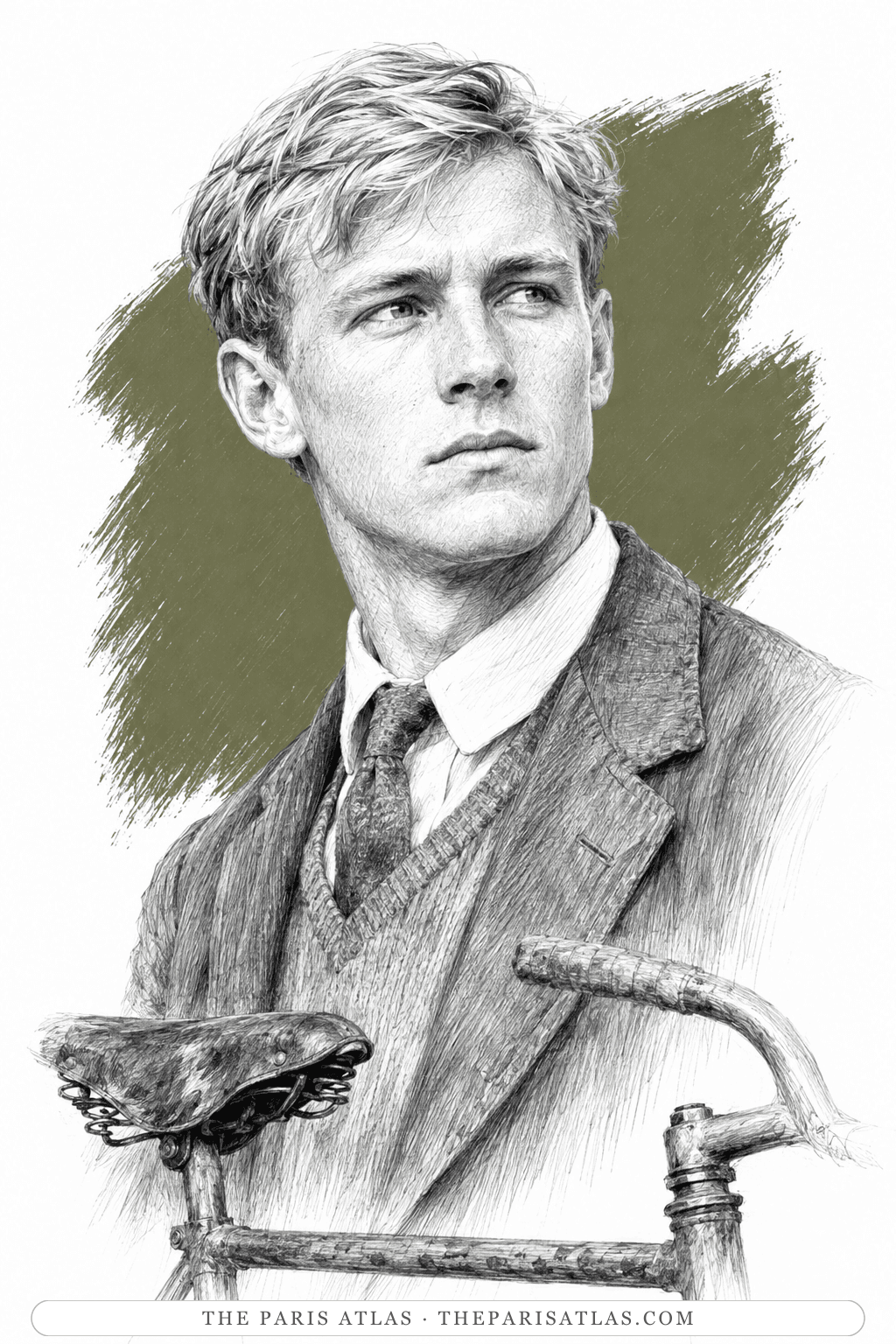
Burne Holiday
The Princeton classmate who turns against the eating clubs on principle, and gives Amory his first sight of a conviction that costs the person holding it.
A cause large enough to use everything he has. The narration says his pacifism came from reading plus 'his own intense longing for a cause that would bring out whatever strength lay in him', and he defends it to Amory as simply his particular duty.
The book

At a glance
- Book One: at Princeton from the first week of freshman year to his departure in Chapter 4, 'Narcissus Off Duty'
- Younger brother of Kerry Holiday, the friend Amory makes on his first day; their home is in Pennsylvania
- The Daily Princetonian, vice-president of the senior class until he resigned it, and the club resignations of 1917
- Amory greets him as Tsar; the student editor he corrects calls him Savonarola, after the friar who preached against the wealth of Renaissance Florence
- Tolstoy, H. G. Wells, Walt Whitman, Edward Carpenter, William James, the gospels, and the socialist magazine The Masses
Who they are in the book
Spoiler-freeBurne Holiday is a Princeton classmate of Amory Blaine, the young man the novel follows, and he is the one character in the book who genuinely changes his mind about how to live. For his first two years he is an ordinary campus success story: fair-haired, silent, endlessly busy, competing against forty other students for the top job on the Daily Princetonian. Then, in his last year, he reads his way out of it.
Princeton in this novel is run by its eating clubs, the private dining clubs that decided who mattered on that campus. Burne concludes that the clubs are bad for the university, resigns from his own, and takes about a hundred other students out with him. The clubs answer with ridicule, and he loses standing steadily for the rest of the year without appearing to notice.
Amory finds him irritating and impressive in roughly equal measure. He is the first person Amory admits is cleverer than he is, and the character the book measures its hero against when it wants to show how little Amory believes anything.
How Burne Holiday Is Portrayed
- A busy apparition in his freshman yearFair-haired, silent and intent, he appears at the boarding house only to sleep, slipping out early to work in the library. He is competing against forty other freshmen for first place on the student newspaper. He catches diphtheria in December and loses, then comes back in February and starts the competition over.
- The taxicab in the dean's officeIn their second year a dean argued with a taxi driver about the fare and said he might as well buy the cab. Next morning the taxicab was standing in his office where his desk should have been, with a sign on it reading 'Property of Dean Hollister. Bought and Paid for.' Two mechanics needed half a day to take it apart and get it out. Burne was the suspected ringleader.
- Revenge on Phyllis StylesTalked into inviting a girl he disliked to the Harvard game, he met her at the station with a friend, both dressed head to foot as college-poster caricatures: peg-top suits, padded shoulders, orange ties, canes with Princeton pennants, and a live tom-cat on a chain painted to look like a tiger. They gave a college cheer with her name on the end and walked her past every stand where her admirers were sitting. The narration's verdict on this is 'dynamically humorous, fundamentally serious.'
- He takes a hundred students out of the clubsIn his last year he leads the movement to resign from Princeton's eating clubs on the grounds that they cost too much, waste time and draw social lines. About a hundred juniors and seniors go with him. Asked whether he minds losing prestige, he answers, 'Of course I don't. What's prestige, at best?'
- 'I've just discovered that I've a mind'That is how he explains his reading, which is not the reading his literary friends do. He is working through H. G. Wells, Leo Tolstoy, Edward Carpenter, the four gospels and William James, and he keeps in his desk a collection of photographs of bearded men, among them Tolstoy, Whitman and Emerson, which he shows off admiringly. Amory tells him they are the ugliest-looking crowd he ever came across.
- How he cured himself of being afraid of the darkHe went out to the same crossroad night after night for three months. Instead of imagining horrors in the woods, he imagined himself as the stray dog or the escaped convict looking back at Burne Holiday, and decided he would rather lose his watch than turn around. He walked further in each night until one night he sat down and fell asleep there.
- The editorial he took apartHe carries the morning paper into the student editor's office and asks whether the faculty will object to his printing irreligious material. The editorial has quoted 'He who is not with me is against me' and called whoever said it capable only of coarse distinctions and puerile generalities. The editor guesses Cromwell, then Washington. Burne tells him St Matthew attributes it to Christ, and the editor falls backwards into the waste-basket.
- What he looks like, and what he lacksBroad-browed and strong-chinned, with honest gray eyes like his older brother Kerry's, he strikes people as solid and safe rather than charming. Amory notices the absence of the personal magnetism he normally admires, and says of him: 'he's the first contemporary I've ever met whom I'll admit is my superior in mental capacity.'
- Drifting out of college lifeHe resigns the vice-presidency of the senior class, sits in on graduate lectures in philosophy and biology, and walks and reads. People decide he has become a snob. Once he passes Amory four feet away without seeing him at all.
- Pacifist, and goneWhen America enters the war he comes out as a pacifist, which at Princeton in 1917 means losing what is left of his friends. Amory tells him nobody will even bother to make a martyr of him. Burne answers with the stoning of Stephen in the Bible, which he believes is what turned Paul into a missionary, and adds that this is his particular duty. A week later he sells everything he owns and rides home to Pennsylvania on a battered bicycle.
The bicycle is the last the reader sees of him. Writing to a friend from France in 1919, Amory says he has 'a great curiosity to know what queer corner of the world has swallowed Burne', and wonders whether he is in prison under a false name. No answer ever comes.
In the last chapter, taking stock of everything he has lost, Amory puts Burne in the list: 'There were no more wise men; there were no more heroes; Burne Holiday was sunk from sight as though he had never lived; Monsignor was dead.' A few pages later he works out what he actually wants, which is to be necessary to people, and the example he reaches for is the sense of security he had found in Burne.
If you like This Side of Paradise


If you like F. Scott Fitzgerald
Explore authors with a similar voice, perspective, and influence.
Ernest Hemingway
Fitzgerald vouched for him to Scribner's before they had met, then edited him better than he edited himself; the friendship's five rounds are chronicled in our journal.
View author
Henry Miller
The Brooklyn dropout who arrived in Paris broke at thirty-eight and wrote the exuberant, banned books that ended American censorship.
View author
Louis-Ferdinand Céline
The doctor of the Paris slums who wrote the century's blackest, funniest novel — and changed the sound of French prose.
View author