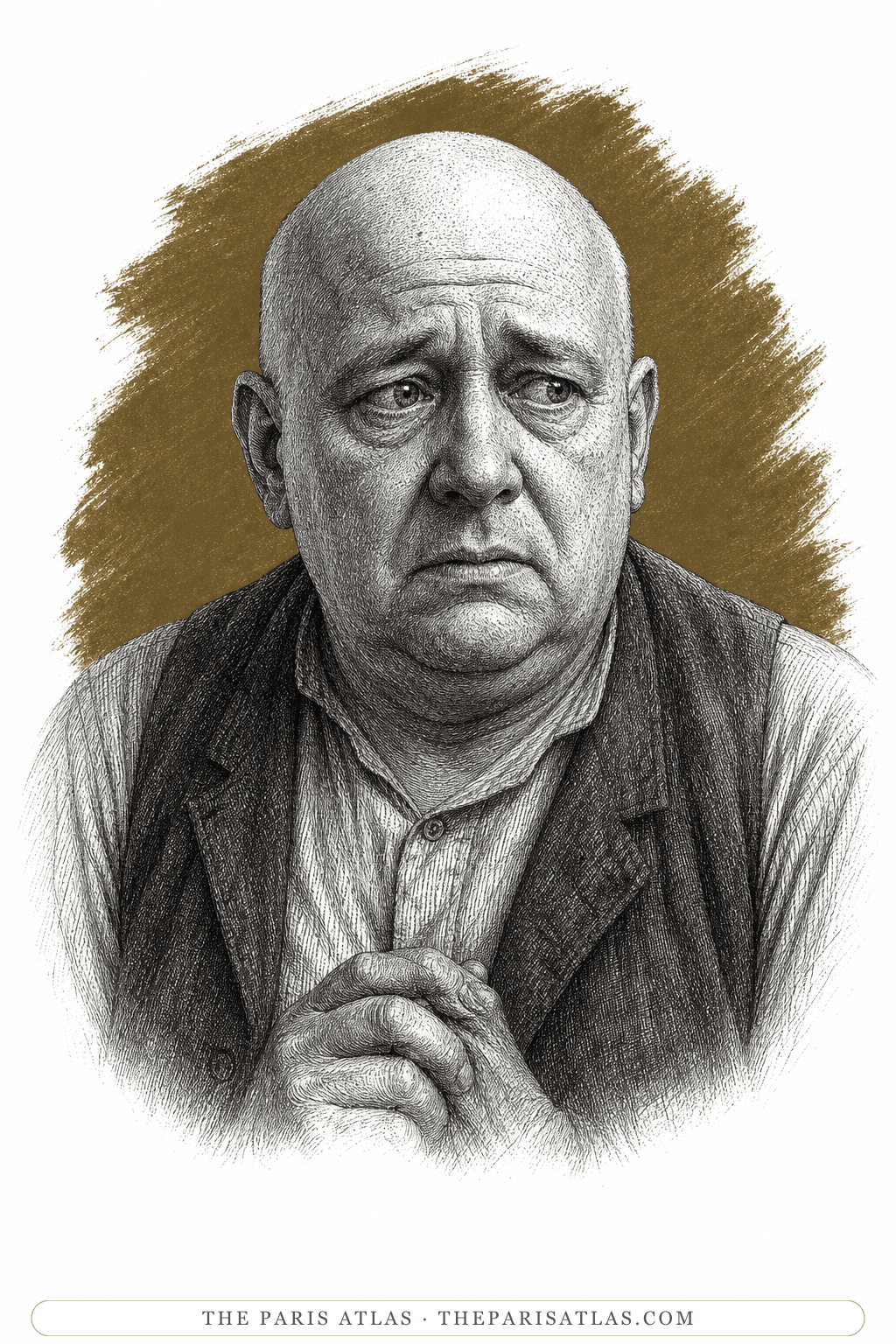
Wing Biddlebaum
A frightened man living alone at the edge of town, known locally for his restless hands, and driven out of another state twenty years earlier on an accusation about the boys he taught.
To be listened to, and for George Willard to come. He spends his evenings walking his porch hoping the young reporter will walk out from town, and the one time he forgets himself far enough to touch him, he goes home in tears.
The book

At a glance
- The subject of 'Hands,' the first story
- Forty, though the book says he looks sixty-five
- A small half-decayed frame house by a ravine at the edge of Winesburg
- Day laborer in the berry fields
- A schoolteacher in a Pennsylvania town, under the name Adolph Myers
- Twenty years, in which one person has come close to him
Who they are in the book
Spoiler-freeWing Biddlebaum is the subject of 'Hands,' the first story in Winesburg, Ohio, the 1919 book of linked short stories by the American writer Sherwood Anderson. He is a fat little bald man of forty who looks sixty-five, and he has lived for twenty years alone in a half-decayed frame house near a ravine outside the town. Winesburg knows him as its mystery and as the fastest picker in the berry fields: with those hands he has taken as much as a hundred and forty quarts of strawberries in a day.
The hands are never still. They flutter, hide in his pockets and behind his back, and come out again to do his talking for him, and it was their movement that got him his name from some obscure poet of the town. He is frightened of them. When he speaks to George Willard, the young reporter on the town paper and the one person in twenty years who has come close to him, he closes his fists and beats them on a table or a fence rail, which makes talking possible.
In an earlier life in a Pennsylvania town he was a schoolteacher named Adolph Myers, and the boys of his school loved him. He taught partly by touch, a hand on a shoulder and fingers in a boy's hair, and Anderson describes this as the way he expressed himself and carried a dream into young minds. Then a half-witted boy of the school became infatuated with him, imagined things at night and went out in the mornings telling them as facts, and the town believed him. A saloon keeper beat the schoolmaster in the yard in front of the children, and a dozen men came to his house with lanterns and a rope, decided at the last not to hang him, let him run, and then went after him throwing sticks and mud. He never understood what had happened. Since the fathers of the boys had talked again and again about the hands, he decided the hands must have been to blame.
How Wing Biddlebaum Is Portrayed
- The handsSlender and expressive, forever active, forever trying to conceal themselves in his pockets or behind his back. Anderson compares their restlessness to the beating of the wings of an imprisoned bird, which is where the name Wing came from.
- What the town knows him forSpeed in the berry fields. Winesburg is proud of his hands in the same spirit in which it is proud of the banker's new stone house and of a local stallion that won the two-fifteen trot at the fall races in Cleveland.
- The friendship with the reporterGeorge Willard is the only person in twenty years who has come close to him. In the boy's company the bent figure straightens, the low trembling voice goes shrill and loud, and the silent man talks, striving to put words to ideas he has accumulated through years of saying nothing.
- What he tells the boyTo stop imitating the people around him. "You have the inclination to be alone and to dream and you are afraid of dreams." Later, on a grassy bank, he goes further: "You must begin to dream."
- The moment he stopsCarried away by his own talk, he lets his hands come to rest on George Willard's shoulders and raises them again to touch the boy's face. A look of horror crosses his face. He thrusts his hands into his pockets, says he can talk no more, and hurries away across a meadow without looking back.
- The name he was born withAdolph Myers. He took Biddlebaum from a box of goods seen at a freight station while hurrying through an eastern Ohio town, and lived in Winesburg with a black-toothed old aunt who raised chickens until she died.
- How the accusation ranHalf-formed doubts already in men's minds hardened into belief overnight. Trembling boys were pulled out of bed and questioned. A saloon keeper called Henry Bradford beat him in the school yard for putting his hands on his son, and men with lanterns drove him out of the town in the rain.
- The last image of himAlone after dark he cuts bread, spreads honey on it, washes the few dishes, and then kneels to pick the crumbs off his clean floor and carry them to his mouth one by one. Anderson ends the story there: in the blotch of lamplight under the table the kneeling figure looks like a priest, and the fingers move fast enough to be a devotee's going through a rosary.
If you like Winesburg, Ohio


If you like Sherwood Anderson
Explore authors with a similar voice, perspective, and influence.

Ernest Hemingway
Anderson's letters of introduction sent him to Paris; In Our Time borrowed the Winesburg shape; The Torrents of Spring paid the debt back in parody.
View author
Sisley Huddleston
The witness who recorded Anderson's Paris — the hotel by the Odéon, the Luxembourg walks, and the long conversations about America and art.
View author
F. Scott Fitzgerald
The Jazz Age's laureate — famous at twenty-three, author of Gatsby at twenty-eight, and owner of the longest posthumous comeback in American letters.
View author