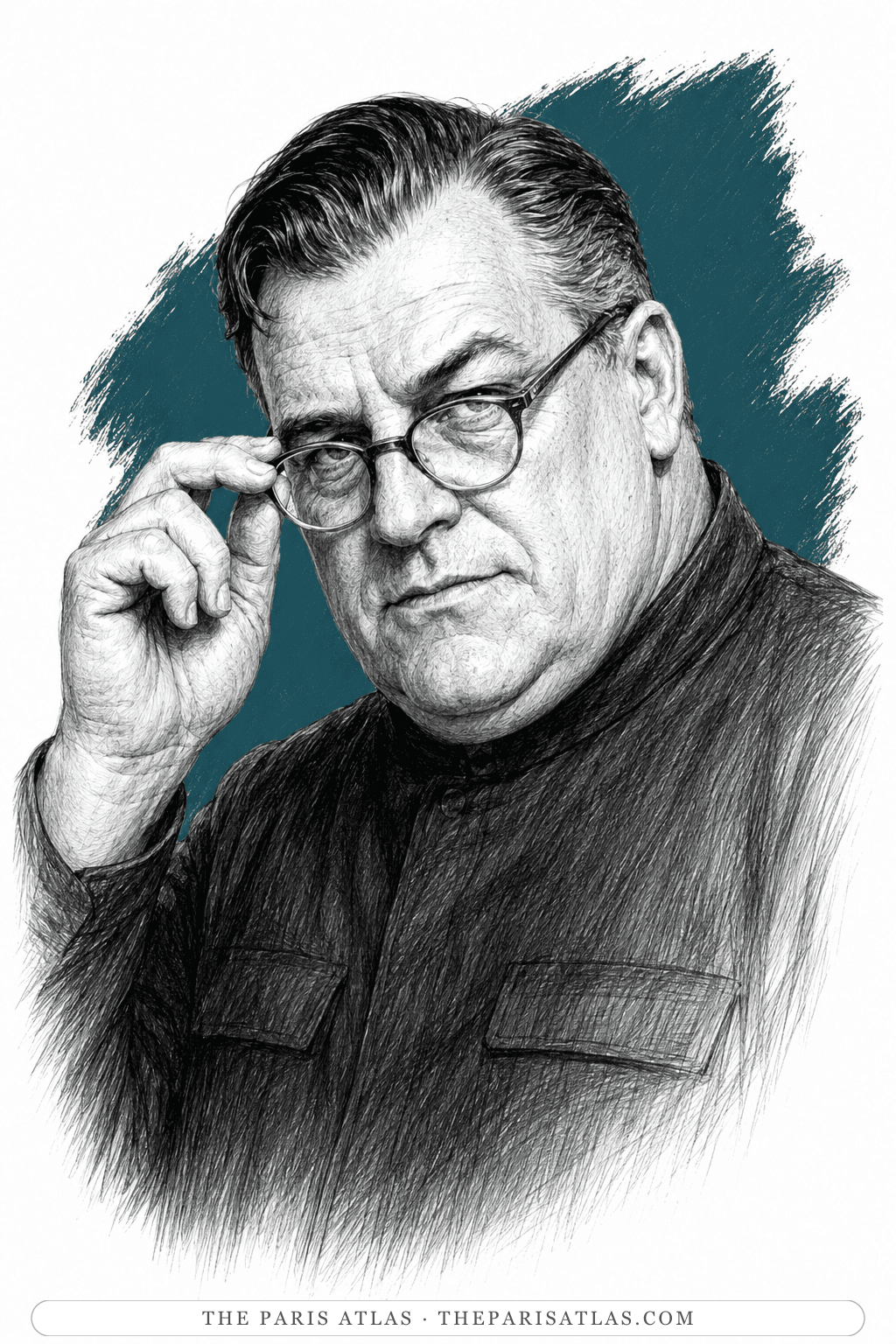
O'Brien
A member of the Inner Party, large and burly with a prize-fighter's build and a courteous, ironic manner. Winston has decided, on the evidence of a single glance across a room, that he is an ally.
To be understood, and to be the one doing the explaining. Every scene he shares with Winston is a lesson: he asks the questions, supplies the answers, takes a plain satisfaction in a mind quick enough to follow him, and tells him at their first real meeting that he will be fighting in the dark for the rest of his life.
The book

At a glance
- An Inner Party official, and the man Winston decides to trust
- Perhaps forty-eight or fifty
- Large and burly, thick neck, coarse and brutal face, spectacles
- A flat in the Inner Party quarter, and a servant named Martin
- "We shall meet in the place where there is no darkness"
- Part One, Chapter 1, at the Two Minutes Hate
Who they are in the book
Spoiler-freeO'Brien holds a post in the Inner Party so senior and so remote that Winston has only a dim idea what it is. He is large and burly with a thick neck and a coarse, humorous, brutal face, and he has a trick of taking off his spectacles and resettling them on his nose that Winston finds disarming and, in some way he cannot define, civilized. He wears the black overalls of the Inner Party. He is perhaps forty-eight or fifty, older than Winston had thought, with pouches under his eyes and a tired, heavy face. Winston has seen him perhaps a dozen times in almost as many years.
The whole relationship rests on two moments and a dream. Seven years before the book opens, Winston dreamt of walking through a pitch-dark room while a voice beside him said, quietly and without emphasis, "We shall meet in the place where there is no darkness." He decided afterwards that the voice was O'Brien's. Then, during a Two Minutes Hate, their eyes met for a fraction of a second and Winston knew — he uses the word in capitals — that O'Brien was thinking exactly what he was thinking. There is no evidence of any kind beyond that. Winston writes his diary to him anyway.
When O'Brien finally speaks to him it is in a Ministry corridor, about a Newspeak article Winston wrote, and about a friend of Winston's who is an expert on the language and whose name has slipped his memory. The friend is Syme, who has been vaporized and cannot legally be referred to at all. Sharing that small crime is how the conversation begins. O'Brien writes his home address on a page torn from a notebook, standing directly beneath a telescreen where anybody watching can read it, and says he is usually at home in the evenings.
In his flat, with the telescreen switched off — a privilege he mentions in passing — he serves wine, which Winston has only read about, and drinks a health to Emmanuel Goldstein. He puts the questions of the catechism one by one. Are you prepared to give your lives, to commit murder, to betray your country, to throw sulphuric acid in a child's face. Winston says yes to all of them, and no to the last, which is whether the two of them would separate and never see one another again. O'Brien says it is necessary for them to know everything. He explains that the Brotherhood cannot be destroyed because it is not an organization, that its members will get no help, no comradeship and no results, and that they will be caught, will confess, and will die.
How O'Brien Is Portrayed
- The gestureResettling his spectacles on his nose with one hand. Orwell says it might have recalled an eighteenth-century nobleman offering his snuffbox. He does it at every turning point in the book, including the ones that go badly for Winston.
- What he wearsThe black overalls of the Inner Party. Winston and everyone in his department wear Outer Party blue; the colour of the overall is how rank shows. O'Brien talks with one hand in a pocket of his and a cigarette in the other.
- The contrastA prize-fighter's physique and an urbane manner, an ugly face and an obviously first-rate mind. Winston is drawn to him for the mismatch before he has any political reason at all, and never entirely stops being drawn to him.
- "We can turn it off"He switches his telescreen off with a snap, and when Winston blurts out that it can be done, answers that yes, they can, they have that privilege. It is the single most convincing piece of evidence in the book that the Inner Party lives in a different world, and he delivers it in six words.
- The catechismAsked in a low, expressionless voice, like a routine whose answers he knows already. He barely addresses Julia and takes it for granted that Winston can answer for her, then turns to her with more expression to ask whether she understands that the man may come back with a different face, different hands, a different voice.
- Irony as a mannerWhen he lists murder, suicide, venereal disease and amputated limbs it is with a faint air of persiflage, as if to say that this is what has to be done and not what anyone would be doing if life were worth living. Winston reads the tone as decency. It never occurs to him to read it as amusement.
- The last line of the rhymeWinston, groping for something to say before he leaves, asks whether O'Brien has heard an old rhyme beginning "Oranges and lemons". O'Brien completes the stanza, including the line about the bells of Shoreditch that Mr Charrington could never recall. Winston takes it as proof of an alliance.
- The handshakeAt the door his powerful grip crushes the bones of Winston's palm. Looking back from the doorway, Winston sees him already waiting with a hand on the telescreen switch, the incident closed, about to resume his important work on behalf of the Party.
O'Brien quotes
Reality exists in the human mind, and nowhere else.
The object of persecution is persecution. The object of torture is torture. The object of power is power.
If you want a picture of the future, imagine a boot stamping on a human face--for ever.
If you like Nineteen Eighty-Four


If you like George Orwell
Explore authors with a similar voice, perspective, and influence.
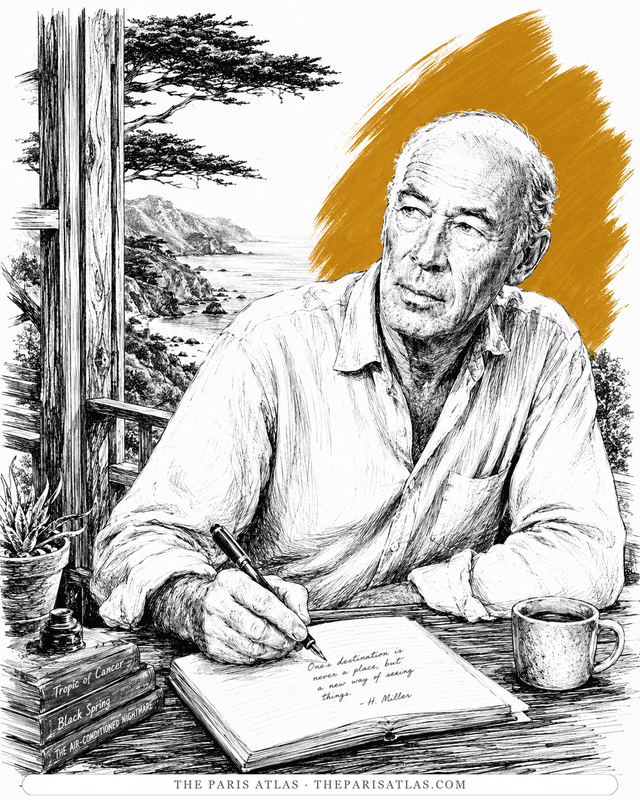
Henry Miller
The Brooklyn dropout who arrived in Paris broke at thirty-eight and wrote the exuberant, banned books that ended American censorship.
View author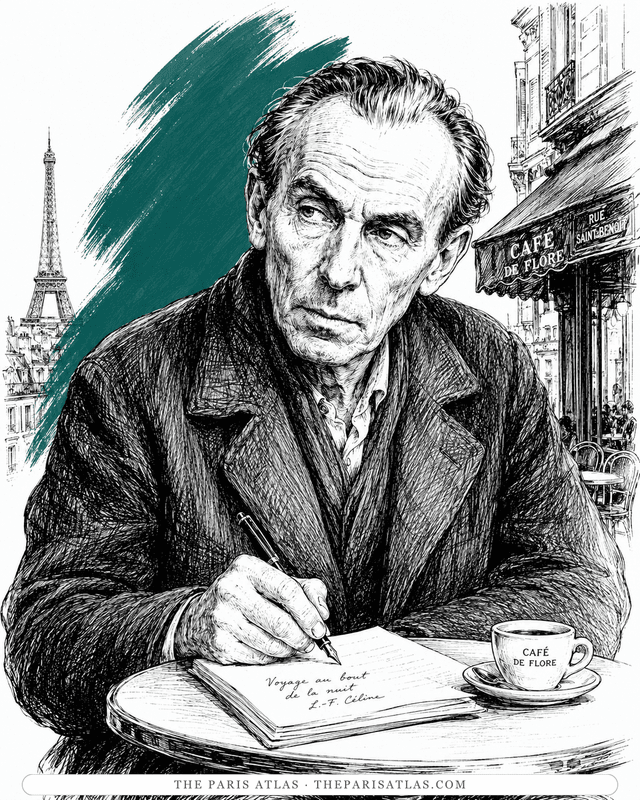
Louis-Ferdinand Céline
The doctor of the Paris slums who wrote the century's blackest, funniest novel — and changed the sound of French prose.
View author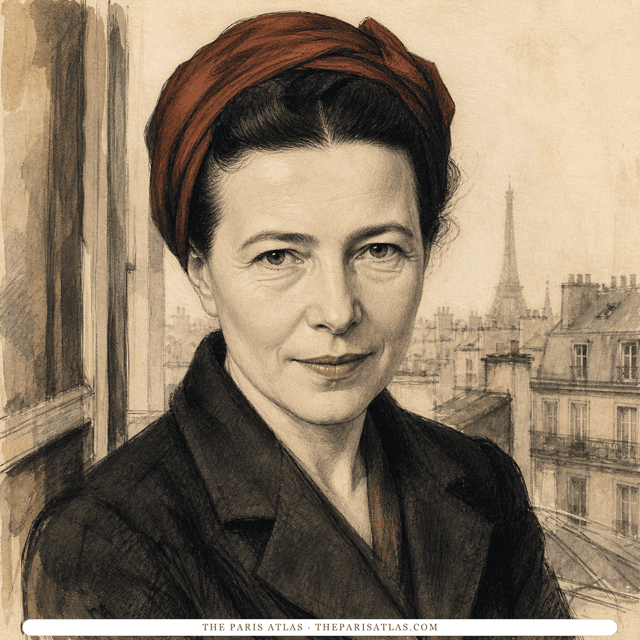
Simone de Beauvoir
French writer and philosopher whose novels, memoirs, and social analysis examined freedom, gender, responsibility, aging, and the material conditions that shape a life.
View author