
Winston Smith
Thirty-nine, a records clerk at the Ministry of Truth, with a varicose ulcer above his right ankle and a memory that will not stay under control. He falsifies the past for a living and keeps an illegal diary about it.
To find one other person who remembers what he remembers. He writes his diary to the future, addressed to nobody, and admits the enterprise is impossible; the sentence he puts down as his creed is that freedom is the freedom to say that two plus two make four.
The book

At a glance
- Records clerk at the Ministry of Truth, and the novel's central figure
- Thirty-nine, and unsure whether the year is 1984
- Small and frail, very fair hair, a high-coloured and roughened face
- The blue overalls of the Outer Party
- Outer Party; employee 6079 Smith W.
- A flat seven floors up in Victory Mansions, London, Airstrip One
- A varicose ulcer above the right ankle, a morning cough, five false teeth
- To Katharine, separated about eleven years; the Party permits separation but not divorce
- A mother and a younger sister, both gone in the purges of the fifties
- 4 April 1984
Who they are in the book
Spoiler-freeWinston Smith is a member of the Outer Party, employee number 6079 Smith W., and lives alone in a flat seven floors up in Victory Mansions, a block built around 1930 and falling apart. He is small and frail with very fair hair, and the varicose ulcer above his right ankle itches whenever he is frightened. He is thirty-nine. He believes he was born in 1944 or 1945, but the records that would settle it have all been through his own department.
That department is the Records Department of the Ministry of Truth, and his job is rectification. Four cylinders of paper drop out of a pneumatic tube onto his desk each morning carrying one-line instructions: a speech of Big Brother's misreported, a production forecast that turned out wrong, a promise about the chocolate ration that has since been broken. Winston rewrites the original so that it agrees with what happened, drops the evidence into the slit called a memory hole, and the corrected version goes on the files bearing its original date. He is unusually good at it. Asked to erase a disgraced official from an Order for the Day, he invents a dead war hero, Comrade Ogilvy, to fill the space, and reflects that a few lines of print and two faked photographs will make Ogilvy as real as Charlemagne.
What separates him from everyone around him is not courage but retention. He can remember that Oceania was at war with Eastasia four years ago, when the Party says it has always been at war with Eurasia. He held, once, for about thirty seconds in 1973, a torn half-page of The Times that proved three confessed traitors had been in New York on the day they confessed to being in Siberia, and he dropped it into the memory hole. He has been unable to stop thinking about it since. His two settled convictions are that the past is being destroyed rather than merely edited, and that if there is hope it lies in the proles, who are eighty-five per cent of the population and pay attention to the Lottery.
His interior life runs on two images. One is the Golden Country, an old rabbit-bitten pasture with elms and a stream, which he dreams so often that he cannot be sure he has ever seen it. The other is his mother, who disappeared in one of the purges of the fifties when he was ten or twelve, after he stole his dying sister's share of a chocolate ration and ran out of the room with it. He dreams of her and the child sinking in the saloon of a ship, looking up at him through the water, and understands in the dream that they died so that he could stay alive.
How Winston Smith Is Portrayed
- How the book describes himSmall and frail, with very fair hair and a face Orwell calls naturally sanguine — high-coloured rather than pale. The skin is roughened by coarse soap, blunt razor blades and the winter just ended. He wears the blue overalls of the Outer Party, which Orwell says only emphasise how meagre he is.
- The body firstOrwell introduces him climbing stairs slowly, resting several times, because the lift is off during daylight hours. Coughing fits empty his lungs each morning. He has five false teeth, and the ulcer above his ankle flares when he bends down. Almost every crisis in the book reaches him through his own body before it reaches his mind.
- The alcoveHis telescreen is set in the long wall opposite the window instead of the end wall, leaving a shallow recess that was probably meant for bookshelves. Sitting in it he can be heard but not seen. The whole plot begins with that construction fault.
- The diaryA quarto blank book with a red back and a marbled cover, cream-laid paper at least forty years old, bought for two dollars fifty. He writes in it with a real nib because the paper deserves it. His first entry breaks down mid-sentence into an account of a war film; his second is the words DOWN WITH BIG BROTHER, written five times and filling half a page while he was not paying attention.
- Face controlHe wears an expression of quiet optimism when facing the telescreen, because that is what is advisable. To look incredulous when a victory is announced is a punishable offence with a name of its own in Newspeak, facecrime. He measures other people's odds of survival by how well they do this, and puts himself in the doomed column.
- Two inkstained fingersAfter his first diary session he scrubs the ink off with gritty dark-brown soap, then lays an identifiable grain of whitish dust on the corner of the cover so he will know if the book has been moved. He is not trying to escape detection. He is trying to know when it has happened.
- What he thinks about the girlBefore he knows anything about Julia he hates her on sight, decides she is an amateur spy, and during the Two Minutes Hate imagines killing her in three separate ways. Five days before they speak he considers following her and smashing her skull in with a cobblestone. He tells her all of this the first afternoon, as a kind of gift.
- The paperweightA hemisphere of glass with a piece of coral set in it, made more than a hundred years ago, bought for four dollars from Mr Charrington. He values it for being useless and for belonging to a period the Party has not got round to altering. Lying in the rented room he thinks of the glass as the sky over a small complete world with himself and Julia inside it.
- The one thing he will not think aboutA recurring nightmare in which he stands before a wall of darkness with something unendurable behind it, knowing perfectly well what it is and refusing to name it. When Julia starts talking about rats in the wainscoting he shuts his eyes and tells her to stop.
- Argument as consolationHe writes "I understand HOW: I do not understand WHY" and it defeats him for years. He calls himself a possible lunatic and decides he can live with that; the horror, he says, is not being a minority of one but being wrong.
Winston Smith quotes
It was a bright cold day in April, and the clocks were striking thirteen.
Freedom is the freedom to say that two plus two make four. If that is granted, all else follows.
Thoughtcrime does not entail death: thoughtcrime IS death.
Everything Winston does to protect himself turns out to have been observed.
If you like Nineteen Eighty-Four


If you like George Orwell
Explore authors with a similar voice, perspective, and influence.
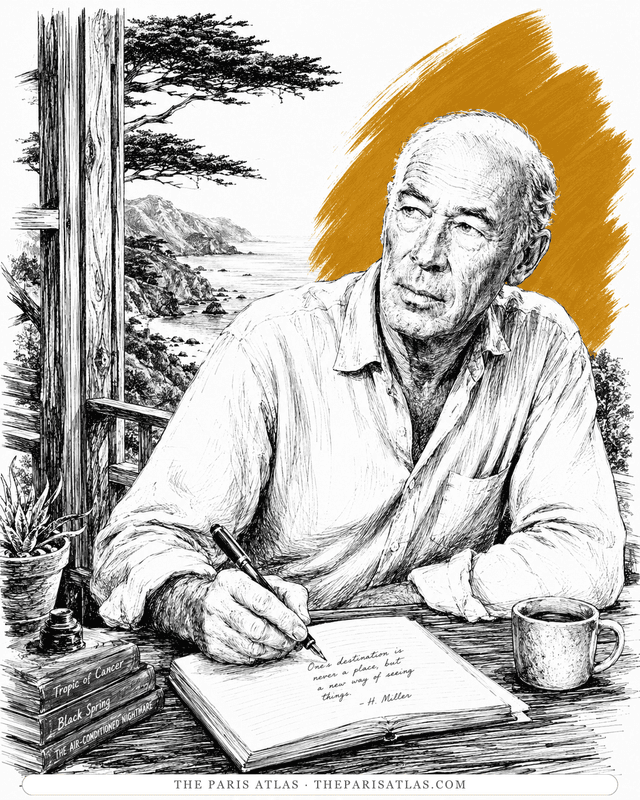
Henry Miller
The Brooklyn dropout who arrived in Paris broke at thirty-eight and wrote the exuberant, banned books that ended American censorship.
View author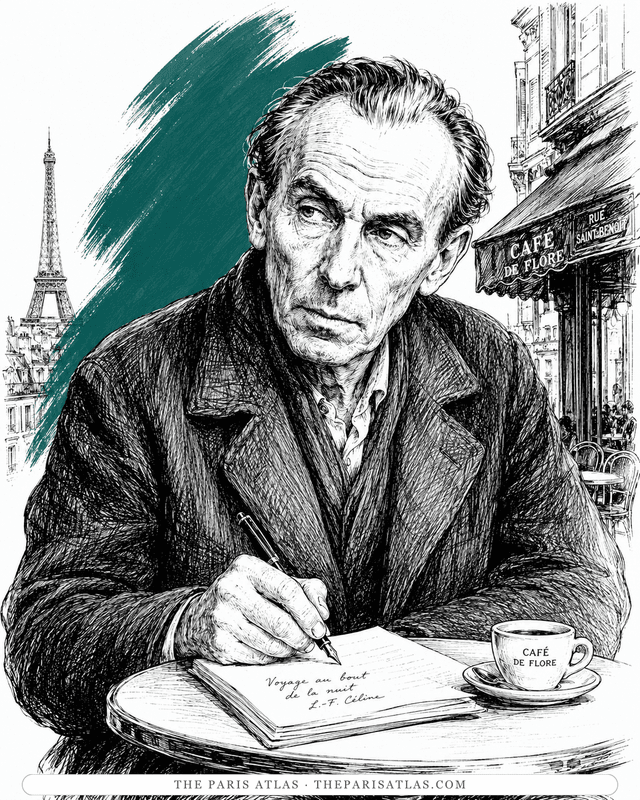
Louis-Ferdinand Céline
The doctor of the Paris slums who wrote the century's blackest, funniest novel — and changed the sound of French prose.
View author
Simone de Beauvoir
French writer and philosopher whose novels, memoirs, and social analysis examined freedom, gender, responsibility, aging, and the material conditions that shape a life.
View author