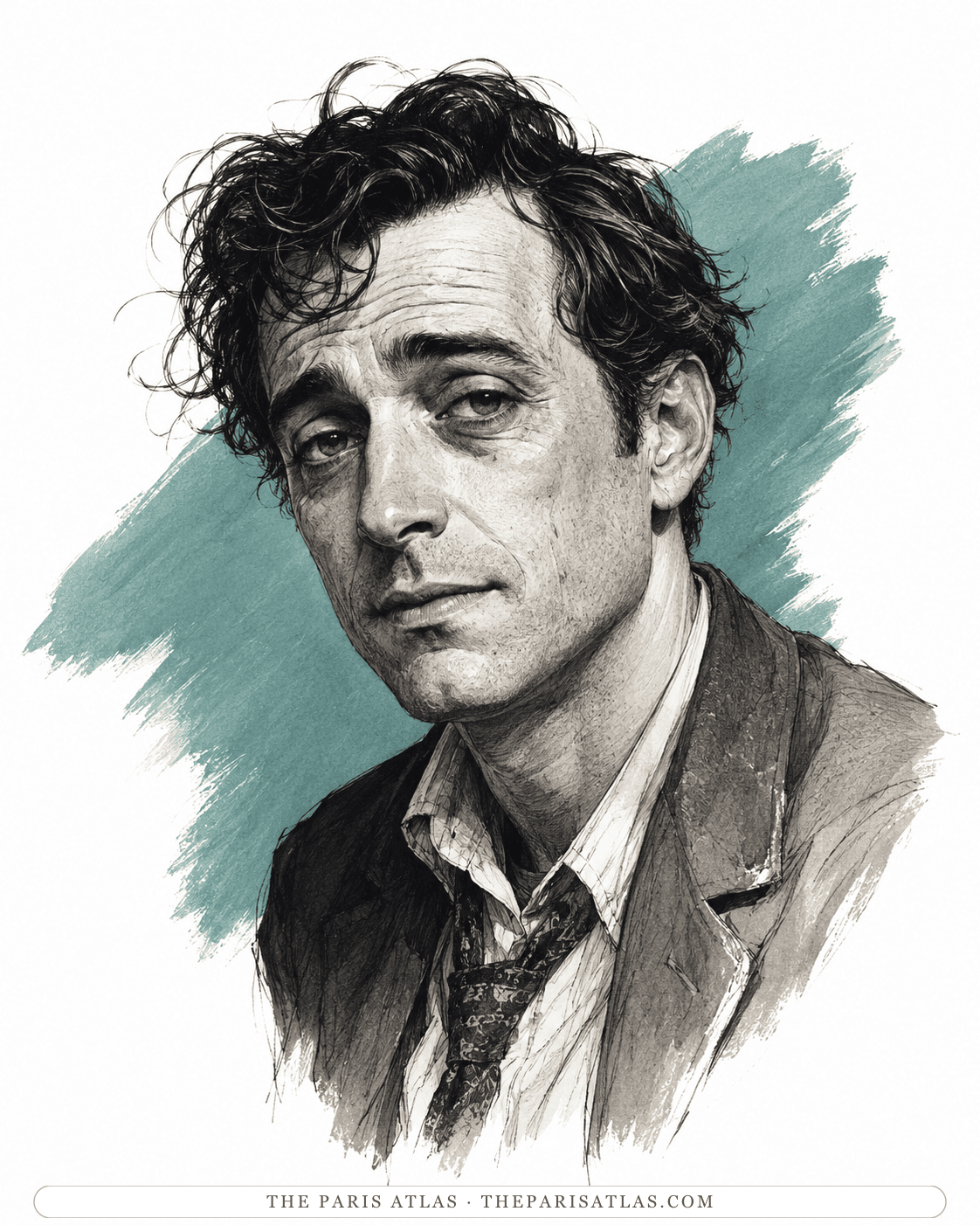
Abe North
A composer who made a brilliant start and has written nothing for seven years — the circle's funniest man, and the first of them the book loses.
A new score on Broadway. He says he will have one long before Dick finishes his scientific treatise, and the joke is that he means it.
The book

At a glance
- American composer; Mary North's husband and one of the Divers' oldest friends
- Seven years before the novel opens, after a brilliant and precocious start
- Albert McKisco's second — and the man who talks him through the night before
- Constant by Paris; the Ritz bar from nine in the morning
- The beach and the Villa Diana, the duel at the golf course, and the Paris chapters up to the Gare Saint-Lazare
- Ring Lardner, in part — Fitzgerald's Great Neck neighbour and friend, a gifted writer whose drinking outran his work; Bruccoli identifies a smaller contribution from Charles MacArthur · Lardner 1885–1933 · Niles, Michigan
Who they are in the book
Spoiler-freeRosemary meets him on the raft before she knows who anyone is: a leonine head, one of the saddest faces she has ever seen, high cheekbones and enormous deep-set dark golden eyes, speaking out of the side of his mouth as though hoping the words will reach her by an unobtrusive route. He is a fine swimmer. Mrs. McKisco's verdict, delivered with surprising violence, is that he is a rotten musician. What Rosemary learns from Earl Brady is more particular: he is a musician who after a brilliant and precocious start has composed nothing for seven years.
He is the best company in the book and the least well. In Paris he has a thin vinous fur over him and his eyes are bloodshot from sun and wine, and Rosemary realizes he is always stopping somewhere for a drink. He acts as Albert McKisco's second in the duel with a mixture of kindness and cruelty, borrowing Tommy's pistols so his man can get familiar with them and then remarking that you sight better along a long barrel. Dick loves him and has long since lost hope for him.
How Abe North Is Portrayed
- The faceA leonine head and a long upper lip, and a voice both slow and shy. Rosemary decides on first meeting that under the shyness there is a desperate humour that amuses her and puzzles her.
- The moral codeHe insists a man cannot live without one, and gives his: he is against the burning of witches. Whenever they burn a witch he gets hot under the collar.
- The musical sawThe story he tells at a dinner at the Villa Diana, the Divers' house above the sea — that he wanted to saw a waiter in two to find out what was inside a waiter, and that using another musician's saw would have eliminated any sordidness. They were stopped by the screams.
- The secondHe handles the duel with awful competence: he inquires about distances, settles on forty paces, counts the shots in a strained voice, and pays the French doctor's fee afterwards on the grounds that they were all in about the same danger.
- The Ritz barThe book finds him there at four in the afternoon, having arrived at nine that morning seeking sanctuary, before the famous Paul has even come in.
- Saint-LazareAt his own farewell he lies athwart his friends like the wreck of a galleon, dominating them with his own weakness. They can feel the dignity and the unfinished achievement, and they are frightened by a will to live that has turned into a will to die.
He never gets on the boat. In Paris he launches what he cheerfully calls a race riot in Montmartre, misidentifies a man to the police, and leaves Jules Peterson — the witness who helped him — exposed to people who want Peterson rather than Abe. He promises to set Peterson up in business in Versailles and hands him two hundred francs on account.
His death arrives as gossip in a Munich café, two paragraphs of men arguing about which club he crawled to. He was , and his cousins wanted it kept out of the papers. Dick, who has to ask three times whether it is really Abe, stands up. It is the first of the losses that finishes him, and the book gives it to him second-hand, from strangers who are chiefly interested in whether Abe's early work holds up.
If you like Tender Is the Night


If you like F. Scott Fitzgerald
Explore authors with a similar voice, perspective, and influence.
Ernest Hemingway
Fitzgerald vouched for him to Scribner's before they had met, then edited him better than he edited himself; the friendship's five rounds are chronicled in our journal.
View author
Henry Miller
The Brooklyn dropout who arrived in Paris broke at thirty-eight and wrote the exuberant, banned books that ended American censorship.
View author
Louis-Ferdinand Céline
The doctor of the Paris slums who wrote the century's blackest, funniest novel — and changed the sound of French prose.
View author