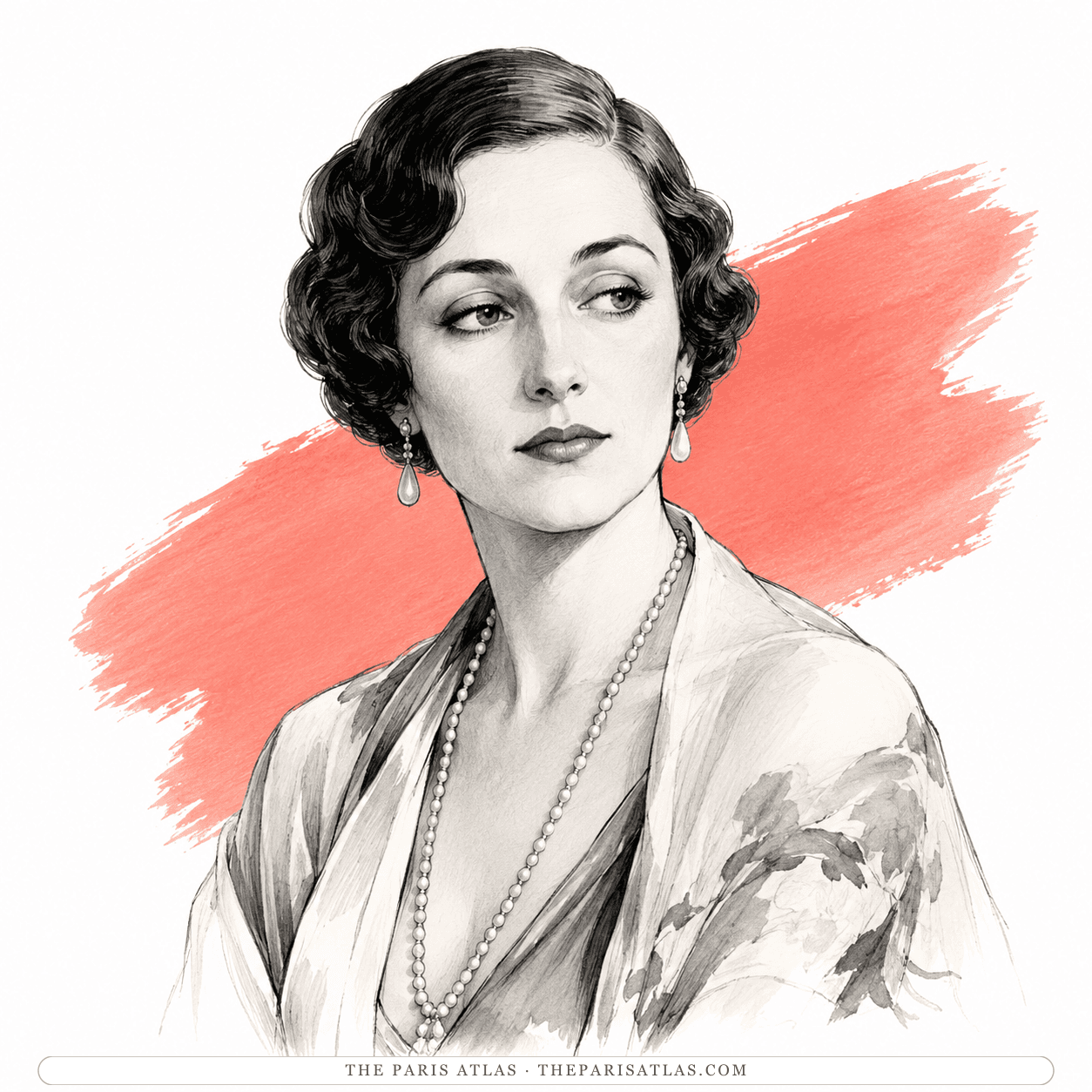
Maria Wallis
An American acquaintance of the Divers who shoots a man on a platform at the Gare Saint-Lazare, and is walked away between gendarmes without ever explaining herself.
The book does not say. She shoots an Englishman on the platform at the Gare Saint-Lazare and is led away between gendarmes without explaining herself. The novel never states whether she knew the man, or what she wanted the shot to settle.
The book

At a glance
- Wealthy American in the Divers' Paris circle
- Shooting an Englishman on the platform at the Gare Saint-Lazare
- Laura, a friend of hers in Paris — Nicole's judgement is that she can do more than they can
- One scene, at the station; afterwards she is only spoken about
- Alice de Janzé, in part. In March 1927 she shot her lover Raymund de Trafford at the Gare du Nord as he was leaving Paris, then shot herself. Both survived, and they married in 1932. Fitzgerald keeps the station and the revolver, moves it to Saint-Lazare, and removes the motive · 1899–1941 · Buffalo, New York
Who they are in the book
Spoiler-freeMaria Wallis belongs to the wealthy American society around the Divers — close enough that Dick later leaves a note for her signed 'Dicole', the word he and Nicole used on communications in the first days of love. Nicole notices her at the Gare Saint-Lazare, where the party has come to see Abe North off, and is unsettled: Maria appears to look through her. Nicole's alarm starts before anything happens.
Then there are shots. Maria has shot an Englishman on the platform, and the book gives one detail that does the work of a whole scene — they had an awful time finding out who he was, because she shot him through his identification card. The crowd splits in two, following the man on the stretcher and the girl walking pale and firm between distraught gendarmes. Dick wants to intervene and Nicole tells him briskly that they are certainly going to hold on to her, because she did shoot the man, and that the useful thing is to telephone Laura, a friend of Maria's in Paris.
How Maria Wallis Is Portrayed
- Seen only from outsideShe is never given a confession, an explanation, or a scene of her own. She exists as an image Nicole glimpses and then as a public event other people interpret.
- Pale and firmThe four words the book spends on her at the moment of arrest, walking between gendarmes while half the crowd follows her and half follows the stretcher.
- Through the identification cardThe one forensic detail, and the reason the victim takes so long to name. It is the most memorable thing about her and it is about the paperwork.
- The snub that wasn'tNicole's discomfort at being ignored on the platform turns out to have been a reading of something else entirely, and the misreading is left standing.
- Made into a jokeDick's way of restoring calm is a line — Maria ought to be with Diaghilev, the ballet impresario — delivered gently, to bring the women back to quietude.
- AbsorbedThe party walks out of the station and the shots enter their lives as a topic. Two porters hold a post-mortem beside them on the pavement about how small the revolver was, and how much blood.
She never reappears. The novel is not interested in her trial or her future, only in the shock wave, and it says so structurally by giving her no interior at all.
What she does instead is mark the end of the Paris idyll. The enamelled surface of the expatriate morning cracks at the exact point of departure, and the party walks out of the station into a different book — one in which . Because she is denied an account of herself, Maria functions as an omen rather than a person: proof that money can conceal disorder and cannot hold it.
If you like Tender Is the Night


If you like F. Scott Fitzgerald
Explore authors with a similar voice, perspective, and influence.

Ernest Hemingway
Fitzgerald vouched for him to Scribner's before they had met, then edited him better than he edited himself; the friendship's five rounds are chronicled in our journal.
View author
Henry Miller
The Brooklyn dropout who arrived in Paris broke at thirty-eight and wrote the exuberant, banned books that ended American censorship.
View author
Louis-Ferdinand Céline
The doctor of the Paris slums who wrote the century's blackest, funniest novel — and changed the sound of French prose.
View author