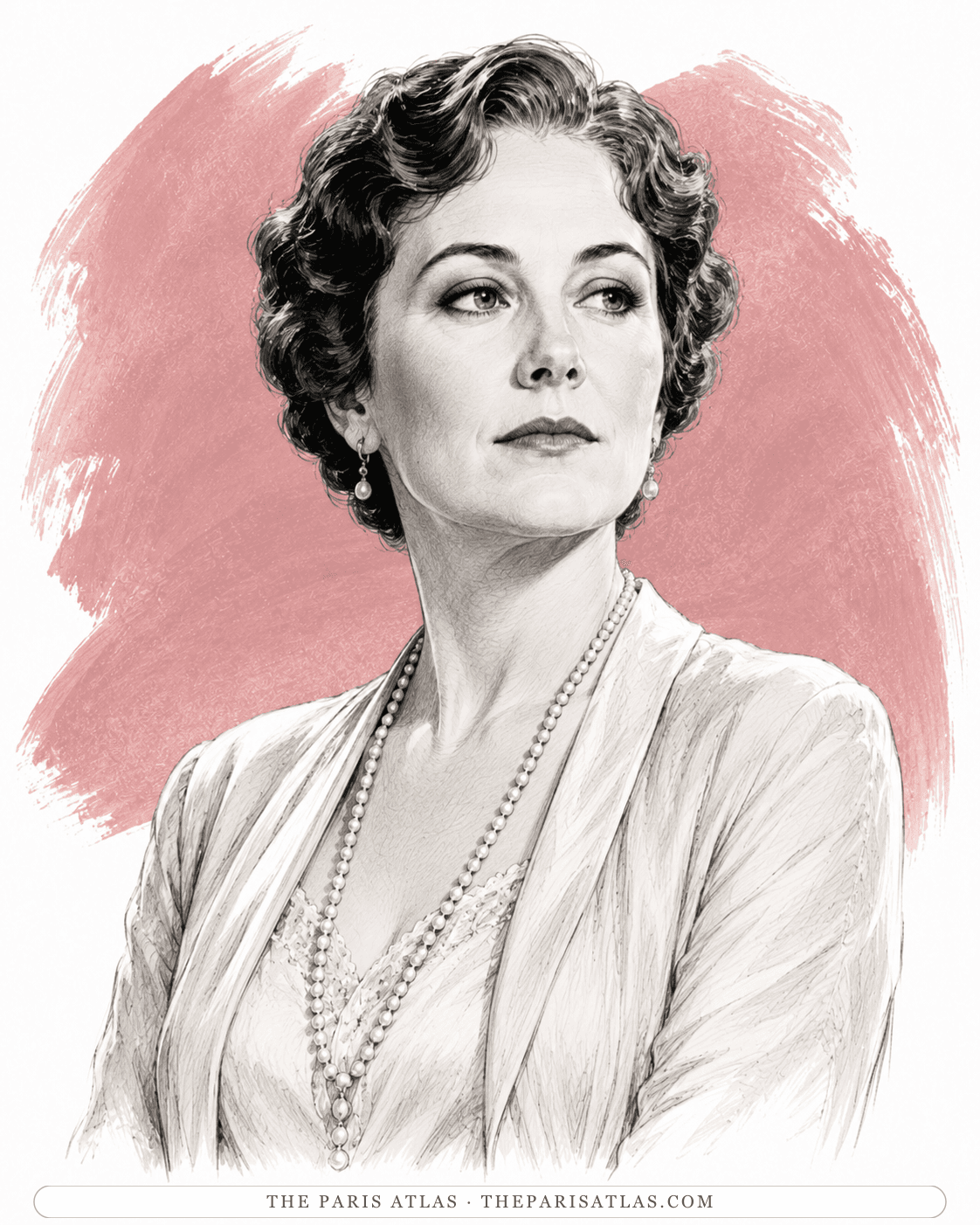
Elsie Speers
Rosemary's mother, manager and best friend — twice widowed, entirely unsentimental, and the reason her daughter can afford to get hurt.
A daughter who can support herself and therefore never has to be rescued. Everything else, including heartbreak, she is willing to file under experience.
The book

At a glance
- Rosemary's mother, manager, and closest friend
- Twice — a cavalry officer and an army doctor
- At sixteen, at Aix-les-Bains, unannounced into an American producer's suite
- Rosemary was brought up to work, not especially to marry
- The Riviera hotel and the Villa Diana dinner, and a last conversation with Dick at the Café des Alliées in August
Who they are in the book
Spoiler-freeMrs. Elsie Speers has been twice satisfactorily married and twice widowed — one husband a cavalry officer, one an army doctor — and her cheerful stoicism deepened each time. She has no personal bitterness and, unusually for a stage mother, is not recompensing herself for a defeat of her own. She spent the slim leavings of the men who widowed her on Rosemary's education, and when her daughter blossomed at sixteen with that extraordinary hair, took her to Aix-les-Bains and marched her unannounced into the suite of an American producer who was recuperating there. When he went to New York, they went too.
By the Riviera she is trying to let go. She sends Rosemary to see Earl Brady alone — it is only a short way, and it is not as if she did not speak French — and is pleased when the errand is carried out accurately, but still wants to launch her out and away. Her doctrine, which the book states in her own silent voice, is that Rosemary was brought up to work and not especially to marry, so she may as well put whatever happens down to experience. She can be wounded or she can wound him, and it cannot spoil her, because economically she is a boy and not a girl.
How Elsie Speers Is Portrayed
- The clear voiceRosemary obeys it without argument. It is the voice that sent her into the stage entrance of the Odéon at twelve and was waiting when she came out again.
- Tired, and fresh-lookingShe appears fresh but she is tired. The book says death beds make people tired indeed, and she has watched beside a couple of them.
- Told her to go aheadShe does not discover the crush and permit it; she authorised it in advance. Rosemary was in love with Dick before Elsie ever saw him, and Elsie told her to go ahead.
- For dissectionRosemary has had crushes before and sooner or later always turned the man over to her mother — for dissection, as Elsie puts it, laughing. Dick observes that he was spared that.
- No provision madeDick notices that her plans contain no allowance at all for him, or for Nicole, and that her amorality is the pension on which her own emotions have retired.
- Practical at five in the morningWoken with news of a duel, she suggests Rosemary go and watch it — she need not go up close, and she might be able to help afterwards. Her consciousness is still clogged with sleep and she is remembering night calls from when she was a doctor's wife.
She gets no ending of her own, and the book leaves her outside the collapse entirely. Her last real scene is the August conversation with Dick, where she tells him he was the first man Rosemary ever cared for and that in every letter her daughter calls him an ideal. Dick keeps up the pretence that he can still think objectively about Rosemary, and finds himself aware of Elsie's full charm, and aware that she means rather more to him than a last relinquished fragment of her daughter.
Whether the upbringing worked is left open, and the book is unusually even-handed about it. Rosemary does become employable, famous, and capable of running her own life. What Dick sees, though, is that the wisdom Rosemary got from her mother is all moulded into the mask she faces the world with, and that underneath it her real depths are romantic and illogical. Elsie has certainly made her independent. Whether she has made her able to feel is a different question, and nobody in the novel answers it.
If you like Tender Is the Night


If you like F. Scott Fitzgerald
Explore authors with a similar voice, perspective, and influence.

Ernest Hemingway
Fitzgerald vouched for him to Scribner's before they had met, then edited him better than he edited himself; the friendship's five rounds are chronicled in our journal.
View author
Henry Miller
The Brooklyn dropout who arrived in Paris broke at thirty-eight and wrote the exuberant, banned books that ended American censorship.
View author
Louis-Ferdinand Céline
The doctor of the Paris slums who wrote the century's blackest, funniest novel — and changed the sound of French prose.
View author