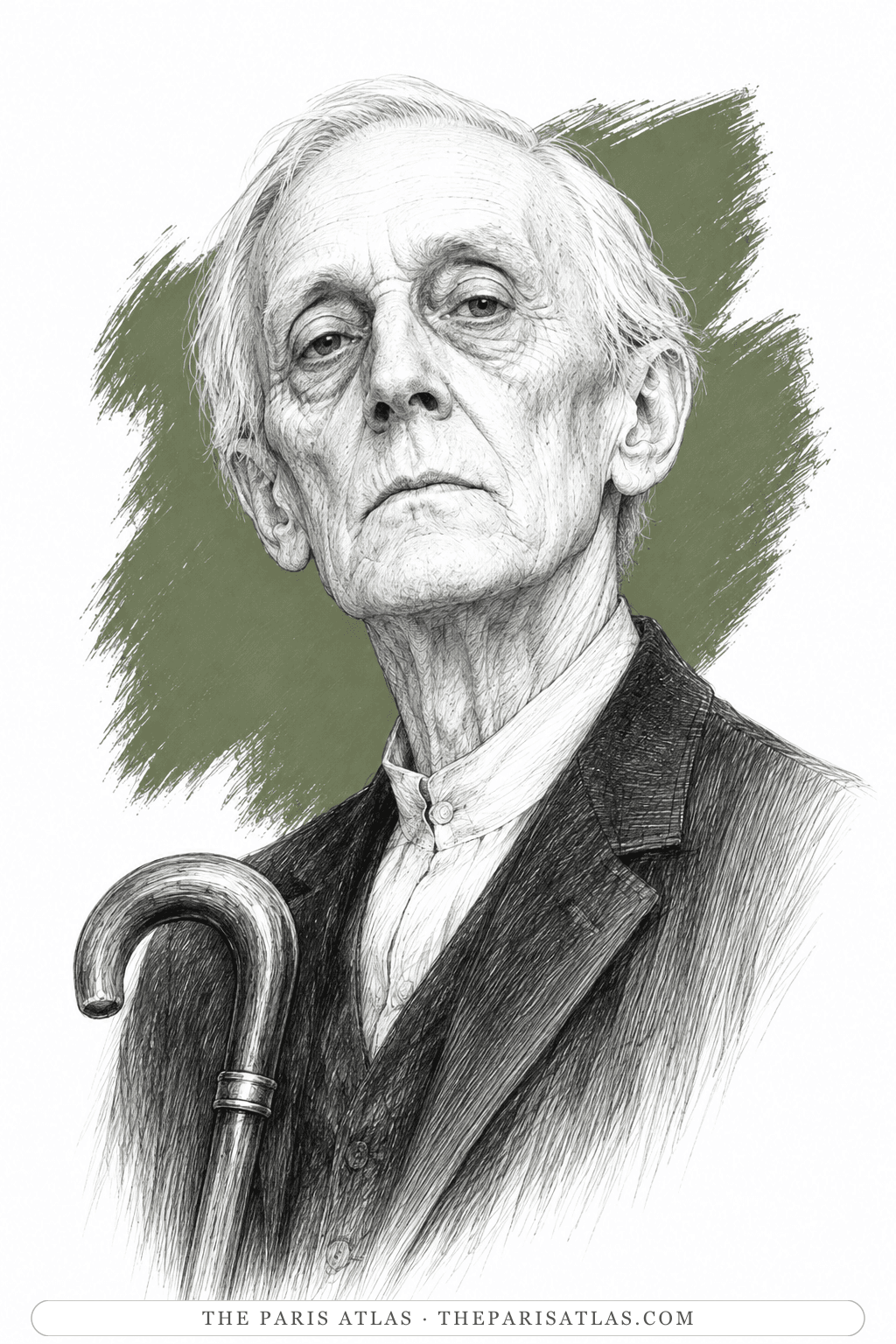
Adam Patch
Anthony Patch's grandfather: a Civil War major who made seventy-five million dollars on Wall Street and then spent fifteen years campaigning against liquor, vice and modern literature.
To leave the world better than he found it, and to see his grandson do some work. He says the second part to Anthony's face in their first scene together: 'Now that you're here you ought to do something. Accomplish something.'
The book

At a glance
- Anthony Patch's grandfather, seen in a handful of scenes at Tarrytown and once at the couple's house in the country
- Seventy-five in 1913, when the novel opens
- About seventy-five million dollars, made on Wall Street between the Civil War and 1895
- His wife Alicia and his son Adam Ulysses Patch are both long dead. Anthony is his only grandson; the other relations are two cousins in Idaho whom Anthony has never heard of
- The Tarrytown estate, run with his secretary Edward Shuttleworth, a former gambler and saloon-keeper he reformed
Who they are in the book
Spoiler-freeAdam J. Patch is the grandfather of Anthony Patch, the main character of The Beautiful and Damned, and the source of the fortune the whole novel is waiting for. He left his father's farm at Tarrytown, north of New York City, early in 1861 to join a New York cavalry regiment, came home from the Civil War a major, went into Wall Street, and by the age of fifty-seven had gathered about seventy-five million dollars.
Then he had a severe attack of sclerosis and changed careers. He decided to devote the rest of his life to the moral regeneration of the world, and ran the campaign for fifteen years from an armchair in the office of his Tarrytown estate, against liquor, literature, vice, art, patent medicines and Sunday theatres. The narrator does not admire the result: in those years he showed himself 'a rabid monomaniac, an unqualified nuisance, and an intolerable bore.'
He is seventy-five when the novel opens and most of his energy has drained away. He is nicknamed Cross Patch, he is unfailingly polite in private, and he sees his grandson rarely and thinks about him almost not at all.
How Adam Patch Is Portrayed
- Why they call him Cross PatchIt is the name he is known by, publicly and behind his back, and both his grandson and his grandson's friends use it. Anthony's own opinion, given to a girl over cocktails, is blunter: 'He's a pious ass — a chickenbrain.'
- The farm, the war, and Wall StreetHe left the family farm at Tarrytown in 1861 for a New York cavalry regiment and came home a major. He then, in the narrator's phrase, 'charged into Wall Street, and amid much fuss, fume, applause, and ill will he gathered to himself some seventy-five million dollars.' He married Alicia Withers, who brought him a hundred thousand dollars and an entrance into New York banking society.
- The reformerHis model was Anthony Comstock, the anti-vice campaigner, after whom he had his grandson christened Anthony Comstock Patch. For fifteen years he aimed his money at liquor, literature, vice, art, patent medicines and Sunday theatres, and by 1913 the campaign has 'grown desultory' and his mind runs mostly on the Civil War.
- The fences at TarrytownThe drive up to the house threads a maze of walls and wire fences. The reason given publicly is that if the Socialists ever had their way, one of the first men they would assassinate would be old Cross Patch.
- The secretary he savedEdward Shuttleworth, who admits Anthony to the house and rarely leaves the room, had been a gambler and a saloon-keeper before Adam Patch reformed him — the 'Accomplished Gin-physician' of a Hoboken bar called Pat's Place. He shows the old man off to visitors, the narrator says, 'as though he were displaying a treasure of immense value.'
- What seventy-five years have done to himAnthony can never look at him without amazement that this feeble old man commands such power. The years have taken his teeth one at a time, sunk his eyes in dark sacks, and turned his temper into that of a spoiled child. The book's image is a bellows: the first twenty-five years blew him full of life and the last twenty-five have sucked it all back out.
- The three men he ruinedIn one conversation he begins gently, remembering playing with his little sister Annie sixty-five years earlier and telling Anthony to think more about the after-life and be steadier. Then his whole manner snaps shut and he finishes with a chuckle: 'when I was just two years older than you, I sent three members of the firm of Wrenn and Hunt to the poorhouse.'
- The wedding at his houseHe offers to hold Anthony's wedding at Tarrytown, and does: a dancing platform on the lawn, a special train chartered from New York, and champagne, which startles the ushers, since he is a militant prohibitionist. His wedding present is a check for five thousand dollars, which the narrator calls the most munificent gift and simultaneously the most disappointing.
- The offer to send Anthony to the warOnce the fighting starts in Europe he lines his walls with pin maps and works through the war news in a rage against the Germans. He offers to get Anthony accredited to any newspaper he likes as a war correspondent and pay his passage. Anthony says he will think it over and never goes.
On an August morning he gives fifty thousand dollars to the cause of national prohibition. That evening he decides to drive over unannounced and see the house Anthony and Gloria have rented in the country. He arrives in the middle of a loud, wet party, with a drunk guest falling toward him in the hall and a Japanese houseman playing a flute on top of a table. He looks at it, says five words to his secretary — 'We'll go back now, Shuttleworth' — and walks out to his car.
He refuses to see Anthony again. The letters go unanswered. He dies at midnight in late November 'with a pious compliment to his God on his thin lips', and the newspapers run respectful obituaries. The will leaves his grandson nothing, gives the bulk of the estate to Edward Shuttleworth to administer for reform causes, and sets off the lawsuit that occupies the rest of the novel.
If you like The Beautiful and Damned


If you like F. Scott Fitzgerald
Explore authors with a similar voice, perspective, and influence.
Ernest Hemingway
Fitzgerald vouched for him to Scribner's before they had met, then edited him better than he edited himself; the friendship's five rounds are chronicled in our journal.
View author
Henry Miller
The Brooklyn dropout who arrived in Paris broke at thirty-eight and wrote the exuberant, banned books that ended American censorship.
View author
Louis-Ferdinand Céline
The doctor of the Paris slums who wrote the century's blackest, funniest novel — and changed the sound of French prose.
View author