
Gloria Gilbert
The most sought-after young woman in New York when Anthony Patch meets her: twenty-two, from Kansas City, honest about her own vanity, and determined never to be responsible for anything.
To stay young and beautiful, be entertained, and never be answerable to anyone. She puts it to Anthony in one sentence on a train: 'How I feel is that if I wanted anything I'd take it.'
The book

At a glance
- Anthony Patch's wife from the second part onward; before that, the girl half of New York is chasing
- Twenty-two when Anthony meets her, and unhappy about it: 'I don't like being twenty-two. I hate it more than anything in the world'
- Kansas City, Missouri. Her father, Russel Gilbert, sells celluloid; her mother, Catherine, follows a mystical system called Bilphism
- First cousin of the novelist Richard Caramel, who brings Anthony to meet her
- Blond, with gray eyes the narrator compares to a cliff of soft granite. She bobs her hair partway through the book, years before it was fashionable and when it was still considered daring
- Muriel Kane and Rachael Jerryl, whom she keeps around because 'they're no exertion'
- Joseph Bloeckman of the film company Films Par Excellence, who proposes and is laughed at. She calls him Blockhead to his face, which the narrator flatly calls a sad and thoughtless thing to do
- Zelda Sayre Fitzgerald — the author's wife, who reviewed the novel and said she recognized her own vanished diary in it · 1900–1948 · Montgomery, Alabama
Who they are in the book
Spoiler-freeGloria Gilbert is the other main character of The Beautiful and Damned. She is twenty-two when Anthony Patch meets her in the winter of 1913, she comes from Kansas City, Missouri, and she is spending the season at the Plaza Hotel in New York with her parents. Boys at college dances have been calling her Coast-to-Coast Gloria since she was seventeen, because she is invited everywhere. Her cousin is Richard Caramel, the novelist who introduces her to Anthony, and his summary of her is that she is 'darn nice — not a brain in her head.'
That verdict is wrong, and the novel spends its length proving it. Gloria talks almost entirely about herself, and does it without embarrassment or apology. She eats gum-drops at teas because standing still makes her nervous. She has clear rules and states them out loud: that she will not argue, that she will not be told what to do, and that she will not have children. Anthony's friend Maury Noble, who meets her once and misses his train because of it, says the odd thing about her is that she seemed 'very young and very old' at the same time.
She is also, straightforwardly, the most beautiful person anyone in the book has seen, and she knows exactly what that is worth and how long it will last. F. Scott Fitzgerald drew her from his wife, Zelda, who reviewed the novel in the New York Tribune and claimed to recognize passages of her own missing diary in it.
How Gloria Gilbert Is Portrayed
- Coast-to-Coast GloriaThe nickname some college boys gave her at seventeen, because she travelled the country going to dances. She repeats it to Anthony rolled back against the cushions and laughing at herself, and it is the first thing he learns about her that she did not tell him.
- She talks about her own legsMaury Noble meets her at a tea before Anthony does and reports the conversation afterward. They talked mostly about her legs, 'as though they were a sort of choice bric-à-brac', and then about her skin, and the exact shade of tan she hoped to reach that summer. He stayed so long he missed his train to Philadelphia.
- The gum-dropsShe keeps a supply and sends men out for more. She explains the habit twice: that she eats them at teas because she has to stand in one place too long, and that they stop her biting her fingernails, which she does when she is nervous.
- 'I belong here'Anthony takes her to a cheap Broadway cabaret called the Marathon on a night when she is in a foul mood, expecting her to hate it. She loves it, and tells him why: 'I've got a streak of what you'd call cheapness. I don't know where I get it but it's — oh, things like this and bright colors and gaudy vulgarity.'
- The diary and the four kinds of husbandThree days before the wedding she reads back through the line-a-day diary she has kept for seven years, full of the names of men. Then she writes out the four types of husband she has decided exist, files Anthony under the fourth, 'a temporarily passionate lover with wisdom enough to realize when it has flown', rules three lines under the entry and prints FINIS.
- The stuffed tomatoIn a Los Angeles hotel a waiter brings her a tomato stuffed with chicken salad instead of celery. She says nothing to him, waits until he has gone, and then hits the table with both fists until the china jumps. A few minutes later, without a word, she eats it. Fitzgerald calls the incident and its variations a fugue running through the first year of the marriage.
- She will not send out the laundryAnthony asks her once to take a turn at it. Over the following weeks her clothes pile up on the closet floor beside the empty hotel laundry bag while he runs out of handkerchiefs, then socks, then shirts. Every argument about it ends with her winning and him apologizing.
- What she says at General Lee's houseOn a crowded tour of Arlington she loses her temper at the restoration and delivers the nearest thing she has to a philosophy: that beautiful things should be allowed to decay with the period that made them. 'There's no beauty without poignancy and there's no poignancy without the feeling that it's going, men, names, books, houses — bound for dust — mortal.'
- The man she pushed off an embankmentShe tells Anthony about Percy Wolcott of Cornell, a college athlete who kissed her after a dance at Hot Springs and then assumed he could go further. She pushed him off a sixteen-foot embankment, breaking his arm and spraining his ankle. He told the story around town, and another admirer then fought him and broke the arm again.
She discovers early in the marriage that she is probably pregnant and says plainly that she does not want the child; the alarm passes without one. After the money runs short, the drinking gets worse and Anthony is drafted, she spends the war alone in New York, fends off one persistent officer, and finds she no longer enjoys being looked at by strangers.
The blow that lands is a screen test. Joseph Bloeckman, now calling himself Joseph Black, arranges it for her. The letter arrives on her twenty-ninth birthday: the director wanted a younger woman for the part, and would consider her for a small role as a haughty rich widow. She kneels in front of the wardrobe mirror, finds the lines at the corners of her eyes, and says, 'Oh, my pretty face! Oh, I don't want to live without my pretty face!'
The lawsuit is won and the thirty million arrives. On the liner to Europe two strangers on deck identify her by her sable coat and one of them says she looks 'sort of dyed and unclean.'
If you like The Beautiful and Damned


If you like F. Scott Fitzgerald
Explore authors with a similar voice, perspective, and influence.

Ernest Hemingway
Fitzgerald vouched for him to Scribner's before they had met, then edited him better than he edited himself; the friendship's five rounds are chronicled in our journal.
View author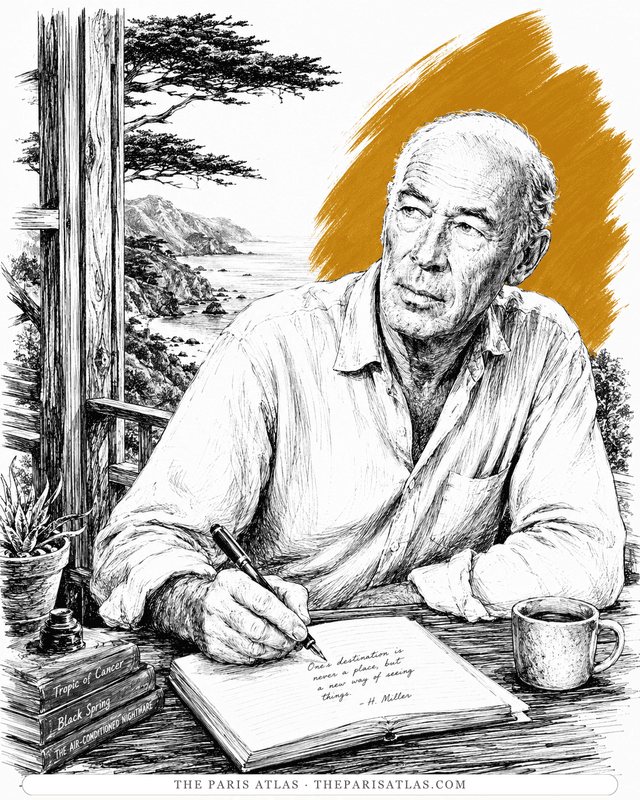
Henry Miller
The Brooklyn dropout who arrived in Paris broke at thirty-eight and wrote the exuberant, banned books that ended American censorship.
View author
Louis-Ferdinand Céline
The doctor of the Paris slums who wrote the century's blackest, funniest novel — and changed the sound of French prose.
View author