
Mrs. Gilbert
Gloria Gilbert's mother: a talkative, worn-down woman from Kansas City who believes in a religion called Bilphism and cannot do a thing with her daughter.
For Gloria to marry someone and stop. She says it to her nephew in a stage whisper: 'between you and me, I'd like to see her settle down.'
The book

At a glance
- Book One and the opening of Book Two: from the visit where Anthony Patch first calls at the Gilberts' hotel apartment to the first winter of the marriage
- Mrs. Gilbert throughout; her nephew Richard Caramel calls her Aunt Catherine
- Wife of Russel Gilbert, a film-supplies manager; mother of Gloria; aunt of the novelist Richard Caramel, which makes Gloria and Richard cousins
- Kansas City, and a rented apartment on the tenth floor of a New York hotel
- Bilphism, plus a palmist named Jenny Martin whom everyone is mad about
Who they are in the book
Spoiler-freeMrs. Gilbert is Gloria Gilbert's mother, a fictional middle-aged woman from Kansas City living with her husband in a New York hotel apartment. She answers the door in the novel's fourth chapter, when Anthony Patch is brought round to meet the famous daughter, and she is the reason the reader learns who Gloria has been before Gloria says a word.
F. Scott Fitzgerald plays her for comedy and does not disguise it. She talks in a set of interchangeable phrases, she believes what palmists tell her, and she has been beaten flat by thirty years of a husband who answers everything with 'yes-yes-yes-yes'. The novel's judgment on that marriage is the coldest sentence in the chapter: 'She told herself that the years had brought her tolerance — actually they had slain what measure she had ever possessed of moral courage.'
She is also the one person in these chapters who is frightened for Gloria. The long afternoon in which she tells her nephew the whole story of her daughter's life is how the reader learns that story at all.
How Mrs. Gilbert Is Portrayed
- Three phrases she uses for everything'As much as anything else', 'at least that's the way I look at it', and 'pure and simple'. Fitzgerald says she uses them 'to balance all her more rickety sentences', and that alternating them gave each remark 'an air of being a general reflection on life, as though she had calculated all causes and, at length, put her finger on the ultimate one.'
- Drawn in circlesShe is 'composed of a succession of semicircles and parabolas, like those figures that gifted folk make on the typewriter: head, arms, bust, hips, thighs, and ankles were in a bewildering tier of roundnesses.' Well ordered and clean, with hair of an artificially rich gray, weather-beaten blue eyes, and the faintest white mustache.
- BilphismShe belongs to an invented faith of Fitzgerald's called Bilphism, whose central idea is that souls are reincarnated and can be young or old. Her nephew is 'an ancient soul'; Gloria is 'a very young soul — irresponsible, as much as anything else.' Challenged on it, she produces her one unanswerable line: 'Bilphism isn't a religion. It's the science of all religions.' She also reports that Shakespeare was a Bilphist, and that it has been proved.
- Thirty years of yesHer husband won their marriage with sheer attrition — 'a war of muddled optimism against organized dulness' — and 'fifteen years of yes's had beaten Mrs. Gilbert'. Fifteen more, plus the ash from thirty-two thousand cigars, finished the job. She now praises him for having walked to a news-stand in cold weather: 'Well, you are spunky!'
- The afternoon she tells everythingSitting with her nephew Richard Caramel, the novelist, she goes through her daughter's whole history: boys from the age of twelve, roughly a dozen affairs in three years, two private engagements she discovered by walking into a room, young men pacing the library, young men threatening to leave for South America, one who still telephones weekly and sends flowers Gloria no longer bothers to refuse.
- What actually worries herThe men are not the part she cannot explain. It is that her daughter has stopped enjoying any of it: Gloria no longer storms at men, she yawns at them, and goes out listlessly with the ones she cares least about. 'She seemed — and it was so strange — she seemed to her mother to be growing cold.'
- Furnishing a house that does not existDuring the wedding presents she sorts the gifts into rooms of an imaginary home, labelling things 'second-best clock' and 'silver to use every day', and embarrasses the couple with references to a room she calls the nursery. She tells the bridegroom's grandfather that he is a very ancient soul, which he takes badly; he refers to her ever after as 'that old woman, the mother'.
She dies in mid-December of the first winter of Gloria's marriage, in a single sentence of Fitzgerald's driest comedy: the Bilphistic demiurge decides that her soul has aged sufficiently in its present incarnation. Anthony takes a hysterical Gloria out to Kansas City for the funeral. Her husband, who had spent thirty years wearing her down, becomes 'for the first and last time in his life, a truly pathetic figure', because he will never again be able so satisfactorily to bore and bully a human soul.
Her one lasting effect surfaces a year later. Russel Gilbert dies too, and on the train home from that second funeral Gloria spends the whole journey grieving for her mother rather than her father, then tells Anthony that she is a Bilphist herself. Anthony is astonished; she defends it flatly, and the novel leaves it there.
If you like The Beautiful and Damned


If you like F. Scott Fitzgerald
Explore authors with a similar voice, perspective, and influence.

Ernest Hemingway
Fitzgerald vouched for him to Scribner's before they had met, then edited him better than he edited himself; the friendship's five rounds are chronicled in our journal.
View author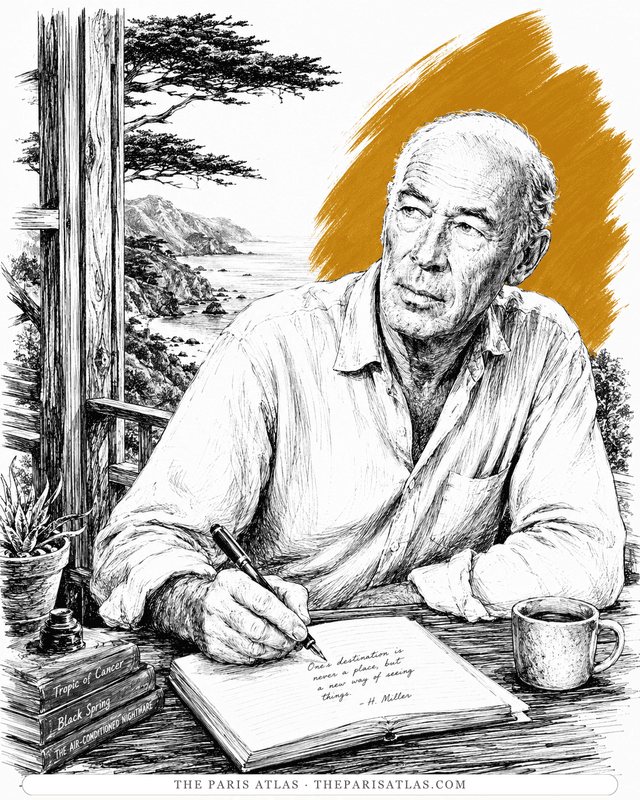
Henry Miller
The Brooklyn dropout who arrived in Paris broke at thirty-eight and wrote the exuberant, banned books that ended American censorship.
View author
Louis-Ferdinand Céline
The doctor of the Paris slums who wrote the century's blackest, funniest novel — and changed the sound of French prose.
View author