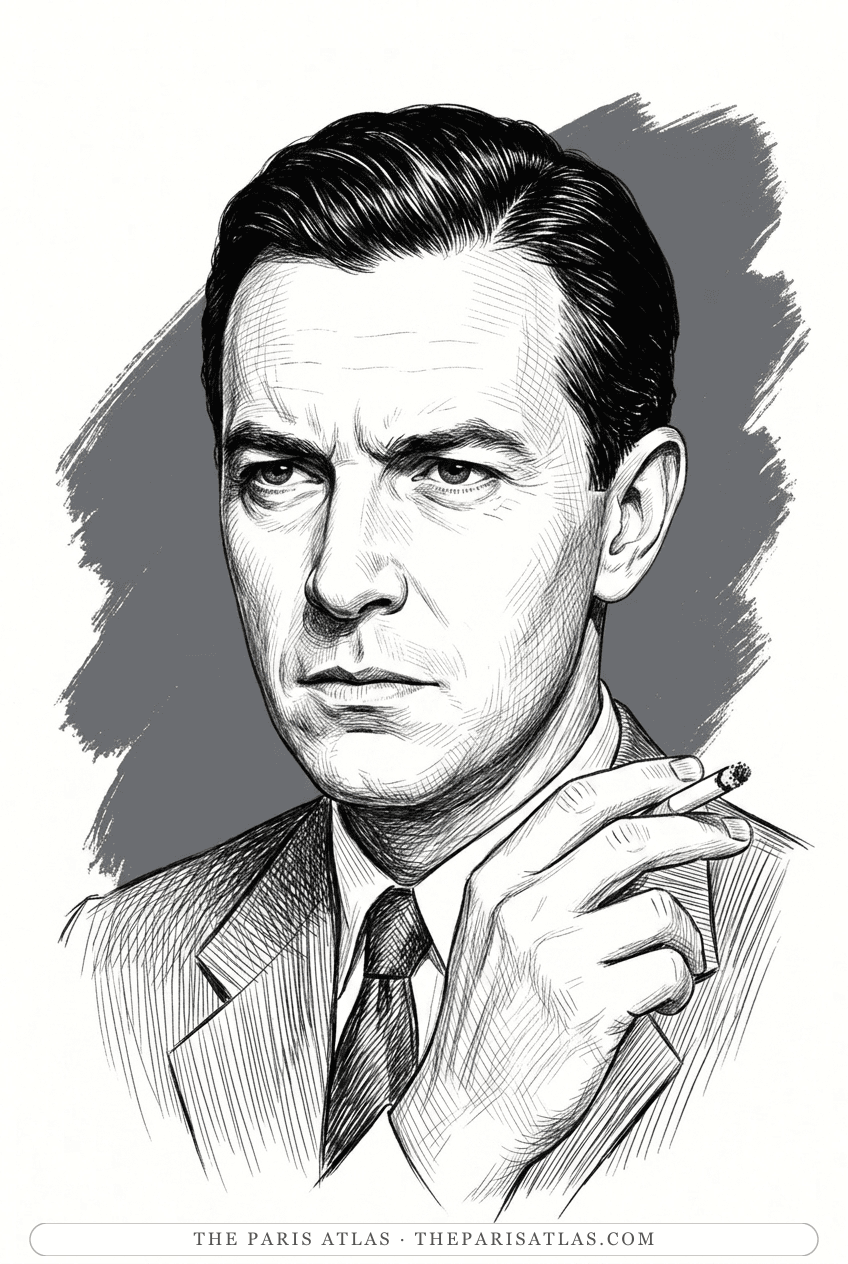
George Boxley
An English novelist imported to write for the screen, contemptuous of the job and, for three weeks, completely unable to do it.
To get a piece of his own writing onto the screen with the writing still in it. His complaint on the first day is: "I can't get what I write on paper."
The book

At a glance
- Two long scenes with Monroe Stahr, in Chapter III and Chapter V, plus a mention in Chapter V
- English novelist, imported to write for pictures
- Three weeks, and by his own account he has accomplished nothing
- Two staff writers he calls hacks
- A chemist's. Stahr gives him the word and carries on with the argument
- Lord Charnwood's life of Abraham Lincoln, which is why he starts thinking of Stahr as a man fighting a long war on several fronts
- Put Yourself in My Place
Who they are in the book
Spoiler-freeGeorge Boxley is an English novelist who has been brought to Hollywood to write pictures. He is bad at it, he knows it, and he blames the medium. He gets two long scenes in the novel, both of them arguments with Monroe Stahr, the studio's head of production, and both of them scenes Stahr wins.
He has been at the studio three weeks when the book first shows him. He has been teamed with two staff writers whose dialogue he despises, he has written a letter of complaint, and he turns up at Stahr's office door. The secretary announces him: "And Mr. George Boxley—looking very angry in a British way."
Fitzgerald uses him to put the literary case against the movies in its strongest form and then answer it. Boxley's objections are the ordinary ones, that the pictures are cheap, that the dialogue is unnatural, that the whole thing is mass production. Stahr does not argue him out of any of it. He tells him a small story about a stenographer, a stove, a pair of black gloves and one match, and Boxley wants to know what happens next, which settles the question.
How George Boxley Is Portrayed
- He arrives as though under arrestFitzgerald describes him entering Stahr's office as if two invisible attendants had hold of his arms and pushed him down into the chair. When he lights a cigarette it looks as if the match is being held for him by forces he is too proud to control.
- What he thinks of the men he works withHe tells Stahr that the whole arrangement is a sort of conspiracy. The two writers assigned with him listen to what he says and then spoil it, and between them, he says, they have a vocabulary of about a hundred words.
- He does not watch the pictures he is paid to writeAsked whether he ever goes to the movies, he says: "No—almost never." Asked whether that is because people in them are always fighting duels and falling down wells, he agrees, and adds the rest of the charge: "Yes—and wearing strained facial expressions and talking incredible and unnatural dialogue." Earlier in the same conversation he has told the head of the studio: "I don't think you people read things."
- The nickelStahr acts out a scene for him: a stenographer comes into an office, empties her purse, leaves a nickel on the desk, puts a pair of black gloves in the stove and strikes her only match, and a second man is watching her. Boxley asks what happens next. Stahr says he does not know, that he was only making pictures, and Boxley falls back on "It's just melodrama." Then he asks the question that gives him away: "What was the nickel for?"
- He corrects Stahr's English mid-argumentStahr starts a second demonstration with a man in a drug-store having a prescription filled. Boxley interrupts: "You mean a chemist's?" Stahr concedes the word, says the prescription is for a relative who is very sick, is corrected again, concedes that too, and keeps going.
- He offers to resignThree weeks in, he tells Stahr he is no good to him and has accomplished nothing, and that he makes suggestions which nobody writes down. Stahr's answer is that he wants him to stay, because something in him does not like pictures and has to be argued out of it.
- He fixes a script by accidentTaken down to another producer's office, where a stalled story conference has begun pitching coins at a light fixture, Boxley sits apart and reads the script. Then he says: "You have the stuffings of a turkey here." He tells them it has beautiful speeches and no situations, that it is too long, that it leaves him cold. Then he gives them an idea, which is that each character should be made to see himself in another character's place, so that the policeman about to arrest the thief finds the thief has his own face. The room takes it up at once, and Stahr touches his shoulder on the way out.
If you like The Love of the Last Tycoon


If you like F. Scott Fitzgerald
Explore authors with a similar voice, perspective, and influence.
Ernest Hemingway
Fitzgerald vouched for him to Scribner's before they had met, then edited him better than he edited himself; the friendship's five rounds are chronicled in our journal.
View author
Henry Miller
The Brooklyn dropout who arrived in Paris broke at thirty-eight and wrote the exuberant, banned books that ended American censorship.
View author
Louis-Ferdinand Céline
The doctor of the Paris slums who wrote the century's blackest, funniest novel — and changed the sound of French prose.
View author