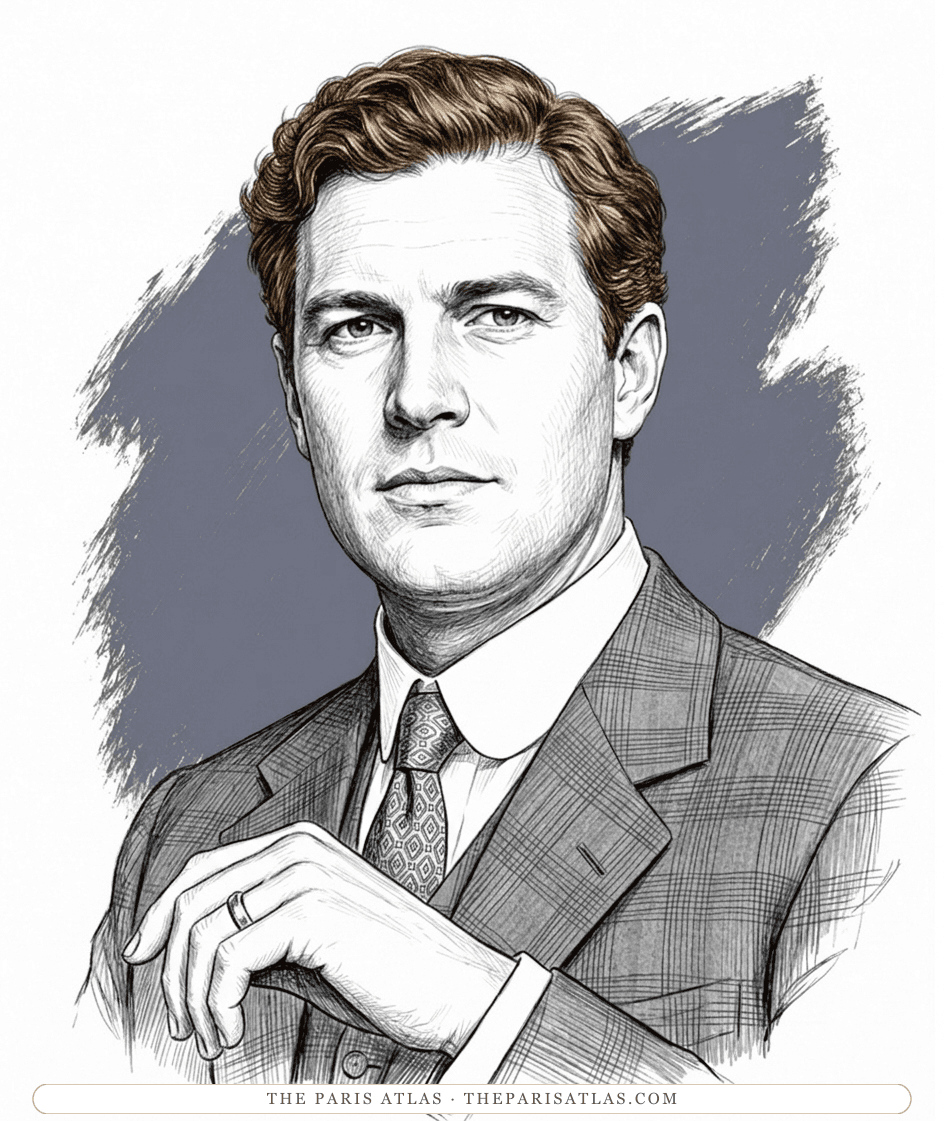
Prince Agge
A Danish prince spending a day at the studio to see how films are made, and the outsider through whose eyes the novel watches the men who run it.
To watch how films are actually made, and, once he has met him, to watch the man making them. Offered the run of as many sets as he likes, he says: "I should rather stay with you."
The book

At a glance
- Chapter III: the executives' lunch, the canteen, and the afternoon on the sets. He appears nowhere else
- A Danish prince, at the studio as a visitor to learn how pictures are made
- The French Foreign Legion
- His descent from Bernadotte
- Cecelia Brady names him as her authority for the lunch, which she did not attend
Who they are in the book
Spoiler-freePrince Agge is a Danish aristocrat who has come to the studio to learn how pictures are made, and he is in the novel for one chapter. Fitzgerald uses him the way a reporter uses a guest pass. He sits through the executives' lunch, walks the sets in the afternoon, and notices the things a man who works there would stop noticing. The narrator, Cecelia Brady, was not at that lunch and says so, naming Prince Agge as her source for it.
He has served in the French Foreign Legion. When he needs solid ground under him he falls back on his descent from Bernadotte, the French marshal who ended up founding the Swedish royal house. He is polite about America and privately unimpressed by businessmen in general, and he decides that Monroe Stahr, the studio's head of production, is much of a man in every way.
The chapter's best-remembered moment belongs to him rather than to Stahr. Crossing the studio canteen he sees an extra in costume as Abraham Lincoln, sitting with his legs crossed over a forty-cent dinner with a shawl round his shoulders against the air-conditioning.
How Prince Agge Is Portrayed
- A guest at the money men's table"Eleven men and their guest, Prince Agge, sat at lunch in the private dining room of the studio commissary." Fitzgerald notes that these are the owners, that eight of the ten are Jewish and five foreign-born, and that when there is no guest they eat in near silence.
- He cannot read the roomStahr tells the table he intends to make a picture that will lose money, and nobody says anything at all. Agge is the one who registers the quiet: "The room had grown so motionless that Prince Agge could hear a grey chunk of ash fall from a cigar in midair." He tries to gauge the general effect on his way out and can tell nothing. Every man at the table is blinking and none of them speaks.
- The prejudice he arrives withFitzgerald puts it in one sentence and does not soften it: "He was hostile to Jews in a vague general way that he tried to cure himself of." It dates from his Foreign Legion service. He allows that things may work differently in America, and the men at the lunch table interest him more than he expected.
- Abraham Lincoln with a slice of pie"Then he saw Abraham Lincoln, and his whole feeling suddenly changed." Agge had been raised on a famous biography of Lincoln and had resented being told to admire him. Now he stops dead and stares at an extra in costume as though at an embalmed head of state. "This, then, he thought, was what they all meant to be." Then: "Lincoln suddenly raised a triangle of pie and jammed it in his mouth, and, a little frightened, Prince Agge hurried to join Stahr."
- He gets the studio explained to himStahr tells him that good writers stop being good writers when they arrive, so the studio puts them on a story in pairs and sets a second pair working behind them without telling either. Agge asks whether the writers like it. Stahr says: "Not if they know about it." Agge then asks what holds a picture together at all, and Stahr answers: "I'm the unity."
Nothing further of Prince Agge was written. The 1941 text carries an editor's bracket at the point where his visit begins, saying that Stahr was to have received him, that he wanted to learn about pictures from the beginning, and that Fitzgerald's own list of characters describes him as an early Fascist. Nothing in the drafted chapters shows him holding any political position at all, and the note is the editor's, not the novel's.
The notes also print a discarded scene in which Stahr introduces Agge to Mike Van Dyke, the studio's oldest gag man, who talks nonsense at him until the prince is stammering. Fitzgerald marked the scene as unsatisfactory and meant to use the joke somewhere else.
If you like The Love of the Last Tycoon


If you like F. Scott Fitzgerald
Explore authors with a similar voice, perspective, and influence.
Ernest Hemingway
Fitzgerald vouched for him to Scribner's before they had met, then edited him better than he edited himself; the friendship's five rounds are chronicled in our journal.
View author
Henry Miller
The Brooklyn dropout who arrived in Paris broke at thirty-eight and wrote the exuberant, banned books that ended American censorship.
View author
Louis-Ferdinand Céline
The doctor of the Paris slums who wrote the century's blackest, funniest novel — and changed the sound of French prose.
View author