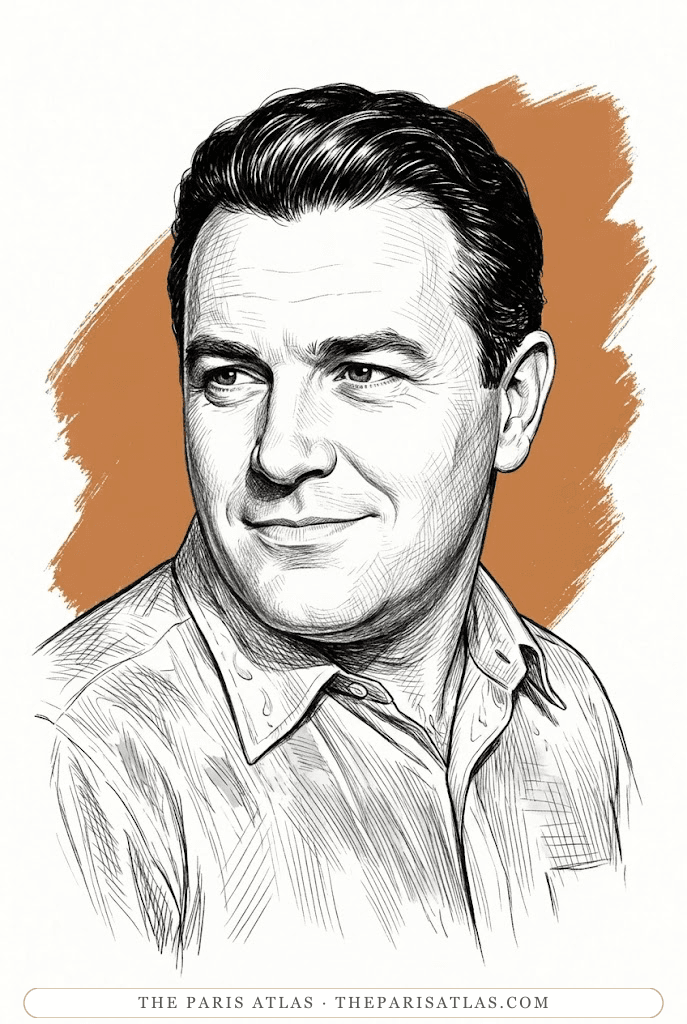
Pat Brady
Cecelia's father and the studio's other owner: shrewd with money, useless at making a picture, and increasingly at war with the partner who can.
To keep hold of what he has. His daughter's summary is that getting his share of the studio was his life's work and that everything since has been an instinct to hang on.
The book

At a glance
- Present from the second chapter on, mostly in his office and at the studio's private lunch table
- Forty-seven, though he tells a room full of people he is forty-three
- Part-owner of the studio: business, publicity and personnel, while his partner makes the pictures
- A bar boy in Ballyhegan
- His daughter Cecelia, who narrates the book, and another daughter, Eleanor, who died while Cecelia was at college; his wife appears as a chalk drawing on his office wall
- Two men in the studio's shorts department, at thirty dollars a week, are cousins of his
- Pat Brady in the drafted chapters, and twice Bill or Billy Brady; Fitzgerald had not fixed the name
Who they are in the book
Spoiler-freePat Brady owns a quarter of the Hollywood studio the novel is set in, and he is the father of the woman telling the story. 'He had acquired with luck and shrewdness a quarter interest in a booming circus — together with young Stahr.' His daughter is blunt about what he has done since: 'That was his life's effort — all the rest was an instinct to hang on.'
He runs the business — money, publicity, contracts and every personal mess that turns up at the studio — while Monroe Stahr makes the pictures. He does not know the first thing about how a film is cut or dubbed, and talks to Wall Street about how mysterious the whole process is. He came up as a bar boy in Ballyhegan, and at the owners' lunch table, where most of the men are Jewish, he is the Irishman.
The name is one of the places where the unfinished manuscript shows. The drafted chapters call him Pat Brady, and twice call him Bill or Billy Brady.
How Pat Brady Is Portrayed
- How he got his quarter of a studioHe and the twenty-two-year-old Monroe Stahr acquired it together, with luck and shrewdness, in the years when the business was booming. His daughter's verdict is that a strong will did not add up to a passable man in him, and that nearly everything he achieved came down to being shrewd.
- His officeThe first of the enormous executive drawing rooms in Hollywood, his daughter says, and the first with one-way glass in the French windows. 'There was a big painting of Will Rogers, hung conspicuously and intended, I think, to suggest Father's essential kinship with Hollywood's St. Francis.' Three secretaries sit outside it, one with a lock under her desk that admits visitors. A story about a trapdoor in the floor for unwanted callers she believes somebody invented.
- What he looks like, and how old he says he is'Father can be very magnetic — he has a tough jaw and an Irish smile.' Once, running into him in New York before she recognised him, she saw a bulky middle-aged man who looked a little ashamed of himself and wished he would move on. Asked his age at his own birthday, he answers forty-three, distinctly. He is forty-seven, and the assistant producer who asked knows it and writes it down in the account book he carries about open in his hand.
- What he cannot do'Nor had he learned much about the feel of America as a bar boy in Ballyhegan, nor did he have any more than a drummer's sense of a story.' A drummer is a travelling salesman. Against that, his daughter notes that he is at the studio before noon and that it is hard to put anything over on him.
- He goes after Stahr's budget at lunchIn the owners' private dining room he raises the South American picture and says the budget is out of proportion to what the country will pay. 'There's not a two million dollar gross in the country now.' Stahr agrees with the figures and then tells the table he means to lose money on it, and the room has nothing to say.
- The department he does runPublic relations and personnel are Brady's, and the studio's private troubles reach him first. A leading man who cannot face his wife goes to him before he goes to Stahr: 'He gave me a lot of phoney advice and I tried it all, but nothing doing.' Two men in the studio's shorts department, on thirty dollars a week, turn out to be cousins of his.
- What he says about his partner in privateOn a hot afternoon his daughter finds him with the windows shut and his shirt soaked through, and asks what is wrong. 'Oh, it's Monroe,' he said. 'That goddam little Vine Street Jesus! He's in my hair night and day!'
- The closetThat is the same afternoon. While he is in the bathroom changing his shirt, a long low moan comes from a closet in the office wall, and his secretary falls out of it with no clothes on, clutching them in one hand. He comes back into the room and stands behind his daughter without saying anything. She had come in to ask him to find work for an actress the studio had discarded.
- The sentimental fatherHe sings Little Girl, You've Had a Busy Day around the house to produce a father-and-daughter feeling, which she can hear coming. He has also made himself practically an alumnus of her college. 'You've had everything,' he used to say happily.
None of this is in the novel. Edmund Wilson put it together in 1941 from Fitzgerald's outline and notes. While Stahr is east, Brady calls the writers together and tells them, in tears, that if they accept a pay cut the executives will take one too and the stenographers will be spared. The writers agree. He cuts the stenographers anyway, and Stahr comes back to a fifty percent reduction and a violent falling-out.
From there the two partners set about each other. Brady finds out about Kathleen and tries to blackmail Stahr with her; Stahr has known for years, through his dead wife's nurse, that Brady had a hand in the death of the husband of a woman Brady was in love with. Neither has evidence that would stand up. Brady then goes to Kathleen's husband, a studio technician, and plays on his jealousy. Stahr, expecting to be murdered, arranges Brady's murder first, repents on the plane east, and dies in the crash before he can call it off. In Fitzgerald's plan the murder of Brady goes through.
In the letter Fitzgerald sent his publisher in 1939 the character is called Bradogue, and is described there as a self-made gentile among the studio's Jewish owners, a shrewd man, and a scoundrel.
If you like The Love of the Last Tycoon


If you like F. Scott Fitzgerald
Explore authors with a similar voice, perspective, and influence.

Ernest Hemingway
Fitzgerald vouched for him to Scribner's before they had met, then edited him better than he edited himself; the friendship's five rounds are chronicled in our journal.
View author
Henry Miller
The Brooklyn dropout who arrived in Paris broke at thirty-eight and wrote the exuberant, banned books that ended American censorship.
View author
Louis-Ferdinand Céline
The doctor of the Paris slums who wrote the century's blackest, funniest novel — and changed the sound of French prose.
View author