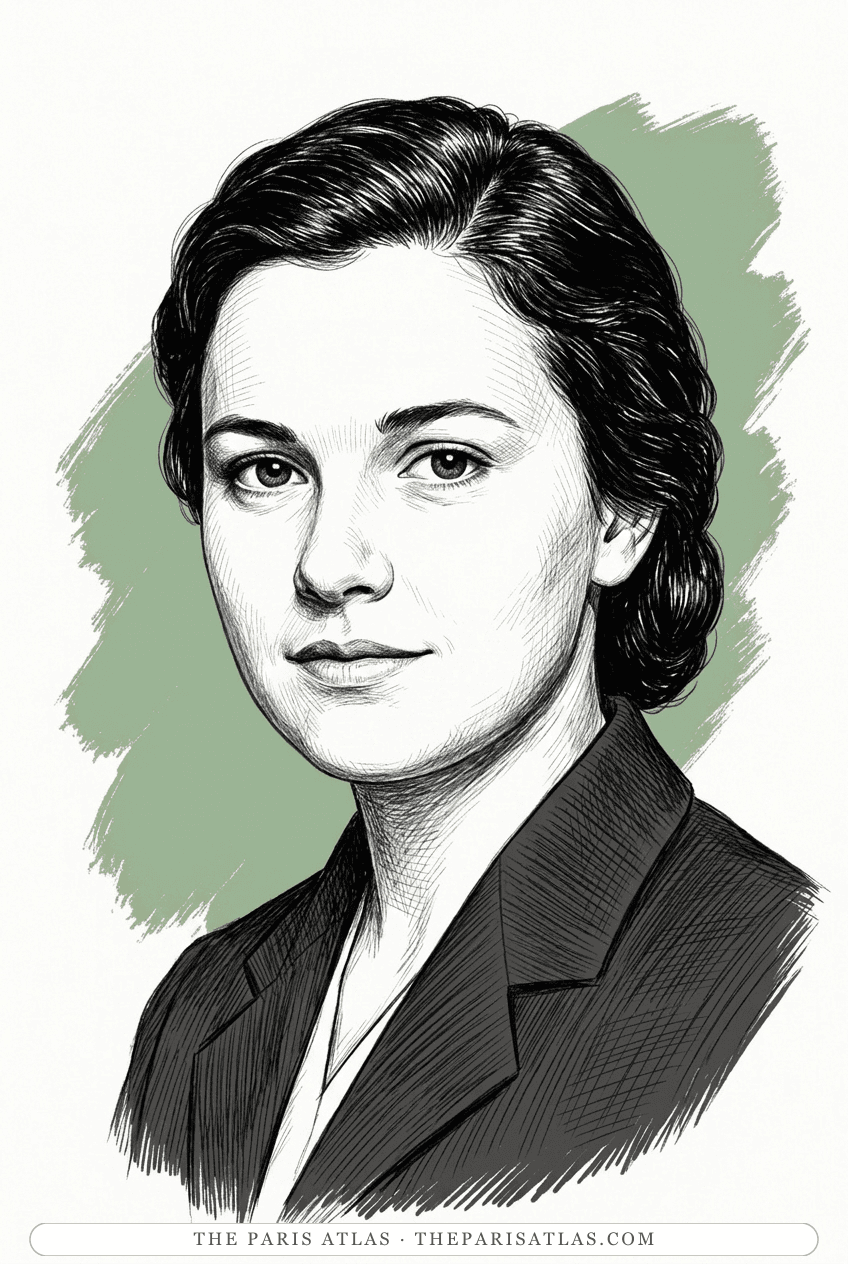
Cecelia Brady
The narrator: a Hollywood producer's daughter, home from college for the summer, in love with her father's business partner and honest about how that went.
To marry Monroe Stahr. She says so plainly on the flight home in the first chapter, and calls herself conceited for it in the same breath.
The book

At a glance
- The narrator of all six drafted chapters, and a character in most of them
- Nineteen during the events; she is telling the story five years later
- Daughter of Pat Brady, part-owner of the studio; her sister, Eleanor, died while Cecelia was at college
- A junior at Bennington College in Vermont; before that two years in Florence and a courtesy debut in Boston
- The flight from New York, her father's office, the studio, the screen writers' ball at the Ambassador, and her family's house
- A boy she was in love with was killed in a car accident while she was at college
- Cecelia on this page. The 1941 edition that Edmund Wilson assembled prints it Cecilia.
Who they are in the book
Spoiler-freeCecelia Brady tells the novel. She is nineteen, a junior at Bennington College in Vermont, and the daughter of Pat Brady, who owns a quarter of a Hollywood studio together with Monroe Stahr. She was raised inside the business and refuses to be impressed or appalled by it. 'Rudolph Valentino came to my fifth birthday party — or so I was told,' she says on the first page, and a few lines later: 'At the worst I accepted Hollywood with the resignation of a ghost assigned to a haunted house.'
She is unusually honest about how she knows what she is telling. She was there for the flight home, the earthquake, the ball at the Ambassador, the afternoon in her father's office and the evening with the Communist organizer. For the long chapter that follows Stahr through a working day she says outright that she is filling in: 'It is drawn partly from a paper I wrote in college on A Producer's Day and partly from my imagination. More often I have blocked in the ordinary events myself, while the stranger ones are true.' The rest she got from other people, and she names them as she goes — a studio technician called Robby, the screenwriter Wylie White, a Danish prince visiting the lot.
She has been in love with Stahr since she was a child, and the book treats that as neither a joke nor a tragedy. She plans her declaration, delivers it, and is refused inside a minute. She is also the one who finds out what her father is, and she is more damaged by that than by Stahr.
How Cecelia Brady Is Portrayed
- Raised in picturesHer father was in the film business the way another man is in cotton or steel, and she grew up taking it for granted. 'Rudolph Valentino came to my fifth birthday party — or so I was told.' At eighteen she meant to write a memoir called The Producer's Daughter, and never got round to it.
- Not shocked by HollywoodShe knows exactly what her English teachers back east expect her to think about the place, and will not oblige them. 'I knew what you were supposed to think about it but I was obstinately unhorrified.'
- Why she tells Stahr's story rather than her own'Not half a dozen men have ever been able to keep the whole equation of pictures in their heads. And perhaps the closest a woman can come to the set-up is to try and understand one of those men.'
- Home from BenningtonShe flies coast to coast for term and holidays; her father pushed her into the college and she is grateful for it. Grounded overnight in Nashville with two men from the studio, she drives out to Andrew Jackson's house at dawn, cannot get in, and sits on the steps letting a screenwriter she met an hour ago put his arm around her.
- She rehearses the scene in the carOn the drive to the studio she talks the screenwriter Wylie White through exactly how Stahr will look up and see her for the first time that morning. 'I bloom, I told you. How often do I have to tell you I bloom.' Then it happens, and she stands there for what feels like an hour while Stahr twitches the side of his mouth and puts his hands in his pockets. 'How different it all was from what you'd planned.'
- Undertake meStahr tells her he would marry her and that he is lonesome as hell, then takes it back: 'But I'm too old and tired to undertake anything.' She walks around the desk and says, 'Undertake me.' He looks up, understands that she means it, and says no.
- What she finds in her father's officeShe goes in to ask him to find work for a forgotten actress and finds him with the windows shut, sweating through his shirt. While he is washing, a long low moan comes from a closet in the wall. His secretary, Birdy Peters, falls out of it with no clothes on. 'Cover her up,' Cecelia says, and covers her with a rug herself. She never sees either woman again.
- She hunts down her rivalNobody at the ball knows the name of the woman Stahr danced with, so Cecelia works through a screenwriter she has known since childhood and then through a faded actress she takes to lunch, is ashamed of using her, and tries to make up for it by asking her father for work for her. 'What people are ashamed of usually makes a good story.'
- She arranges the CommunistStahr rings her at home: 'I want you to arrange something, Cecilia — I want to meet a Communist Party member.' She produces one, gives them the most decorated room in the house, moves them out to the garden when they start needling each other, and ends the night kneeling over Stahr on the grass. 'I loved him, and what he said didn't change that, but I hated Brimmer to carry off this impression.'
Nothing past the two weeks she and Stahr spend going around together was written. The rest comes from Fitzgerald's outline and notes, summarised by Edmund Wilson in 1941. In that plan she lets slip to her father, in the middle of a conversation about the attention Stahr has been paying her, that Stahr is in love with someone else. It is the piece Pat Brady needs, and he uses it. Stahr, disgusted with the whole family, drops her. She has an affair with a man she does not love, probably the screenwriter Wylie White.
Her father is murdered and Stahr is killed in a plane crash, and Cecelia breaks down completely. Fitzgerald wrote an opening he then discarded, meaning to move it to the end of the book: Cecelia at twenty-five, in a tuberculosis sanatorium in Arizona, telling the whole story to two other patients on the terrace. 'I don't owe them any loyalty,' she says there.
If you like The Love of the Last Tycoon


If you like F. Scott Fitzgerald
Explore authors with a similar voice, perspective, and influence.
Ernest Hemingway
Fitzgerald vouched for him to Scribner's before they had met, then edited him better than he edited himself; the friendship's five rounds are chronicled in our journal.
View author
Henry Miller
The Brooklyn dropout who arrived in Paris broke at thirty-eight and wrote the exuberant, banned books that ended American censorship.
View author
Louis-Ferdinand Céline
The doctor of the Paris slums who wrote the century's blackest, funniest novel — and changed the sound of French prose.
View author