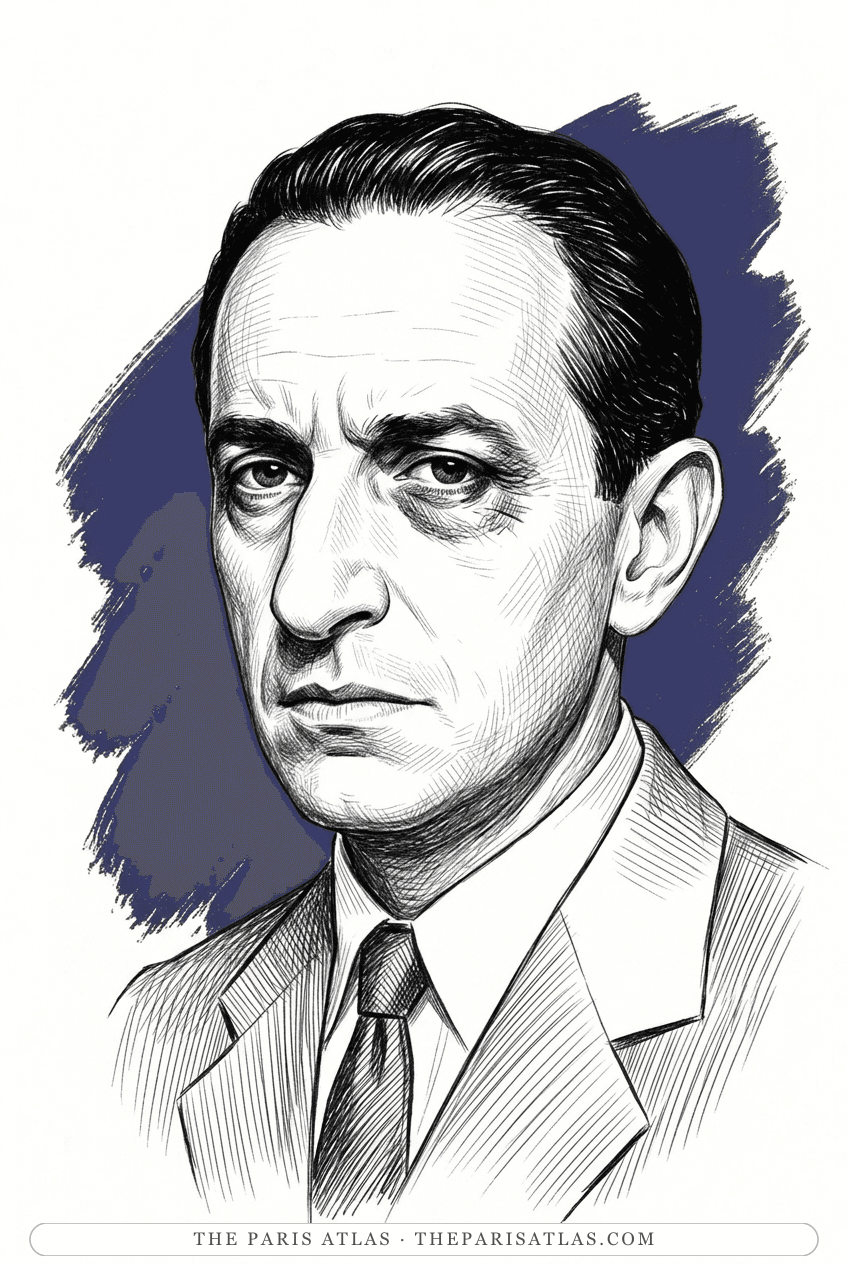
Manny Schwartz
Once the head of a film company, now broke and out of the business, travelling west on the same plane as the man who will not see him.
The book

At a glance
- Chapter I only: the grounded plane, the Nashville airport, and Andrew Jackson's house outside the town
- Head of a film combine. Wylie White cannot recall which and guesses at First National, Paramount and United Artists
- Out of the business and out of money. White's opinion is that he will be back
- A daughter, spoken of in the past tense
- Manny Schwartz. He is introduced to Cecelia Brady as Mr. Schwartz, and Wylie White calls him Manny
Who they are in the book
Spoiler-freeManny Schwartz is a ruined film executive, and he is in the first chapter of the novel and no other. The narrator, Cecelia Brady, meets him on a night flight from the East to California. He is middle-aged, sitting across the aisle, and he swings between talking with nervous excitement and going completely silent. Her verdict on him is delivered before he has said anything of substance: "Meeting him was like encountering a friend who has been in a fist fight or collision, and got flattened."
What flattened him is that he lost his company. The screenwriter Wylie White, who is travelling with him, says plainly that he was the head of some combine once and cannot remember which, then guesses at three of them. Schwartz has no job and no money, and he is chasing the one man who might restore him. That man, Monroe Stahr, is on the same plane under the name Mr. Smith, and has already told him no.
He also has a settled view of writers, which he delivers to White's face on the steps of Andrew Jackson's house. He says there is a writer for you, a man who "Knows everything and at the same time he knows nothing." Then: "I have no words for them. I only know it's true."
How Manny Schwartz Is Portrayed
- The man across the aisleCecelia Brady picks him out before she is introduced to him: a middle-aged passenger who alternates nervous talk with long silences and sits crouched as though he is about to spring. Nothing is physically wrong with him. Fitzgerald says his face has simply fallen out of alignment.
- He recognises the man in the private compartmentAnother passenger goes by toward the cockpit, and Schwartz gets to his feet to stare after him. The stewardess says the man has the bridal suite to himself and gives his name as Mr. Smith. Schwartz cannot leave the alias alone, and asks the others twice whether they heard what he is calling himself. Cecelia Brady records that she never heard a laugh with less mirth in it.
- He is turned down at the airportDuring the stopover at Nashville, Schwartz gets to Stahr and asks him for something. Cecelia Brady steps away and misses it; when she returns he looks as though a truck has backed over him, and Wylie White is telling him it serves him right. Stahr, asked later, cannot remember the words. White repeats them for him: whatever Schwartz was after, the answer was no. What he was after is never revealed.
- The metal handleHe turns up at Andrew Jackson's house before dawn with a mark by his eye and one line of explanation: "I fell upon a large metal handle." Nobody asks him anything else about it.
- The daughterIn the taxi he pats Cecelia Brady's knee and offers, cheerfully, to act as chaperone. Then: "Once upon a time when I was in the big money, I had a daughter—a beautiful daughter." The narration notes the tense he uses: "He spoke as if she had been sold to creditors as a tangible asset."
- He gets out of the taxi and staysHe shuts the door on the other two before they realise he is not coming. "I'm not going to the Coast—I decided that when I woke up." He tells them he used to be a man of decision and that they would be surprised, arranges for the driver to return in two hours, and says he will be glad to entertain himself looking around. Then he hands Wylie White a note for Mr. Smith, written by the headlights of the taxi and almost illegible, warning Stahr to look out for something the note does not name.
Manny Schwartz shot himself at Andrew Jackson's house after the taxi drove away. Fitzgerald tells the reader in the same paragraph in which Cecelia Brady last sees him, then adds that the passengers did not learn of it for twenty hours. Edmund Wilson's synopsis of the unwritten chapters calls it a suicide outright and sets it against the death Fitzgerald had planned for Stahr at the end.
The book gives the circumstances rather than a reason. Schwartz had run a film company and lost it, had no work and no money, spoke of his daughter as something creditors had taken, and had spent the flight trying to reach the one man who could have put him back in the business. He was refused in an airport at half past two in the morning. He then declined to continue the journey, sent Stahr a note saying he must be no good, and stayed behind at a house he had gone out of his way to see and could not get into.
Wilson's synopsis adds what the note meant. Schwartz had been trying to warn Stahr against his own partner, Pat Brady, who had wanted Stahr out of the company for years.
If you like The Love of the Last Tycoon


If you like F. Scott Fitzgerald
Explore authors with a similar voice, perspective, and influence.
Ernest Hemingway
Fitzgerald vouched for him to Scribner's before they had met, then edited him better than he edited himself; the friendship's five rounds are chronicled in our journal.
View author
Henry Miller
The Brooklyn dropout who arrived in Paris broke at thirty-eight and wrote the exuberant, banned books that ended American censorship.
View author
Louis-Ferdinand Céline
The doctor of the Paris slums who wrote the century's blackest, funniest novel — and changed the sound of French prose.
View author