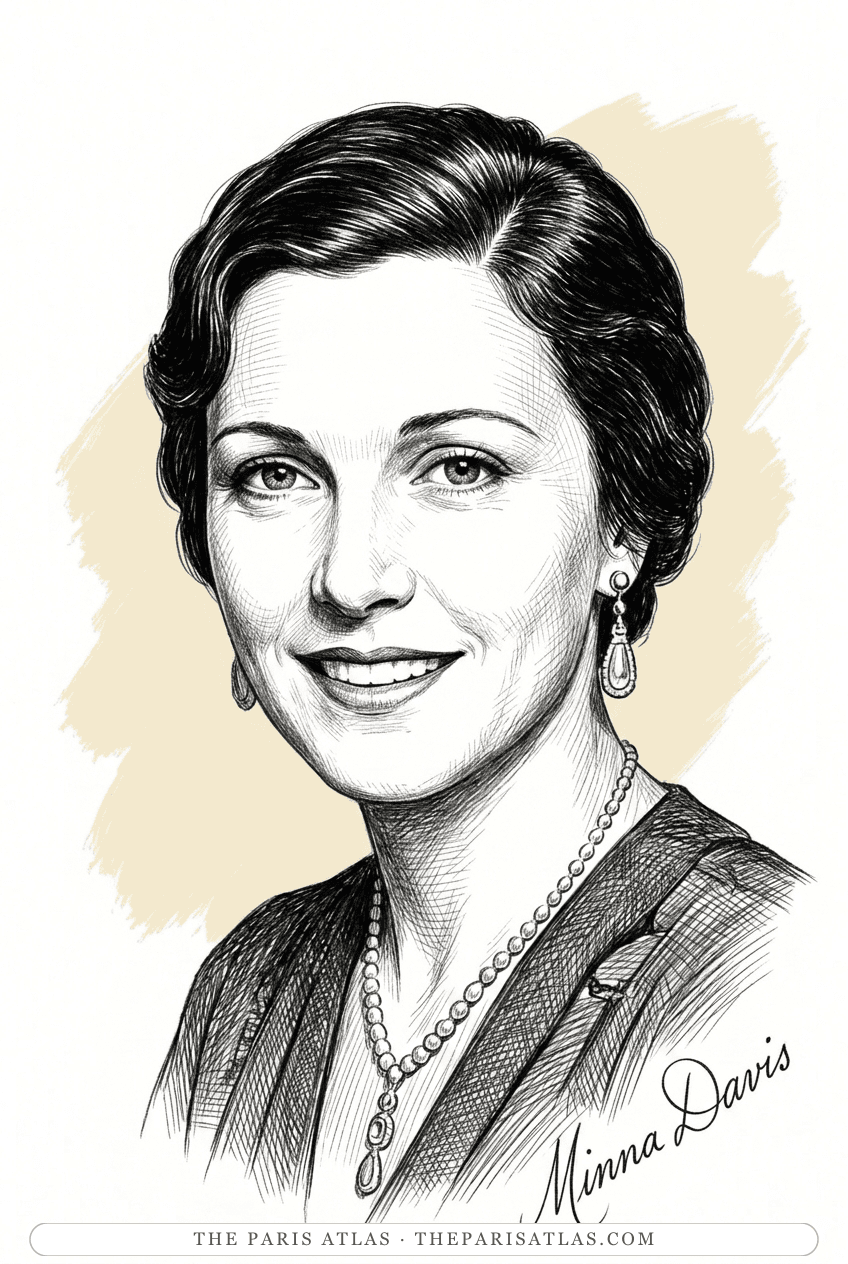
Minna Davis
A film star, married to Monroe Stahr and dead three years before the novel opens. She never appears, and the book builds her entirely out of other people's memory.
The book

At a glance
- Never on the page. She died three years before Chapter I and is spoken of throughout
- Film star. Fitzgerald says her jollity had fascinated a generation
- Monroe Stahr, the studio's head of production
- Ten years before the novel she and her mother lived in an apartment in the old Hollywood picture district, near the hotel where Stahr later meets Kathleen Moore
- Stahr; the screenwriter Jane Meloney, a great friend of hers; and Doctor Baer, who used to enlist her when Stahr needed to be made to rest
- Driving back from the coast one night, Stahr places Kathleen Moore against a lit restaurant window he remembers from Erie, Pennsylvania, and thinks: "Minna had never been Beautiful Doll."
Who they are in the book
Spoiler-freeMinna Davis was a film star, and she was married to Monroe Stahr, the man who runs the studio this novel is set in. She died three years before the story begins and she never appears in it. Everything the reader gets comes at second hand: a signed photograph on an office wall, a few sentences from people who knew her, and the thoughts of a widower who almost never says her name aloud.
She is also the reason the novel has a love story. On the night an earthquake floods the studio's back lot, Stahr sees two women floating past on a prop head of the goddess Siva, and one of them has his wife's face. That woman is Kathleen Moore, an Irishwoman recently arrived from London who has never been in pictures. The resemblance is not Stahr's invention. Several people have told Kathleen Moore about it, and she can point to the part of her own face where it sits.
The rest of the novel is Stahr working out how much of what he feels belongs to the living woman in front of him. Fitzgerald is exact about the direction of travel. Stahr's grief is not deepening, it is wearing out, and he half regrets losing it.
How Minna Davis Is Portrayed
- Three years gone, and already forgottenThe morning after the flood, Stahr has the policeman traced who put the two women off the back lot, hoping for a name. The man remembers nothing, not even which of them was the good-looking one. Fitzgerald states the conclusion flatly: "Even on the lot here Minna was forgotten."
- The photograph on the wallThe only physical trace of her in the book is in the office of Stahr's partner: "there was a signed photograph of Minna Davis, Stahr's dead wife, and photos of other studio celebrities and big chalk drawings of mother and me." She hangs among the other studio names, under a large painting of Will Rogers.
- The face, when it turns up againIn the flood, Stahr looks up and finds it four feet away: "Smiling faintly at him from not four feet away was the face of his dead wife, identical even to the expression." A day later, on a doorstep, he sees it whole: "It was Minna's face—the skin with its peculiar radiance as if phosphorus had touched it, the mouth with its warm line that never counted costs—and over all the haunting jollity that had fascinated a generation." He later tells Kathleen Moore that she resembles the way Minna Davis actually looked more than the way she looked on screen.
- Strangers know him only as her husbandStahr's name never went on a picture, so nobody outside the studio recognises it. He gives it over the telephone to a woman who has to think, then places him: "You were the husband of Minna Davis." At Kathleen Moore's door the same evening, the same introduction: "He was Minna Davis's husband, he's a producer."
- The marriage, as he remembers it"He had never lost his head about Minna, even in the beginning—it had been the most appropriate and regal match imaginable." The feeling arrived at the wrong end of it: "She had loved him always and just before she died, all unwilling and surprised, his tenderness had burst and surged forward and he had been in love with her."
- Mourning going staleWatching a young actor drive off with a girl, Stahr notices what he has lost: "Little by little he was losing the feel of such things, until it seemed that Minna had taken their poignancy with her; his apprehension of splendor was fading so that presently the luxury of eternal mourning would depart." Later, alone in his half-built house, the loss repeats itself on the way to bed: "Minna died again on the first landing, and he forgot her lingeringly and miserably again, step by step to the top."
Edmund Wilson's synopsis of the unwritten chapters, assembled from Fitzgerald's notes and outline, gives Minna Davis a last function in a plot she does not live to see. Stahr knows, by way of his wife's trained nurse, that his partner Pat Brady had a hand in the death of the husband of a woman Brady was in love with. That knowledge is the only weapon Stahr holds when the two men come to threatening each other, and neither of them has evidence that would stand up.
If you like The Love of the Last Tycoon


If you like F. Scott Fitzgerald
Explore authors with a similar voice, perspective, and influence.
Ernest Hemingway
Fitzgerald vouched for him to Scribner's before they had met, then edited him better than he edited himself; the friendship's five rounds are chronicled in our journal.
View author
Henry Miller
The Brooklyn dropout who arrived in Paris broke at thirty-eight and wrote the exuberant, banned books that ended American censorship.
View author
Louis-Ferdinand Céline
The doctor of the Paris slums who wrote the century's blackest, funniest novel — and changed the sound of French prose.
View author