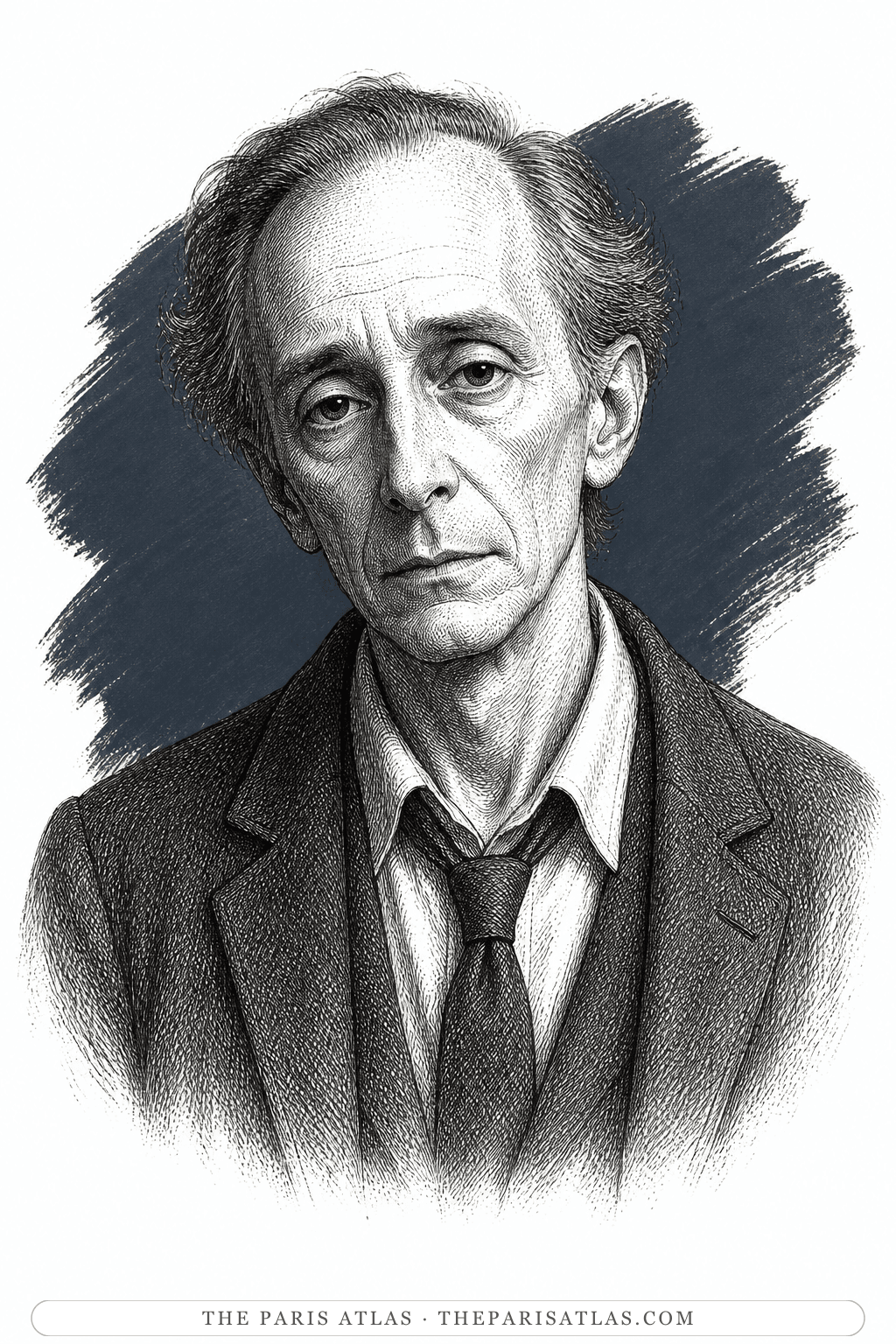
The Voice
A psychoanalyst who sees patients in a room high up in a New York hotel. He is called the Voice because that is all his patients get: he sits behind them with his face against the light. The third novella is about what listening has done to him.
To be loved as a man rather than as a father or a doctor — he says it is what he fears most, having only ever been loved the other way.
The book

At a glance
- The analyst in "The Voice", and the novella's title
- Never given. His patients call him the Voice
- Twenty-five years of listening to confessions
- A room high up in a New York hotel that the book calls the Hotel Chaotica
Who they are in the book
Spoiler-freeThe Voice gives his name to the last of the three novellas in Winter of Artifice, the 1939 book by the French-born American writer Anaïs Nin. He is an analyst. He works out of a room in an enormous hotel where the lifts run day and night and confessions seep through the walls of the corridors, and his patients lie on a couch while he sits behind them in an armchair with his back to the window.
Nin builds him first from below, as his patients see him: a substitute for the priest, the one who can always transmute the pain, a man they dream of as a god or a demon but always as somebody above them. Three of them get long sections — a violinist called Lillian, a crippled cellist called Mischa, and a woman called Lilith who works out how to turn the interview round.
The second half of the story is the demolition. Away from the chair he does not fit anything: his clothes hang on him, his hat is always the wrong size, his jokes are paradoxes rather than jokes. He has listened to other people for twenty-five years and nobody has ever asked him a question. He falls in love with a patient, and the novella declines to rescue him.
This profile is drawn from the Swallow Press edition of 1948, read in the Internet Archive's scan of the book.
How The Voice Is Portrayed
- The angle he watches fromLooking down at people on the divan he sees where the hair thins and parts, the brow like a landslide, the skin as it only shows obliquely. From there every nose slants without audacity and every mouth looks like a wound. He keeps the position deliberately, to keep the compassion raw.
- The hotelHis consulting room is one cell in a tower of them. Walking the corridor to reach him, a patient can hear singing, weeping, quarrels and confessions coming through the doors, and the lifts arrive full of people in a hurry to confess.
- "I want to reconcile you to yourself."What he tells a patient he is for. Nin describes the effect as being confronted with an original self, with the acquired disguises taken off one at a time.
- The one question he asks MischaA cellist comes to him limping and talks only about his stiff hand, session after session. He lets it run, then asks about the lameness. Afterwards he tells him he offered the world his hurt hand so that nobody would look at his leg.
- "That is happiness."Standing at the window while a woman has just killed herself outside it, he says the band is playing in the park and people are skating, and that he could have been walking in the snow. He knows what happiness is now that he is confined to the armchair; he did not recognise it when he had it.
- Changing chairsLilith challenges him to lie on the couch while she takes the armchair and asks the questions. He looks uneasy and bewildered, and his voice stops being firm the moment his back is no longer to the light.
- The frog under the doorRefused an evening, he slips a long letter under her door with a tiny toy frog tied to it, and writes that this is his transformation, so that he can get in through a closed door.
- "Nobody ever asked me anything about myself."He breaks off in the middle of a story about his childhood and weeps. He has taken confessions for twenty-five years, he says, and nobody has ever turned round and let him talk, or tried to guess what he needed.
- Clothes that do not fitNin spends a page on it. Nothing men wear seems to be made for him — the hat stands stiffly away from his head, the coat hangs as though on a cross of wood, the flesh is the colour of death. He died in the body, she writes, and was never resurrected.
If you like Winter of Artifice


If you like Anaïs Nin
Explore authors with a similar voice, perspective, and influence.

Henry Miller
The entangled careers of the Villa Seurat: she financed and prefaced his scandal, he detonated her prose — and each wrote the other into the century's record.
View author
Louis-Ferdinand Céline
The doctor of the Paris slums who wrote the century's blackest, funniest novel — and changed the sound of French prose.
View author
Martha Gellhorn
War correspondent who covered the Spanish Civil War, D-Day, and conflicts across five more decades; Hemingway's third wife, 1940–1945.
View author