Biquet
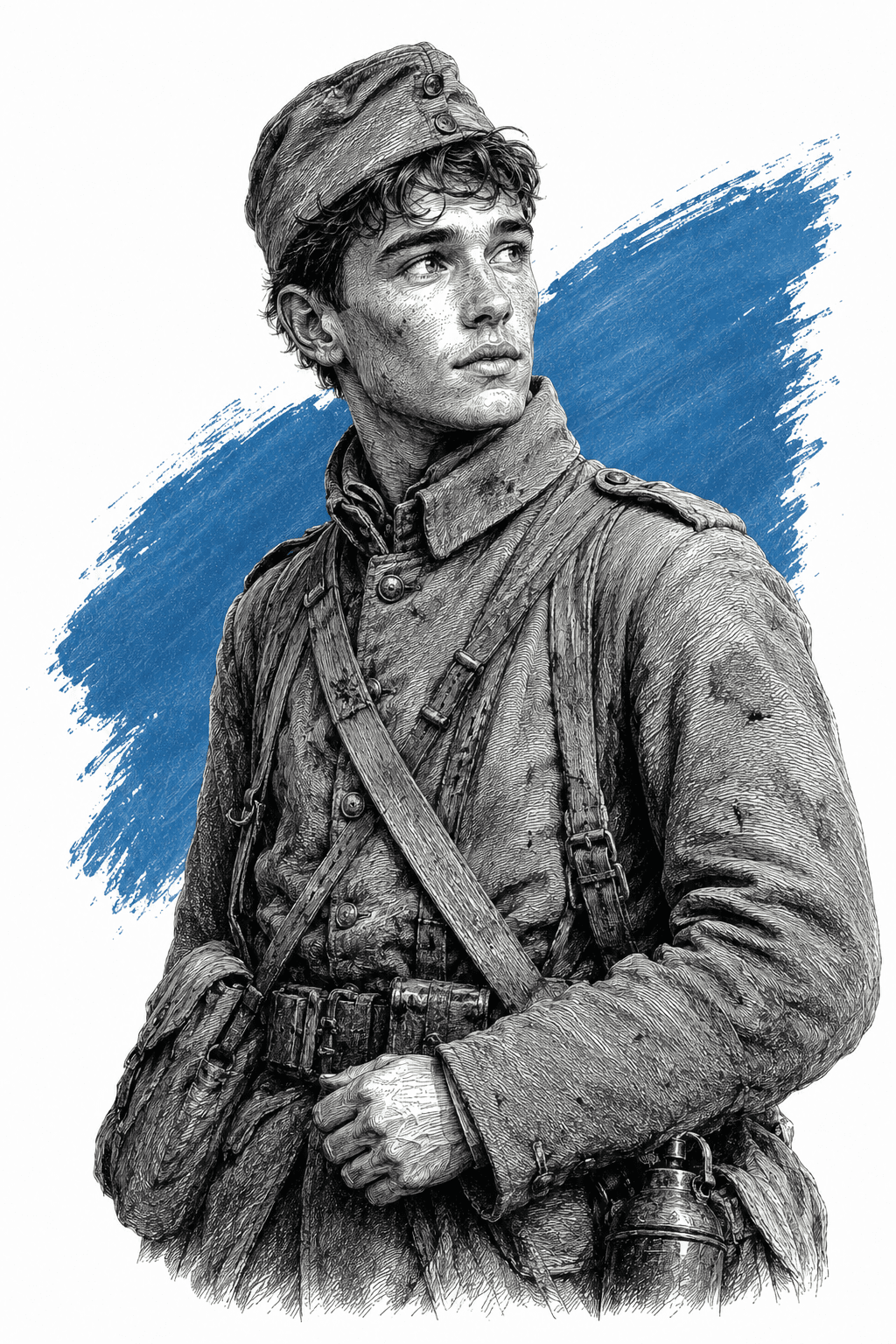
The youngest man in the squad, a twenty-year-old Breton who writes home that the sun is out and they are all right now.
The book

At a glance
- Private in Corporal Bertrand's squad
- Twenty, class of 1913
- Brittany
- Eugène, used once, by his mother
- Unofficial doorman of the squad's stretch, announcing everyone who comes
- Four German prisoners brought in single-handed during the May attacks
Who they are in the book
Spoiler-freeBiquet is twenty, from Brittany, and belongs to the class of 1913, meaning he was called up for his military service the year before the war and has effectively never been a civilian adult. Blaire, who is old enough to be his father, is in the same squad. His first name is Eugène, which appears only once, in a letter from his mother.
He is short and square, with grey skin and a jaw like a paving stone, and the narrator describes his head as looking like something that was never finished. He is also cheerful, competent and completely without self-pity, which is what makes his one letter home land the way it does.
How Biquet Is Portrayed
- Where he sleepsA trough scraped out at ground level with a thin mattress of muck and room for exactly one body. He calls it home in a nutshell, and defends the tent-cloth over it from passing troops who try to steal it.
- How he wakes upNot by noise. He is woken by the smell of a relieving regiment marching past with their boots level with his nose, and says it gave him nose-ache.
- Small economiesTobacco kept in a sock pulled tight with string, string kept because it is the useful thing, and a greatcoat so caked with dried mud that he says it has stopped being a greatcoat and become armour plate.
- What he did in the May attackRan on ahead of everyone, disappeared into the distance, and came back with four German prisoners. He says he has not saved any Frenchmen but he has given some Germans a bad time.
- The letter from his motherShe writes that by the time he reads it he will be in the cold and the mud with nothing. He laughs at it, because the sun is out, there is a room with a table, and they are all right now. He says she is completely off it.
- The letter he writes backHe lays out pen, ink and paper carefully, like a gentleman, writes in big regular handwriting, then reads it over, smiles at it and tells the narrator he would laugh if he knew what was in it.
Biquet is one of the four killed on the night patrol, shot in the belly. Laid out in the trench, his square face is contorted with the effort of dying and the narrator cannot look away from it.
The letter comes back. The address has washed off in the rain, and a cyclist hands it to the narrator, who collects post for the dead. It is the cheerful one, written in the sunshine at Gauchin-l'Abbé, telling his mother that she has it wrong, that it is hot rather than cold and there is nothing to do but walk about in the sun. The narrator reads a line of it, puts it back in the envelope, and notes that Biquet is lying in the open a few yards along the same trench.
If you like Le Feu


If you like Henri Barbusse
Explore authors with a similar voice, perspective, and influence.

Louis-Ferdinand Céline
The lineage runs straight downhill: Le Feu's trench-level truth-telling, pushed past despair into Journey's night.
View author
Ernest Hemingway
The other heir — Hemingway called Le Feu the war's one true book written in the fighting, and his own war prose kept its standard.
View author
Erich Maria Remarque
German novelist whose direct, unsentimental fiction follows soldiers and survivors marked by the First World War.
View author