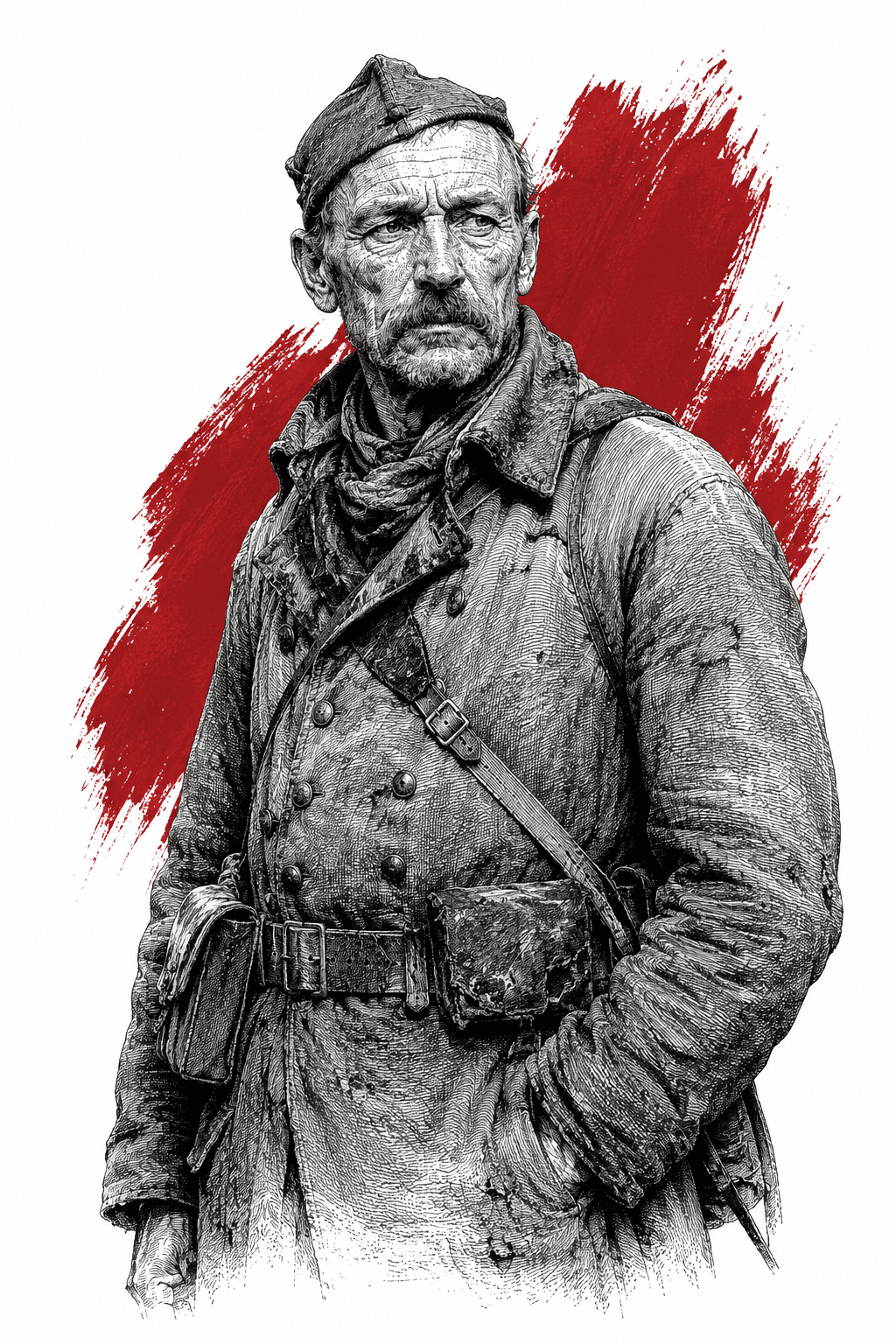
Cocon
The squad's arithmetician, an ironmonger's counterman from Lyon in spectacles, who answers everything with a number.
The book

At a glance
- Private in Corporal Bertrand's squad
- Counter hand at an ironmonger's in Lyon
- The Man of Figures
- Spectacles, which is how the squad knows him at a distance
- Lice, worse than anyone else's
- Ten thousand kilometres of French trench, and as much German
Who they are in the book
Spoiler-freeCocon sold hardware over a counter in Lyon, in a black smock, with his hands blackened by graphite. He is small, dry and bespectacled, and the squad calls him the Man of Figures. He collects statistics the way an insect collects, and serves them to anyone who stands still.
The joke about him is that the numbers are useless. The other half of the joke, which Barbusse never quite says, is that they are the only method anyone in the book has for getting the size of the war into their heads.
How Cocon Is Portrayed
- The lookA small, sharp, angular face made of ridges and triangles, with the two discs of his spectacles perched on it. When he is annoyed the whole face contracts.
- What he countsThat a soldier has eighteen pockets. That the French side of the front holds around ten thousand kilometres of trench, and the Germans as much again. That each man in the squad has worn out four greatcoats and six pairs of boots, that they have been billeted in forty-seven villages, and that twelve thousand men have passed through a regiment of two thousand.
- How he uses itTo place himself. He works out the figures, gives them to whoever is next to him, and then asks what they amount to: in all that, what are we?
- The liceA bad recurrence spreads down his neck and wrists and keeps him apart from the others for a week of scratching, and he comes back to the squad surly. On a cold, wet rest day he sits alone in a corner too weak to change his shirt, and is simply eaten.
- The childIn a billeted village he takes a small boy between his knees and coaxes out of him what his father says at home: that they will have made fifty thousand francs by the end of May, and that once his brother is got out of the front line the war can go on.
- The one thing figures do not settleAfter Volpatte comes back from the rear and describes the offices, Cocon has no calculation to offer. He says only that it takes away any desire to die.
Cocon is killed at some point during the attack. He is found the next morning in the middle of the plateau with only his head above ground; the narrator's guess is that he fell into a shell-hole and a second shell filled it in on top of him. A crust of mud on his chin looks at first like a heavy beard. Nobody recognises him. Volpatte breaks the mud off with a stick, puts the man's helmet back on the head and holds the round handles of his scissors up in front of the eyes to stand in for spectacles, and then the squad knows him.
If you like Le Feu


If you like Henri Barbusse
Explore authors with a similar voice, perspective, and influence.

Louis-Ferdinand Céline
The lineage runs straight downhill: Le Feu's trench-level truth-telling, pushed past despair into Journey's night.
View author
Ernest Hemingway
The other heir — Hemingway called Le Feu the war's one true book written in the fighting, and his own war prose kept its standard.
View author
Erich Maria Remarque
German novelist whose direct, unsentimental fiction follows soldiers and survivors marked by the First World War.
View author