Pépin
The one man in the squad whose civilian trade nobody can name. A thief, a knife-carrier, and the first over the German parapet.
The book

At a glance
- Private in Corporal Bertrand's squad
- None that anyone in the squad can name
- Made at the depot, and understood by the squad to be for the separation allowance
- A square of red-and-white checked oilcloth strapped to his back
- A knife, and stolen silver cutlery
- A German officer's helmet
Who they are in the book
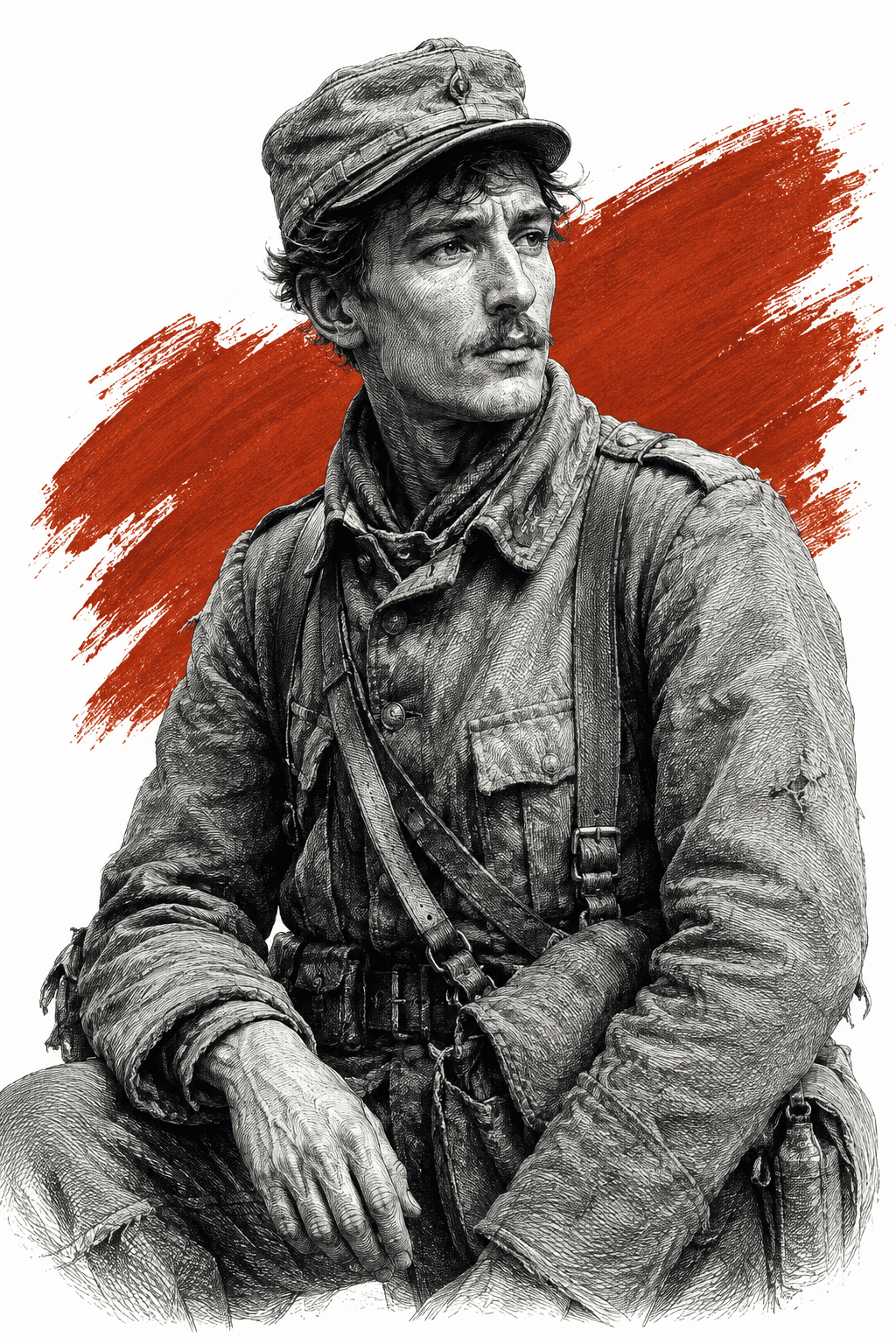
Spoiler-freePépin is the squad's bad character, and the book neither excuses him nor makes him a villain. He has a knife-blade face, a pale complexion and a cold grey look, and he is recognisable at any distance by a square of red-and-white checked oilcloth strapped to his back, taken from a dining-room floor in some abandoned house.
He is the only man whose peacetime occupation nobody can supply. What is known about him is that he came back from sick leave and married someone at the depot, and the squad's understanding is that this was to draw the separation allowance paid to soldiers' wives.
How Pépin Is Portrayed
- How you know himThe oilcloth draught-board on his back, visible from behind; from the front, the narrow face and the flat grey stare. He prowls the trench rather than sits in it.
- What he takesA pair of fawn gaiters off a corpse, which fascinate the rest of the squad. Silver table things from a woman he was billeted on, which he still carries and shows off, remarking cheerfully that she will spend the rest of her life looking for them.
- What he wants from the GermansNot victory. A silver-braided helmet, a pistol worth four pounds and a pair of field-glasses. He is annoyed with himself for the chances he let slip early in the war while he was still a beginner.
- The quarrelA conversation about the price of a pig turns into a fight between him and Tulacque over nothing at all. Tulacque grabs his prehistoric flint hatchet, Pépin goes pale and green-eyed, and the squad gets between them. He mutters afterwards that he will see to it later.
- The German officerOn the matches expedition the four cooks blunder into the German end of a shared trench. When a solitary officer walks past they burst out and jump him. He says one word in French. Pépin knifes him, catches the helmet as the man falls, and claims it on the grounds that he did the work.
- First into the trenchIn the attack he throws himself flat at the edge of the German parapet, gets entangled with a corpse, and rolls down into the trench ahead of everyone else in the squad. He had asked earlier to be given one of the kitchen knives issued for close work, and been refused.
Pépin is killed clearing the captured trench. He went down into a German dug-out after the men hiding in it, nobody knew he was in there, and the position was smoked out to make sure of it. He was found afterwards among the Germans he had bayoneted, and the soldier who describes it to the squad, a butcher from the Paris suburbs before the war, delivers the whole account as a professional appraisal. Volpatte's only comment is that the squad is one man down.
If you like Le Feu


If you like Henri Barbusse
Explore authors with a similar voice, perspective, and influence.

Louis-Ferdinand Céline
The lineage runs straight downhill: Le Feu's trench-level truth-telling, pushed past despair into Journey's night.
View author
Ernest Hemingway
The other heir — Hemingway called Le Feu the war's one true book written in the fighting, and his own war prose kept its standard.
View author
Erich Maria Remarque
German novelist whose direct, unsentimental fiction follows soldiers and survivors marked by the First World War.
View author