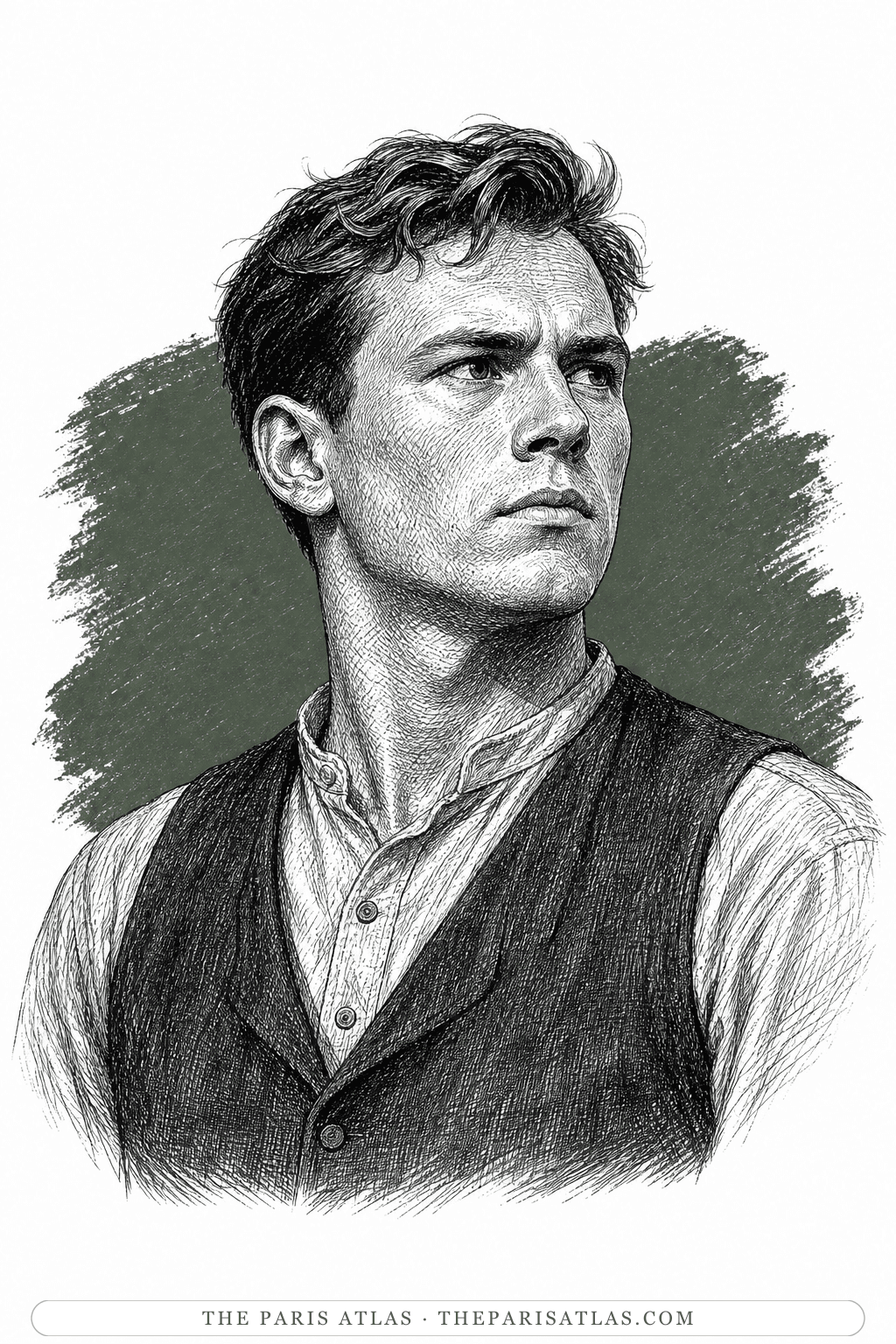
Ed Hall
A carpenter's apprentice who wants more money, becomes the factory superintendent, and causes Bidwell's first strike.
More money, and then more standing. He says it in the dark on Turner's Pike with his arm round a girl he cannot afford to marry: “I got to have more money.” The whole of his career follows from that sentence.
The book

At a glance
- Carpenter's apprentice; later foreman and superintendent of the corn-cutting machine factory
- A few dollars a week as an apprentice; twenty-five dollars a week as foreman, when other men in the shop got a dollar and a half a day
- Ben Peeler, the Bidwell carpenter, who became a lumber dealer and stopped driving nails
- The piece-work system, and therefore the town's first strike
Who they are in the book
Spoiler-freeEd Hall is apprenticed to Ben Peeler, the town carpenter, and earning a few dollars a week when the book first shows him: a young man walking a girl home from the station at night, taking his arm off her waist to complain that he will never be able to marry on what he is paid. He is the first person in Bidwell to say out loud that the town has a duty to get behind Steve Hunter's machine, and he says it loudly and often.
It works. He becomes foreman and then superintendent of the corn-cutter factory at twenty-five dollars a week, more money than he had ever expected to see. He also becomes, within a few years, the man his old friends in the shop hate. The novel uses him as its measurement: everything that happens to the town happens to Ed Hall first.
How Ed Hall Is Portrayed
- The convertIn the drug store, against the old cabbage farmers shaking their heads at the model in the jeweller's window: “It's the town's duty to get out and plug for that machine. We got to wake up here.” Steve Hunter takes him aside afterwards and mentions that live young fellows are going to be needed as superintendents.
- The night workSteve pays him to go out after dark and replace the plants that have died in the test field, so that the long rows always look healthy to the Sunday crowds walking down Turner's Pike. He is told it is fair enough, because a hundred things can kill a plant and the machine would get the blame.
- The waiting roomOn his first pay nights as foreman he walks down to the deserted railway station, goes into the empty waiting room with its one low oil lamp, takes the roll of money out of his pocket and counts it. Then he goes out, is not satisfied, comes back and counts it again, and once more on his way home to bed.
- Mr. HallThe tobacconist calls him Mr. Hall for the first time and he laughs it off and winks at the men in the shop. Afterwards he is sorry he did not simply accept the title, and decides he can no longer be getting thick with the young fellows who will be working under him.
- The trickTo prepare for piece work he puts on overalls, takes a bench beside fifty men and tells them he is going to show them up. Their pride is touched and they work like demons for two weeks, laughing at him each night. Then the piece rates are set on the fortnight's output, and Bidwell has its first strike.
- The manhuntWhen crowds go out of town after the murderer, Ed remembers working on the farm where the harness maker used to walk on Sundays and goes there alone, dragging one reluctant workman along for company. He finds Joe Wainsworth under a tree and knocks him face down in the road, and then tells the story in the car three times, giving himself all the credit and privately regretting the witness.
The strike is broken. Tom Butterworth and Steve Hunter win that one and a larger one after it, three men are killed, and hundreds of workmen say nothing about it afterwards. Ed Hall ends the novel at the head of a new factory going up along the Wheeling tracks, growing fat and prosperous — the same road, from the same starting point, that Steve Hunter travelled a decade earlier.
Clara stops him hitting the captured harness maker in the moving car, and he takes it, with one cautious eye on the front seat, because his employer's daughter is his employer's daughter.
If you like Poor White


If you like Sherwood Anderson
Explore authors with a similar voice, perspective, and influence.

Ernest Hemingway
Anderson's letters of introduction sent him to Paris; In Our Time borrowed the Winesburg shape; The Torrents of Spring paid the debt back in parody.
View author
Sisley Huddleston
The witness who recorded Anderson's Paris — the hotel by the Odéon, the Luxembourg walks, and the long conversations about America and art.
View author
F. Scott Fitzgerald
The Jazz Age's laureate — famous at twenty-three, author of Gatsby at twenty-eight, and owner of the longest posthumous comeback in American letters.
View author