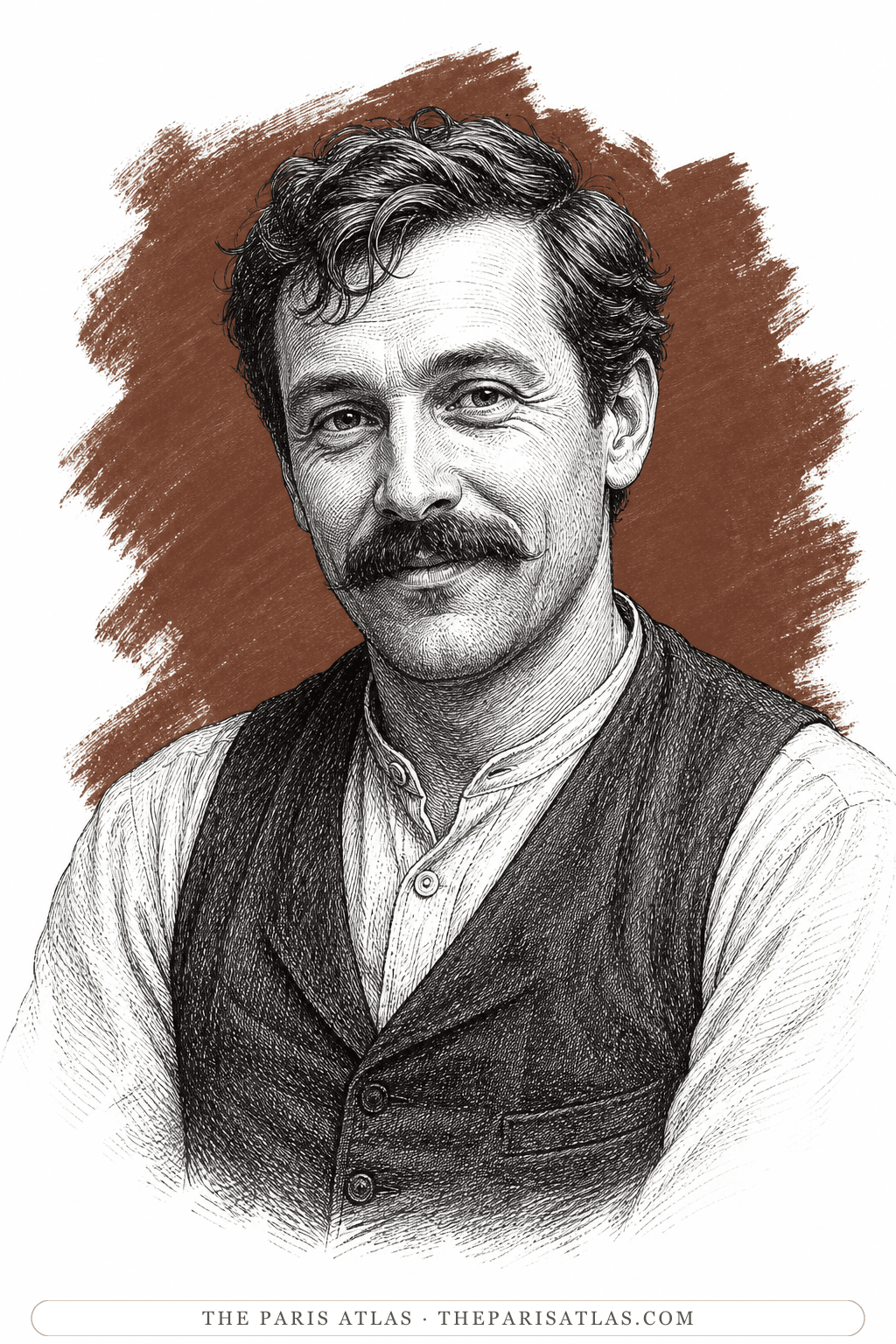
Jim Gibson
The journeyman harness maker who drifts into Bidwell drunk, goes to work for Joe Wainsworth, and takes the shop away from him.
To run the shop and be seen running it. What he asks of Joe Wainsworth is simple: “What I want you to do here is to shut your eyes and give me a chance. That's all I ask.” Once he has it, he tells the story in every bar on Main Street.
The book

At a glance
- Journeyman harness maker, employed by Joe Wainsworth; in practice the man who runs the shop
- Drifted into Bidwell drunk during the factory boom, and knew the whole town within a week
- Every Saturday evening, by system — a habit he says keeps him steady the rest of the week
- Nearly twice in one year what he had lost in the plant-setting machine company
Who they are in the book
Spoiler-freeJim Gibson arrives in Bidwell drunk during the boom, when there is more harness repair work in town than one man can handle, and Joe Wainsworth hires him because he has to. Within a week he knows everybody in Bidwell. He is the same age as his employer and seems much younger, he gets drunk every Saturday evening on principle, and he has a real talent for making money that he has no interest in making for himself. He tried running his own shop once, did well, and closed it to go on a month's drunk.
What he wants from a job is the running of it. The contest with Joe over who is in charge of the harness shop lasts about a month and Jim wins it completely, and then keeps winning it in public for years, because being able to say so in a saloon is most of the point.
How Jim Gibson Is Portrayed
- The first jobA teamster comes in with a heavy work harness over his shoulder and throws it down. Where Joe would growl and refuse to promise a date, Jim looks it over and says it is an easy job — “We'll fix that up in a jiffy.” — and promises it for the next afternoon at a higher price than his employer would have named.
- The argument about factoriesHe spends hours a day trying to get Joe to stock factory harness, and his case is not stupid: nobody but an old horseman can tell hand-stitched from machine-stitched, the factories put on more decoration, and “The machine-made can be sold cheaper.” His conclusion is a slogan: “Quick sales and profits, that's the story.”
- The experimentOne afternoon he stops at a saloon on his way back from lunch, then walks in, slaps his employer on the back and calls him old daddy, purely to see what will happen. If Joe had thrown him out he would not have minded much. Joe apologises to him instead, and Jim goes straight to the bartender at Ben Head's to describe it.
- The eighteen setsA travelling salesman comes in with factory harness; Joe orders him out; Jim calls him back, places an order for eighteen sets and makes his employer sign it. When the salesman had gone, he tells the men outside the shop, the old man sat there and cried.
- The sidewalk sermonTo two strikers and a man repeating what he has heard from a socialist speaker, Jim explains that unions and parties are for people who cannot look after themselves: “Character counts. Yes, sir, character makes a man what he is.” His proof is himself. There is a man inside with the money, he says, and out here is the man with the power.
- The self-assessmentHe is entirely accurate about himself and it changes nothing: “I was a drunkard and down and out when I came to this town; a drunkard, that's what I was and that's what I am.” He likes to work and scheme for money and knows that having it does him no good and never will.
On the evening the eighteen factory harnesses are hanging on the walls, Jim stands in the shop doorway telling the story of the order to a small crowd, knocks down a pale striker who calls him a lickspittle, and goes inside to work. Behind him Joe Wainsworth climbs down off his harness-maker's horse, checks the street, and comes back along the shop with the half-moon knife he has been sharpening. Jim turns and opens his mouth. He never gets a word out.
Tom Butterworth, who has heard the story of Jim's triumph over his employer in a hotel bar that same night and has not yet heard the rest of it, spends the drive home telling Hugh and Clara that this is exactly the kind of man to handle workers, and that he means to look him up in the morning.
If you like Poor White


If you like Sherwood Anderson
Explore authors with a similar voice, perspective, and influence.

Ernest Hemingway
Anderson's letters of introduction sent him to Paris; In Our Time borrowed the Winesburg shape; The Torrents of Spring paid the debt back in parody.
View author
Sisley Huddleston
The witness who recorded Anderson's Paris — the hotel by the Odéon, the Luxembourg walks, and the long conversations about America and art.
View author
F. Scott Fitzgerald
The Jazz Age's laureate — famous at twenty-three, author of Gatsby at twenty-eight, and owner of the longest posthumous comeback in American letters.
View author