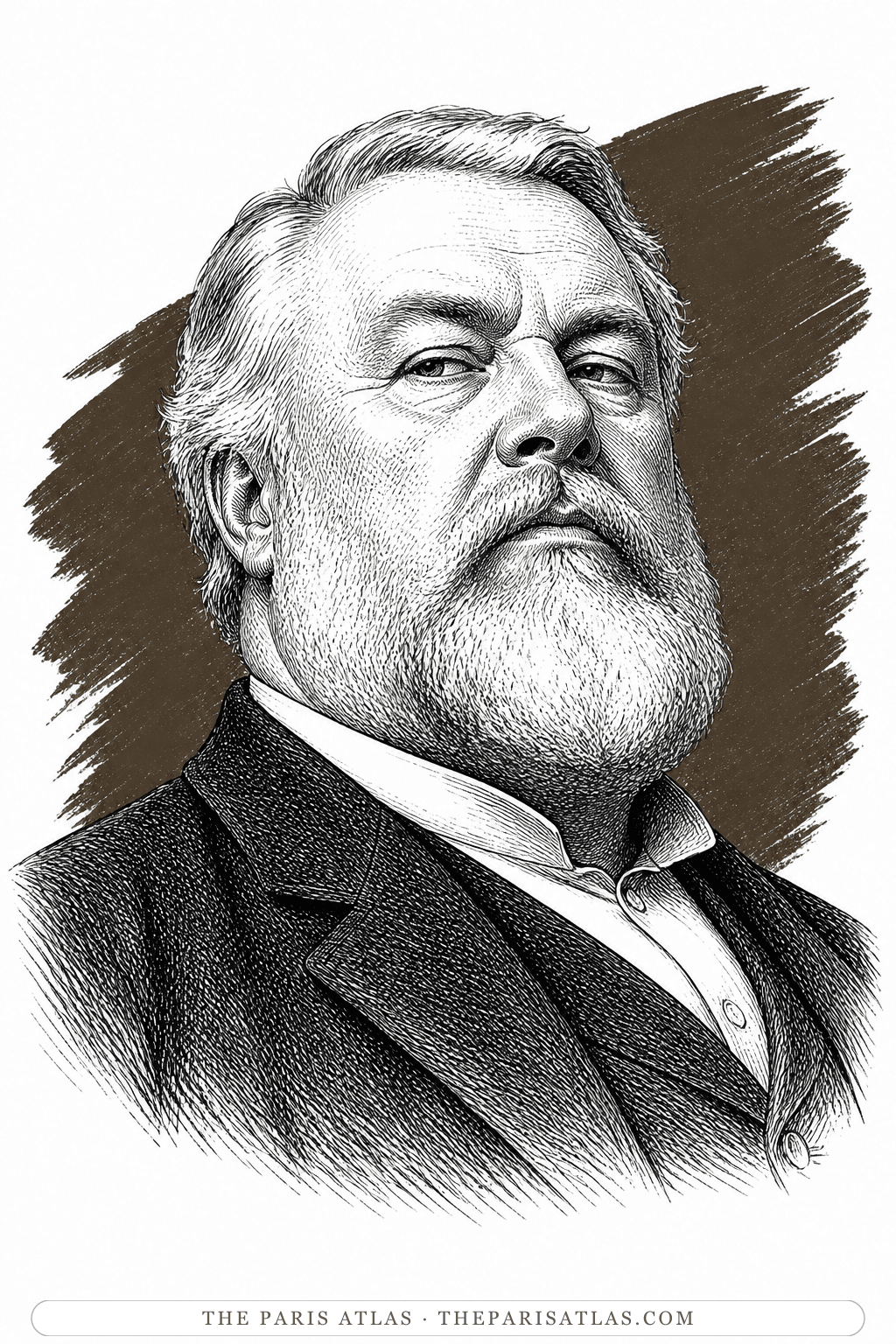
Tom Butterworth
Clara Butterworth's father: the county's richest farmer, who buys the failed factory, becomes the town's real power, and cannot say one kind thing to his daughter.
To be the big man of Bidwell, and to see his daughter married in a way that helps. He puts it to Clara the day she comes home from college: “I want you should marry pretty soon now.” If the husband is educated and smart, he will build them the biggest house Bidwell has ever seen.
The book

At a glance
- Farmer, over a thousand acres; partner to Steve Hunter and, later, the man who manages Hugh McVey's money
- The town's milk and ice supply, a slaughterhouse, an ice house, and more than a hundred beehives
- Trotting races — he goes to the Cleveland grand circuit every autumn and bets ten dollars rather than own a horse
- A wife dead young, whom he had suspected without cause, and one daughter, Clara
- Growing fat, wearing a diamond ring, and planning an automobile-tyre plant with a man he met in Chicago
Who they are in the book
Spoiler-freeTom Butterworth owns over a thousand acres, rents most of it out on shares, and runs everything else in the neighbourhood as a sideline: the town's milk and ice, a slaughterhouse in a field half a mile from his house, a hundred beehives in his orchards and a honey shipment to Cleveland every year. He is tall, white-bearded and scrupulously clean, he chews tobacco, and he loves fast trotting horses too much to risk owning one. His wife died young. He is, as the book says more than once, an intensely possessive man, and he suspected her too.
He appears first as the man who brings factory harness into Joe Wainsworth's shop and last as the man driving Bidwell's first motor car at fifty miles an hour, shouting about tyre plants. In between he goes into partnership with Steve Hunter, buys the failed factory, learns to talk like a prince to men he used to work beside, and grows heavy, with a diamond ring on his left hand.
How Tom Butterworth Is Portrayed
- The four harnessesHe walks into the harness shop at noon to say he has ordered four sets of work harness from a factory in Philadelphia, and asks whether Joe Wainsworth will repair them when they break. He is not being cruel. He does not think about it again for years, and the novel treats the moment as the first touch of the new age on the town.
- The bedroom doorHaving sacked the farm hand who assaulted his seventeen-year-old daughter, he stands outside her door in the dark and interrogates her as though she were a guilty woman. She offers him one chance to say something kind. He turns and walks away without a word, and the relationship never recovers.
- The noteDriving through the hills with Steve Hunter in a hired buggy on the night Clara leaves for college, he takes fifty thousand dollars of stock on nothing but his signature and no collateral, having decided that anyone else offered the same deal would have taken it. He also decides that night to quietly deed three farms to Clara in case the whole thing goes wrong.
- The blowoutTold his daughter has eloped to the county seat, he hires every horse and rig in three livery stables, empties three hotel kitchens, sends for Henry Heller's orchestra and invites everyone he sees: “The sky's the limit to-night, Jim.”
- The motor carHe brings the first automobile in Bidwell back from Cleveland, learns to drive in a week, and takes his daughter and son-in-law out on the roads at fifty miles an hour with the announcement, “Now watch me step on her tail,” which he has just learned from the mechanic. He asks aloud where the great trotting horses of his youth would be now, trying to catch him.
- The toneHis summary of his own career, delivered over the engine noise: “I saw the hole in the doughnut.” He also tells Hugh that he keeps Steve Hunter going straight down the track the way his hand keeps the car on the road.
- The Iowa manWhen a stranger in Iowa turns out to hold the patent Hugh needs, Tom's instruction is unembarrassed: “We'll whipsaw this other fellow through the courts. We'll fight him till he's sick of fight and then we'll buy him out cheap.” He has had the man looked up. He has no money and he drinks.
Tom does better out of the plant-setting swindle than anybody. He sells his stock before the crash like the other partners, then buys back in just before the failure so that he can stand in the stores afterwards and challenge anyone to inspect the books. He and Steve pick up the plant cheap and make a fortune on the corn-cutter, and the two bankers who were cut out cannot say a word in public. In the last chapters he wins two strikes and tells his son-in-law what the answer to labour trouble is: “Pretty soon we'll do all the work by machines. Then what'll we do? We'll kick all the workers out and let 'em strike till they're sick, that's what we'll do.”
With his daughter he ends where he began. He lies to Steve Hunter's face on the night of the wedding to cover the fact that he had spread word of an engagement that never existed — his own invention, which left Clara's name attached to a swindler's. Then he hovers around the newly married pair for weeks, coming to the shop every morning to make jokes about married life, like a bird whose chick has been pushed out of the nest early. It is the nearest to tenderness the book allows him, and he can only do it sideways.
If you like Poor White


If you like Sherwood Anderson
Explore authors with a similar voice, perspective, and influence.
Ernest Hemingway
Anderson's letters of introduction sent him to Paris; In Our Time borrowed the Winesburg shape; The Torrents of Spring paid the debt back in parody.
View author
Sisley Huddleston
The witness who recorded Anderson's Paris — the hotel by the Odéon, the Luxembourg walks, and the long conversations about America and art.
View author
F. Scott Fitzgerald
The Jazz Age's laureate — famous at twenty-three, author of Gatsby at twenty-eight, and owner of the longest posthumous comeback in American letters.
View author