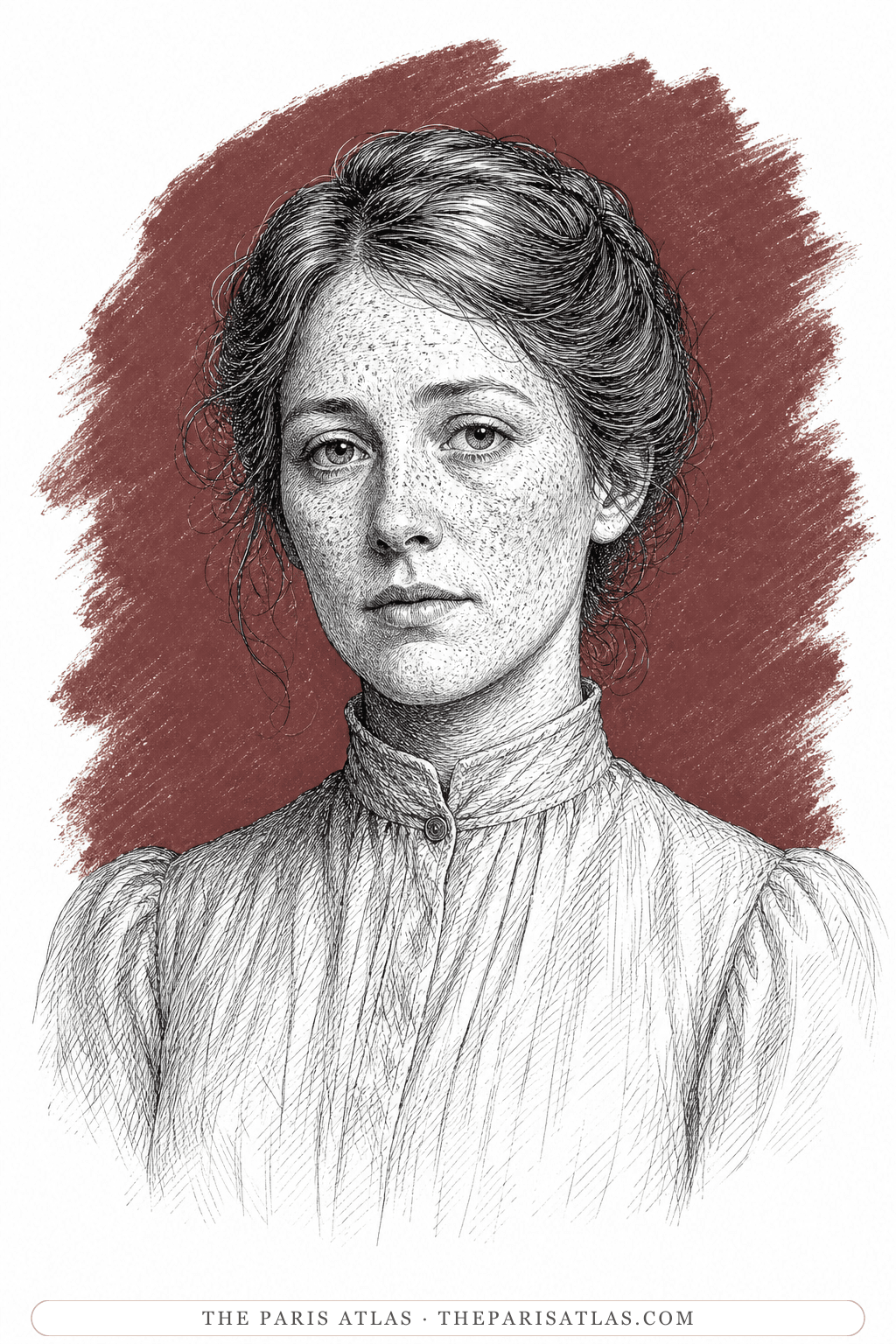
Rose McCoy
The country schoolteacher who lives in the room next to Hugh McVey's for years, while neither of them says anything.
To be married, and to stop being alone. She lies awake in a farmhouse bedroom listening to the cattle and the farmer snoring next door, thinking that she would like a man to lie with her the way the farmer's wife has one.
The book

At a glance
- Country schoolteacher; daughter of the widow McCoy, in whose house Hugh McVey boards
- Thirty — slender, red-haired, freckled, with tired blue eyes
- A small frame house on Turner's Pike, its back door facing the Wheeling railway tracks
- George Pike, the Wheeling station agent, until a disagreement about religion ended it
- Only from Friday evening to Monday morning; the rest of the week she boards near her school
Who they are in the book
Spoiler-freeRose McCoy is the daughter of Mike McCoy, a railway section hand killed in an accident, and she lives with her mother in a small frame house on Turner's Pike with its back door facing the Wheeling tracks. The men on the line remember her father: they tip half-rotten ties over the fence into the potato patch, and at night the brakemen on the coal trains heave chunks of coal over and shout that it is for Mike. She is thirty, slender, red-haired and freckled, with tired blue eyes, and she teaches a country school, which means she is away boarding at a farmhouse from Monday morning until Friday.
Hugh McVey lodges in the house. They have never once been alone together when the book introduces them, and they are both awake at night thinking about each other.
How Rose McCoy Is Portrayed
- Why she teachesShe was engaged to George Pike, the Wheeling station agent, and a wedding day was fixed. A difficulty about religion came up, George married another woman, and Rose became a schoolteacher. He still lives a few hundred yards along the road, with his wife.
- The plateOne wet Sunday with the house to themselves, Hugh drops a plate and the embarrassment breaks. He picks up another and refuses to give it up; she tells him he is as awkward as a puppy and wonders aloud how he manages anything at all over at that shop of his. They struggle for it laughing, and her cheeks are flushed, and then she takes it out of his hand and goes into the kitchen.
- Behind the lilac bushThat same afternoon she goes out along Turner's Pike, turning at the bridge to look back at the house, crosses the creek on a fallen log and stands hidden by a lilac at the wall of the old pickle factory — the place where she and George Pike once nearly became lovers. Hugh walks past on the road without seeing her. She sits down in the wet grass and cries.
- The reachAt two o'clock one clear night she is sitting at her window in a nightgown, looking along the road towards George Pike's house. Hugh kneels on the floor of the next room and puts his long arm across the gap between the windows, close enough to touch the back of her head, and then takes it back and stands up and bangs his head on the ceiling. He hears her window go softly down.
- The Governor's speechHe takes her to town to hear the Governor of the State speak, and the Governor names Hugh from the platform as one of the greatest intellects alive. Hugh pulls her away down a side street. At the gate she had meant to suggest a walk under the trees; instead she says he should be proud, and that she would be proud to be spoken of like that, and asks why he goes on living in a cheap little house like theirs.
- What she says out of the questionThe verdict she reaches standing at the gate that night, and does not say aloud: “How could a man like him care anything for a homely little school teacher like me?”
Nothing happens between them, and the novel is precise about why. Hugh decides that she is a good woman and takes that to settle the matter, telling himself in the dark that he has no right. She decides that a man the Governor of the State praises from a platform could not want her. In her sleep she is not thinking of Hugh at all: “Yes, George, I love you, I belong to you,” she whispers, to the man who married someone else.
When Clara Butterworth walks into the machine shop in a summer dress, Rose is displaced in Hugh's mind within the hour, and the novel says so flatly — beside Clara she looks dowdy and commonplace. She does not appear again. Years later the McCoy house has been pulled down and replaced by a warehouse.
If you like Poor White


If you like Sherwood Anderson
Explore authors with a similar voice, perspective, and influence.

Ernest Hemingway
Anderson's letters of introduction sent him to Paris; In Our Time borrowed the Winesburg shape; The Torrents of Spring paid the debt back in parody.
View author
Sisley Huddleston
The witness who recorded Anderson's Paris — the hotel by the Odéon, the Luxembourg walks, and the long conversations about America and art.
View author
F. Scott Fitzgerald
The Jazz Age's laureate — famous at twenty-three, author of Gatsby at twenty-eight, and owner of the longest posthumous comeback in American letters.
View author