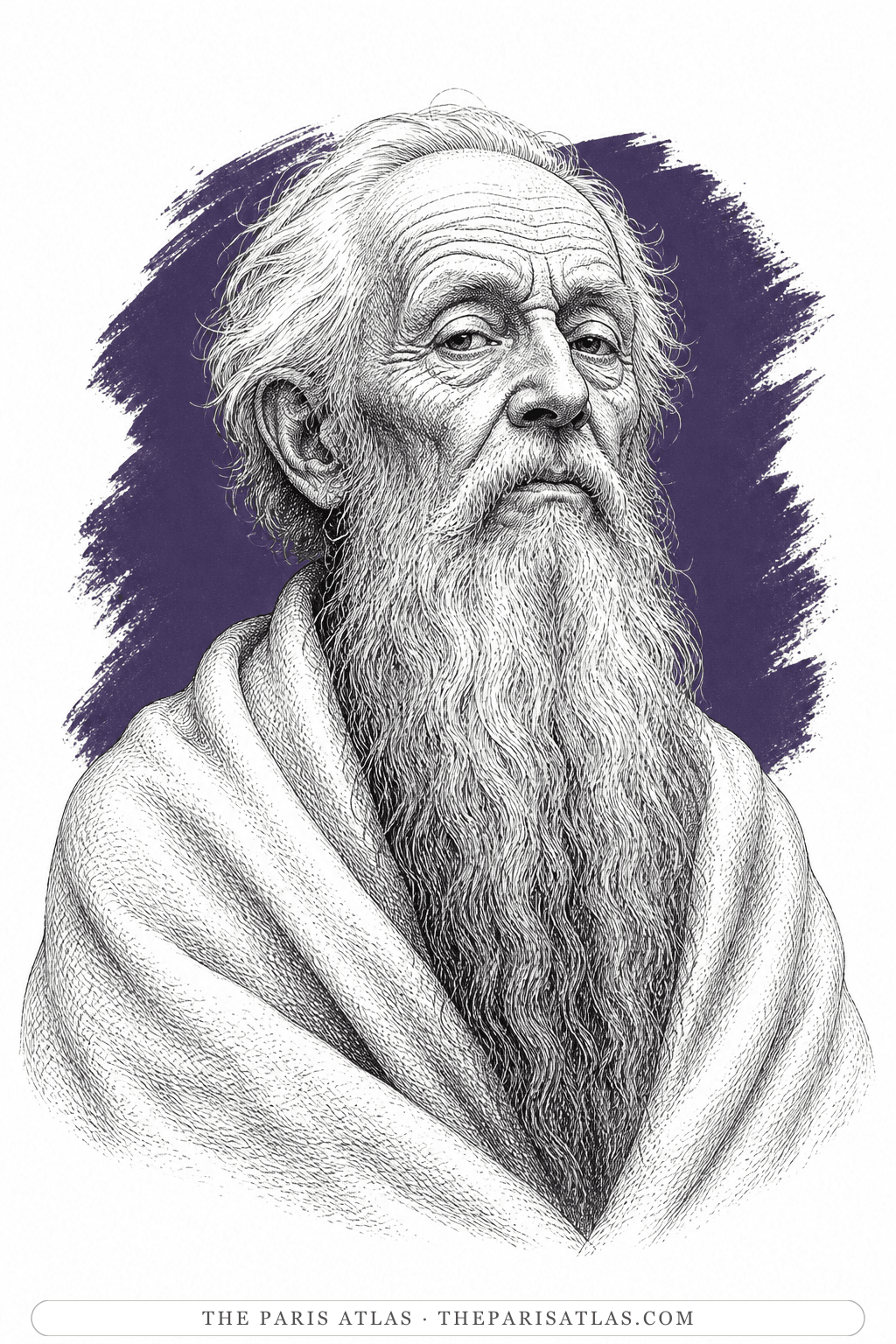
Benjamin Button
The title character of "The Curious Case of Benjamin Button": a man born in Baltimore in 1860 looking like a seventy-year-old, who grows younger every year for the rest of his life.
To be believed about his own age, and left alone to live at it. Refused entry to Yale as a dangerous lunatic, he walks out of the registrar's office, turns in the corridor in front of a crowd of undergraduates, and says it again: "I am eighteen years old."
The book

At a glance
- The main character of "The Curious Case of Benjamin Button", the sixth of the eleven pieces
- Baltimore, a September morning in 1860, at the Maryland Private Hospital for Ladies and Gentlemen
- Son of Roger Button of Roger Button & Co., Wholesale Hardware; husband of Hildegarde Moncrief; father of Roscoe Button
- Rejected by Yale at eighteen; graduated from Harvard in 1914, aged fifty-four
- Lieutenant-colonel in the Spanish-American War, wounded and decorated at San Juan Hill; commissioned brigadier-general in 1917 and sent home
- Golf, and dancing — the Boston in 1906, the Maxine in 1908, the Castle Walk in 1909
Who they are in the book
Spoiler-freeBenjamin Button is the main character of "The Curious Case of Benjamin Button", a short story F. Scott Fitzgerald published in Collier's magazine in May 1922 and collected in Tales of the Jazz Age the same year. He is born in a Baltimore hospital in the summer of 1860, to a well-connected wholesale-hardware family, and the first thing anybody notices about him is that he is an old man. He is five feet eight inches tall, he has a smoke-coloured beard down to his waist, and the first thing he says to his father is a request to be got out of the crib, or at least given a comfortable rocking chair.
That is the whole of the story's invention. Everything else in it behaves normally: the Civil War breaks out, Baltimore gossips, Yale rejects him, business prospers. Benjamin simply runs the other way through it. He is a stooped old man in short trousers at five, a capable businessman at forty, a Harvard football star at fifty, and a boy of fifteen when his own son is a prominent married man. Fitzgerald credits the idea to a remark of Mark Twain's: "This story was inspired by a remark of Mark Twain's to the effect that it was a pity that the best part of life came at the beginning and the worst part at the end."
The joke is a good one, and Fitzgerald plays most of it for laughs. What the story is really about is nobody believing him. Benjamin spends his whole life stating a plain fact about himself and being told he is a liar, a lunatic, or a discredit to the family.
How Benjamin Button Is Portrayed
- The first thing he saysHis father is brought to the crying-room and shown a seventy-year-old man wrapped in a blanket. The old man looks him over and asks, "Are you my father?", then complains that he asked for something to eat and was brought a bottle of milk. As his father leaves to buy him clothes, he calls after him: "And a cane, father. I want to have a cane."
- What his father tried to do about itRoger Button buys a suit off a fancy-dress dummy in a shop window because nothing in the boys' department fits, cuts a section off the beard with a pair of hospital shears, and dyes the white hair black. He brings home a rattle, lead soldiers and toy trains, and asks a toyshop clerk whether the paint will come off a pink duck if the baby puts it in his mouth. His first choice of name for his son was Methuselah.
- The rattle and the cigarBenjamin jingles the rattle at intervals through the day because it is expected of him. Left alone he smokes his father's Havanas in the nursery and reads the Encyclopedia Britannica while the cotton cows and the Noah's ark lie untouched on the floor.
- Thrown out of YaleHe passes the entrance examinations at eighteen and reports to the registrar with his hair dye run out. The registrar takes him for his own father, then for a lunatic, and orders him out of town: "You are a dangerous lunatic." A mob of undergraduates chases him to the railroad station. He swears revenge and later gets it, playing for Harvard against Yale and scoring seven touchdowns and fourteen field goals in one game.
- The nailsHis famous business coup, in 1890, was the proposal that all nails used to nail up boxes in which nails are shipped become the property of the man receiving them. It passed into law and saved his father's firm more than six hundred nails a year. He was also the first man in Baltimore to own and run an automobile.
- Made to call his son "Uncle"By 1914 Benjamin looks about twenty and his son Roscoe is a married man of standing. Roscoe tells him to stop it, to turn round and start back the other way, and to answer to "Uncle" in front of visitors, because it looks absurd for a boy of fifteen to use his first name.
- The brigadier-generalCalled back into service by letter in 1917, he goes to a tailor on Charles Street to be measured for a uniform and is asked whether he wants to play soldier. At Camp Mosby a colonel rides up, looks down at him and asks, "Whose little boy are you?" Two days later Roscoe collects him and takes him home without the uniform.
- The forgettingThe story's last pages take everything back. There is no memory left of San Juan Hill or of the early years of his marriage, only his nurse Nana, a crib, a word for the elephant in the park and a word for the sun. Fitzgerald states it flatly: "He did not remember."
It ends by subtraction. His wife Hildegarde moves to Italy; his son Roscoe houses him but wants no scandal. He goes to kindergarten and enjoys it, then goes back a second year, then a third, by which point he is too small to understand what the coloured paper is for and is frightened of the other boys. He is taken out of school and handed to a nurse called Nana. Fitzgerald spends the last page removing things one at a time — the war, the marriage, the nights with his grandfather, then the words, then the light: "Then it was all dark, and his white crib and the dim faces that moved above him, and the warm sweet aroma of the milk, faded out altogether from his mind."
David Fincher's 2008 film The Curious Case of Benjamin Button, written by Eric Roth, keeps the premise and the name and changes everything else. Fitzgerald's Benjamin is a Baltimore hardware magnate in a comic story of about eighteen pages who is treated by his family as an embarrassment; the film's Benjamin is a New Orleans foundling raised in a nursing home, whose life is organised around a lifelong love affair with a woman named Daisy and framed by a deathbed reading during Hurricane Katrina. None of that is in the story. The film won three Academy Awards and put the story back into print, which is how most readers now arrive at it.
If you like Tales of the Jazz Age


If you like F. Scott Fitzgerald
Explore authors with a similar voice, perspective, and influence.
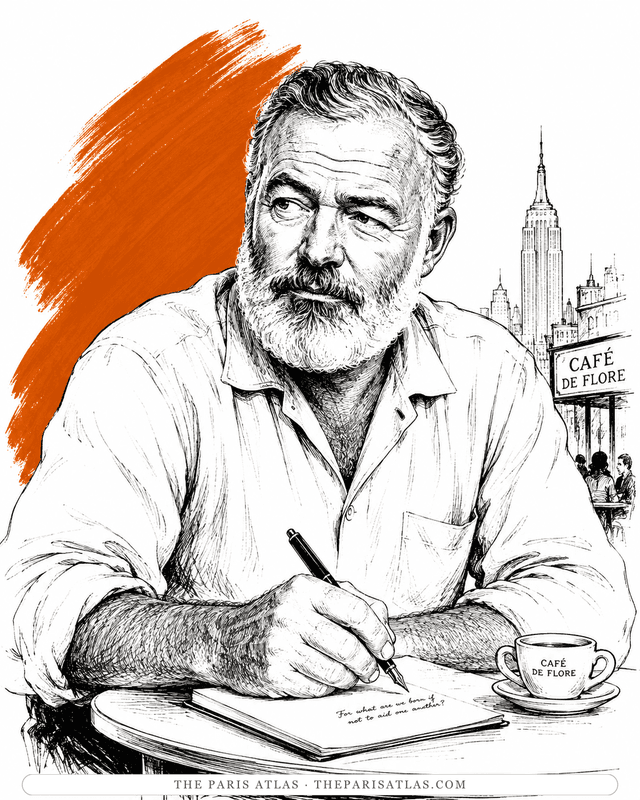
Ernest Hemingway
Fitzgerald vouched for him to Scribner's before they had met, then edited him better than he edited himself; the friendship's five rounds are chronicled in our journal.
View author
Henry Miller
The Brooklyn dropout who arrived in Paris broke at thirty-eight and wrote the exuberant, banned books that ended American censorship.
View author
Louis-Ferdinand Céline
The doctor of the Paris slums who wrote the century's blackest, funniest novel — and changed the sound of French prose.
View author