F. Scott Fitzgerald's second story collection, published in 1922 — eleven very uneven pieces, two of them among the best things he ever wrote, and a table of contents in which he grades them himself.
Eleven stories and sketches that F. Scott Fitzgerald gathered in September 1922, two years after his first novel made him famous at twenty-three. The book is uneven, and Fitzgerald is the one who says so: instead of a plain list of titles he wrote a short note on each piece, explaining where it came from and what he now thought of it, including which one he liked least. Two of the eleven are major. "May Day" follows several sets of strangers through New York on 1 and 2 May 1919, a night when returning soldiers really did wreck a socialist newspaper office. "The Curious Case of Benjamin Button" is about a man born looking seventy who ages backwards, and is the story the 2008 film took its title from.
The story, in more detail
F. Scott Fitzgerald was twenty-five and living on magazine money. This Side of Paradise had made him famous in March 1920, and for the two years that followed he wrote short stories at speed to pay for the life the fame came with, selling them to the Saturday Evening Post, the Smart Set, the Metropolitan, Collier's, the Chicago Tribune and Vanity Fair. Charles Scribner's Sons collected eleven of them on 22 September 1922, six months after his second novel, The Beautiful and Damned. It was his second book of stories; the first, Flappers and Philosophers, had come out in 1920.
The table of contents is the unusual part. Rather than list the eleven titles, Fitzgerald wrote a paragraph on each one, saying where it came from and what he made of it now. He explains that "The Camel's Back" was written in a single day in New Orleans to pay for a wrist watch, and then adds: "I like it least of all the stories in this volume." He credits his wife, Zelda, with the dice-game scene in "The Jelly-Bean", because he could not manage it himself. He reprints a piece of hate mail. He apologises for a Princeton sketch he says he can no longer laugh at, and includes it anyway. Writers do not usually hand a reader that kind of ammunition, and it is the most likeable thing about the book.
He also sorted the eleven into three groups, and the group names are his: "My Last Flappers", "Fantasies" and "Unclassified Masterpieces". The last of those is a joke at his own expense, and the three pieces filed under it are a domestic tragedy he half-apologises for, an absurd one-act written in a hotel bedroom, and a parody of backwoods feud fiction. Reviewing the collection in the New York Times that October, Hildegarde Hawthorne complained that the stories gave "too much of the effect of samples", while granting the book showed "a development in his art, a new turn". Both halves of that verdict have held up. What has kept the book in print for a century is its middle: "May Day", "The Diamond as Big as the Ritz" and "The Curious Case of Benjamin Button".
What's inside
The first four pieces, under Fitzgerald's heading "My Last Flappers", are magazine stories about young Americans in 1919 and 1920. "The Jelly-Bean" is set in a small Georgia city, where Jim Powell, a twenty-one-year-old who has spent his life idling around a garage, is invited to a country-club dance and finds himself in the middle of a rich girl's very bad night. "The Camel's Back" is a farce set in Toledo at Christmas 1919: a lawyer goes to a fancy-dress ball inside a camel costume, sharing it with a taxi driver who works the back half, and the evening ends in a marriage nobody meant to perform. "Porcelain and Pink" is a short comic playlet in which a young woman spends the entire scene in a bathtub, talking through a window to a man who thinks he is talking to her sister.
"May Day" is the longest thing in the book and the best. It runs through New York across 1 and 2 May 1919, cutting between four groups who barely know each other exist: Gordon Sterrett, a broke veteran trying to borrow three hundred dollars from a rich former classmate; two demobilised privates hunting for a drink; a Yale fraternity dance at Delmonico's; and the late-night office of a socialist weekly that a crowd of soldiers is working itself up to break into. Fitzgerald built it out of real events — that spring, mobs of returning servicemen attacked socialist offices in several American cities — and it is the only story here in which he writes poor men as carefully as rich ones.
The middle group, "Fantasies", is where the collection stops behaving like magazine work.
"The Diamond as Big as the Ritz" sends John T. Unger, a sixteen-year-old from a Mississippi town called Hades, to spend the summer with a school friend whose father owns a mountain that is one solid diamond. The estate covers the only five square miles in the United States that have never been surveyed; it is defended with anti-aircraft guns, staffed by two hundred and fifty people held in slavery sixty years after abolition, and maintained by murdering anyone who leaves. "The Curious Case of Benjamin Button" opens in Baltimore in 1860 with a baby born as a seventy-year-old man, and follows him as he grows steadily younger through a Yale rejection, a marriage, a war, Harvard and kindergarten. "Tarquin of Cheapside" is a short Elizabethan sketch Fitzgerald wrote as a Princeton undergraduate, in which a man is chased through the London streets after a rape and spends the rest of the night writing; the poem he is writing identifies him. "O Russet Witch!" follows a New York bookshop clerk named Merlin Grainger across forty years and four glimpses of a red-haired woman he never speaks to properly and builds a whole inner life around.
The last group, "Unclassified Masterpieces", holds three short pieces. "The Lees of Happiness" is a straight-faced tragedy about a magazine writer and the chorus girl he marries, and a blood clot that ends one of their lives without ending it. "Mr. Icky" is an absurdist one-act that parodies rustic stage drama and finishes on a moth-ball. "Jemina" is a parody of hillbilly-feud fiction, also written at Princeton, in which two Kentucky families annihilate each other and Fitzgerald plays the whole thing as slapstick.
How it ends — spoilers aheadThe final movement, ending included. Open when you're ready.
"May Day" ends in three places at once. Gordon Sterrett wakes in a cheap hotel off Sixth Avenue and understands that he has married Jewel Hudson, the woman he owed the money to: "he realized that he was irrevocably married to Jewel Hudson." He goes out, buys a revolver at a sporting goods store, returns to his room on East Twenty-seventh Street and shoots himself at the table where his drawing materials are. In the newspaper office, one of the two soldiers has gone out of a back window and died on the pavement below, and the other is seized in the Biltmore lobby the next morning when Edith Bradin points him out. And the two undergraduates who spent the dawn calling themselves Mr. In and Mr. Out are still in an elevator, asking for a floor above the top one.
"The Diamond as Big as the Ritz" ends with aeroplanes. A prisoner escapes, the bombers come, and at dawn Braddock Washington climbs his own mountain to offer God a bribe: the greatest diamond in the world, in exchange for the previous day being restored exactly as it was. Fitzgerald gives the answer in one line — "God had refused to accept the bribe." Washington then detonates the mountain with his wife, his son and two of the men he enslaved inside it, and the château throws itself into the lake. His two daughters get out with John Unger and a pocketful of stones that turn out to be rhinestones.
"The Curious Case of Benjamin Button" ends where it has been going since the first page. His son Roscoe makes him answer to "Uncle". He goes to kindergarten, then goes back a second year and a third, until the coloured paper stops meaning anything. He is left with his nurse, a crib, a word for the elephant in the park and a word for the sun, and then with nothing at all. Fitzgerald closes on the erasure itself: "Then it was all dark, and his white crib and the dim faces that moved above him, and the warm sweet aroma of the milk, faded out altogether from his mind."
Themes and analysis
These readings discuss events throughout the book, including its ending.
Outside the dance
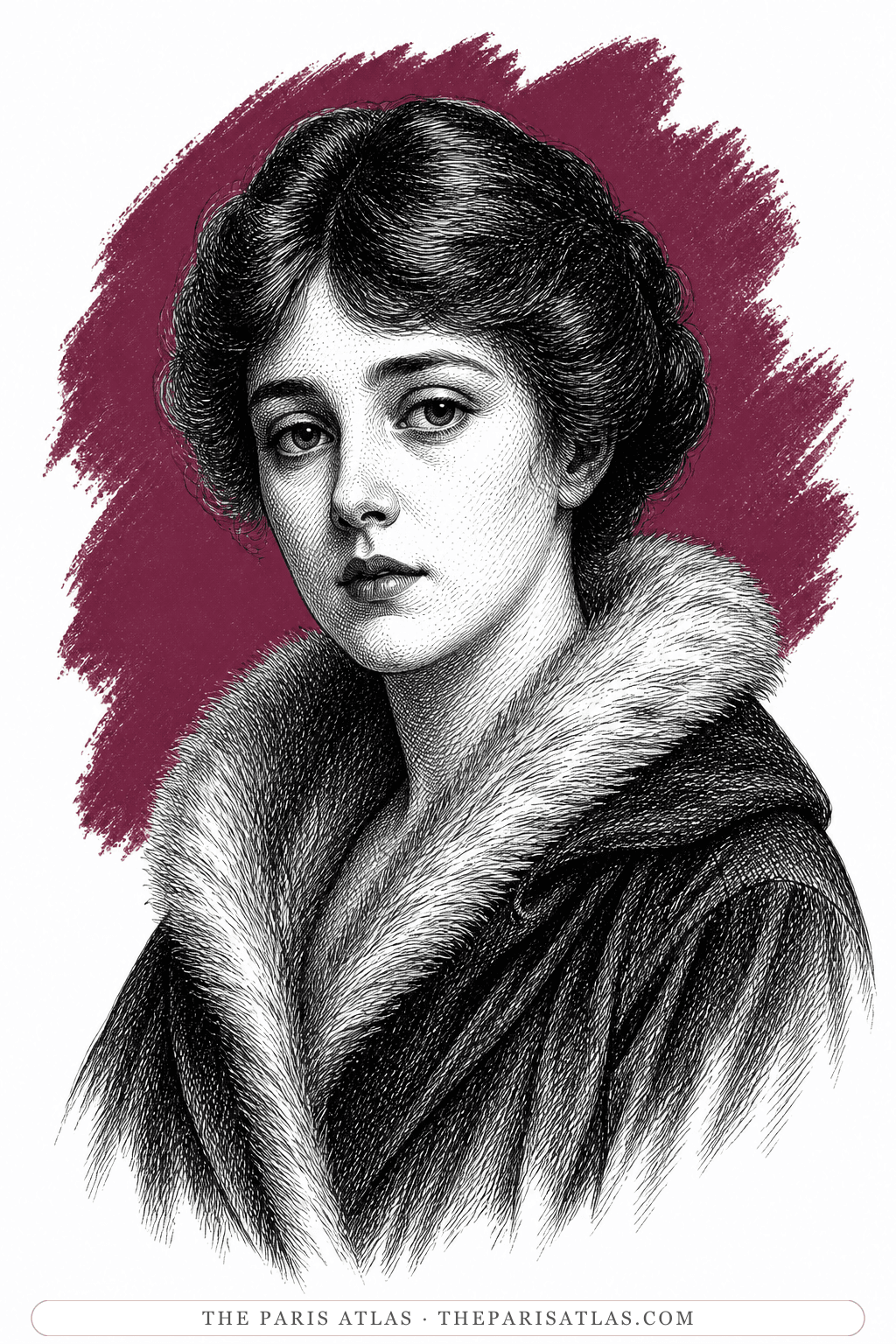
Edith imagines surprising her brother as a delightful entrance, with her crimson cloak making her the bright center of the encounter. Fitzgerald interrupts that self-flattering adventure with Jewel, whom the waiter prevents from entering the dance Edith can leave so easily. The change of viewpoint makes social permission visible: the same doorway grants one woman freedom and subjects another to negotiation. Outside, an unfamiliar man’s remark frightens Edith. The city no longer behaves like a setting arranged for her pleasure, and her glamorous self-image offers little protection.
In May Day, Edith leaves Delmonico's to surprise her brother at his newspaper office. Her crimson cloak carries the brightness of the dance into a much less sheltered city. (Illustration — The Paris Atlas)
The wrong toys
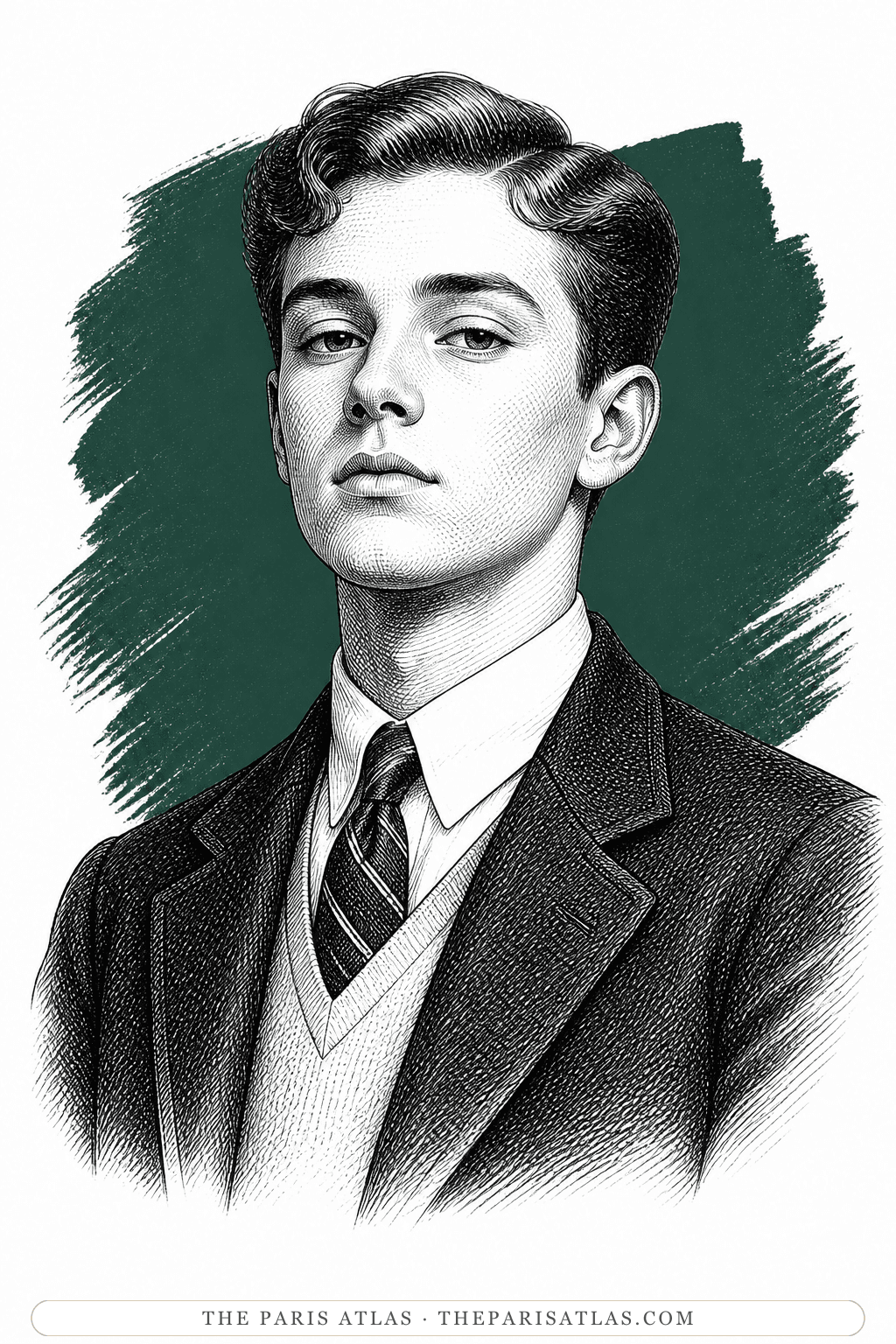
Benjamin’s preference for the encyclopedia exposes a household organized around what a baby ought to want rather than what this child enjoys. He shakes the rattle obediently, not enthusiastically, while his father keeps buying toys to sustain an image of normal infancy. The joke sharpens when breaking a window wins paternal approval and Benjamin begins breaking things deliberately to oblige him. Behavior usually treated as disobedience becomes a dutiful performance. Fitzgerald’s impossible child makes the family’s supposedly natural expectations look rehearsed, rewarded and insistently imposed.
Benjamin's family supplies toys; he prefers the Encyclopedia Britannica. The nursery scene turns Fitzgerald's backward-aging premise into a quiet comedy of incompatible expectations. (Illustration — The Paris Atlas)
Why we recommend it
1
"May Day" is the reason to buy it
Seventy pages cutting between a broke veteran, two demobilised privates, a fraternity dance and a socialist newspaper office on the night of 1 May 1919. It is the earliest thing Fitzgerald wrote that stands with his novels, and the only one in which he gives working men the same attention he gives college men.
2
The table of contents is a small classic in itself
Fitzgerald wrote a note on every story explaining where it came from and what he thought of it, named the one he liked least, credited his wife with a scene he could not write, and reprinted a piece of hate mail. Almost no author does this, and it makes the whole book easier to read honestly.
3
"The Diamond as Big as the Ritz" is unlike anything else he wrote
A boy spends a summer with a school friend whose father owns a mountain of solid diamond and murders his houseguests to keep it quiet. Fitzgerald said he wrote it purely to amuse himself, and the freedom shows.
4
It is short, and it is free
The whole collection has been in the public domain for decades and is on Project Gutenberg. Nothing in it runs long, and the weakest pieces are the shortest ones.
Every person here is invented, and because this is a collection of eleven unconnected stories, no one appears in more than one of them. The guides below cover the three stories that carry the book: "May Day", set in New York on 1 and 2 May 1919; "The Diamond as Big as the Ritz", set on a hidden Montana estate; and "The Curious Case of Benjamin Button", set in Baltimore from 1860 onwards. Each face opens a spoiler-free guide, with endings kept behind a warning.
The title character of "The Curious Case of Benjamin Button": a man born in Baltimore in 1860 looking like a seventy-year-old, who grows younger every year for the rest of his life.
In "The Curious Case of Benjamin Button": the general's daughter who marries Benjamin because she prefers older men, and never forgives him for stopping being one.
The central figure of "May Day": a twenty-four-year-old back from the war in France, out of work, out of money, and asking a rich former classmate for a loan he will not get.
In "May Day": twenty-two, the most danced-with girl at the Yale fraternity ball, and the only character in the story who crosses from the party into the riot.
In "May Day": the woman Gordon Sterrett owes two hundred dollars and cannot get away from — described secondhand for forty pages before she is allowed to speak.
The sixteen-year-old at the centre of "The Diamond as Big as the Ritz", invited to spend the summer at a school friend's house and slow to work out that no guest has ever left it.
The younger daughter of the diamond mountain in "The Diamond as Big as the Ritz": sixteen, never punished in her life, and genuinely sorry about the guests her father has killed.
The elder Washington daughter in "The Diamond as Big as the Ritz": the one who invited the houseguests her father then had killed, and the one who offers to take in laundry at the end.
The owner of the diamond mountain in "The Diamond as Big as the Ritz": the richest man in the world, who keeps the secret by imprisoning the airmen who find him and murdering the guests who leave.
Edith Bradin's brother in "May Day": a former Cornell economics instructor writing for a radical weekly, working late on the night a mob comes up his stairs.
In "The Diamond as Big as the Ritz": the quiet schoolboy who invites John T. Unger home for the summer, and mentions on the train that his father is the richest man in the world.
Bring it to book club
Fitzgerald names the story he likes least and half-apologises for several others. Does knowing an author's own verdict change the way you read his book?
"May Day" cuts between rich college men and two penniless soldiers. Does Fitzgerald write the soldiers as well as he writes the students, and how much does the answer matter?
"The Diamond as Big as the Ritz" is a fairy tale about a man who murders his guests to protect his fortune. What is it saying about American money, and does the fairy-tale form let it say more or less?
"The Curious Case of Benjamin Button" runs one impossible idea through an otherwise ordinary world. Is that a joke, an argument, or a horror story?
The three group headings are Fitzgerald's own: "My Last Flappers", "Fantasies" and "Unclassified Masterpieces". What is he telling a reader by sorting his own work that way?
A complete discussion guide is on our editorial calendar. Join the letter to hear when it ships.
Inside the book
Selected works from this book, with notes on each.
The Jelly-Bean
A young man who has idled away his twenties in a Georgia garage goes to a country-club dance, wins a rich girl's money back at craps, and resolves to change his life. Metropolitan Magazine, October 1920. Zelda Fitzgerald wrote the dice game.
The Camel's Back
A Toledo lawyer attends a fancy-dress ball inside a camel costume with his taxi driver in the back half, and accidentally gets married. Saturday Evening Post, April 1920 — written in one day, and the story Fitzgerald says he likes least of the eleven.
May Day
New York, 1 and 2 May 1919, told through four groups of strangers: a broke veteran, two demobilised privates, a Yale fraternity dance, and a socialist newspaper office a mob is about to storm. Smart Set, July 1920. The best thing in the book.
Porcelain and Pink
A one-act comic playlet. A young woman stays in the bathtub for the entire scene, flirting through a high window with a man who believes he is talking to her sister. Smart Set, January 1920.
The Diamond as Big as the Ritz
A schoolboy spends the summer with a friend whose father owns a Montana mountain made of one diamond, keeps two hundred and fifty people enslaved to guard it, and murders his houseguests on their way out. Smart Set, June 1922.
The Curious Case of Benjamin Button
A man is born in Baltimore in 1860 looking seventy years old, and grows younger every year for the rest of his life. Collier's, May 1922, and the source of the title of the 2008 film.
Tarquin of Cheapside
Elizabethan London. A man is chased through the streets after a rape, hides in a stranger's garret, and writes all night; the poem he produces reveals who he is. Written at Princeton, published in the Smart Set in 1921.
O Russet Witch!
Forty years in the life of a New York bookshop clerk, told through four glimpses of a red-haired woman he never really knows and builds his whole imagination around. Metropolitan Magazine, 1921.
The Lees of Happiness
A magazine writer marries a chorus girl, and a blood clot ends his life without ending it. The most straightforwardly sad thing Fitzgerald had written by 1922. Chicago Sunday Tribune, December 1920.
Mr. Icky
A very short absurdist one-act, subtitled by Fitzgerald as the quintessence of quaintness in one act, parodying the rustic peasant plays then fashionable on the London stage. Smart Set, March 1920.
Jemina
A parody of Kentucky feud fiction in which two mountain families wipe each other out, played entirely for laughs. Written at Princeton; Vanity Fair, January 1921. Fitzgerald's own note says he can no longer find it funny.
Timeline
1919
Fitzgerald is discharged from the army in February and moves to New York, writing streetcar-card copy for the Barron Collier advertising agency. On 1 May, servicemen attack the offices of the socialist daily the New York Call; his story "May Day" is set on that day and the next.
1920
This Side of Paradise makes him famous in March. Over the next twelve months he sells four of the stories collected here, to the Smart Set, the Saturday Evening Post, the Metropolitan and the Chicago Sunday Tribune.
1921
"Tarquin of Cheapside" and "O Russet Witch!" appear in magazines, along with "Jemina" in Vanity Fair. Two of the three had been written years earlier at Princeton.
1922
"The Diamond as Big as the Ritz" runs in the Smart Set in June and "The Curious Case of Benjamin Button" in Collier's in May — the two pieces Fitzgerald wrote for his own amusement rather than for the market.
1922
Charles Scribner's Sons publishes the collection on 22 September, six months after the novel The Beautiful and Damned, with Fitzgerald's annotated table of contents in place of a list.
1922
Reviewing it in the New York Times on 29 October, Hildegarde Hawthorne writes that the stories give "too much of the effect of samples", but grants the book "a development in his art, a new turn".
2008
David Fincher's film The Curious Case of Benjamin Button takes the story's title and premise and invents nearly everything else. It wins three Academy Awards and returns the story to print in a dozen new editions.
Book editions
Hardcover
Hardcover
Charles Scribner's Sons
·
1922
First edition, published 22 September; the first printing is reported at 8,000 copies.
Paperback
Vintage
·
2010
ISBN-13
9780307476371
The widely stocked American trade paperback.
Paperback
Alma Classics
·
2013
ISBN-13
9781847493095
British edition.
Paperback
Oxford University Press
·
2023
ISBN-13
9780198856085
Oxford World's Classics, second edition, with notes and an introduction.
The novel F. Scott Fitzgerald published six months earlier, in March 1922, about a New York couple waiting for an inheritance while the waiting ruins them. Same year, same city, same money.
Ernest Hemingway's first real book of stories, from 1925. The two men met in Paris that spring; put the collections side by side and you have two completely different ideas of what a short story is for.
Sherwood Anderson's 1919 book of linked stories about one small American town. It was the collection every young American writer of the moment had read, and it is Fitzgerald's opposite in every way but ambition.
F. Scott Fitzgerald, the American novelist best known for The Great Gatsby. Charles Scribner's Sons published this collection on 22 September 1922, when he was twenty-five.
What is Tales of the Jazz Age?
A collection of eleven short stories, playlets and sketches, most of them written for American magazines between 1919 and 1922. It was Fitzgerald's second story collection, after Flappers and Philosophers in 1920.
What are the best stories in it?
"May Day" and "The Curious Case of Benjamin Button", with "The Diamond as Big as the Ritz" close behind. The collection is uneven and Fitzgerald says so himself in his own table of contents, where he names "The Camel's Back" as the one he likes least.
Is the Benjamin Button film based on this book?
It takes its title and its premise from the story here, and almost nothing else. Fitzgerald's "The Curious Case of Benjamin Button" is a short comic piece set in Baltimore between 1860 and about 1930. The 2008 film, directed by David Fincher and written by Eric Roth, moves the story to New Orleans and invents the nursing home, the lifelong romance with Daisy, and the framing story told from a hospital bed. It won three Academy Awards, for art direction, makeup and visual effects.
Is "May Day" based on real events?
Yes. It is set on 1 and 2 May 1919, and the attack on the newspaper office at its centre is drawn from a real one: on 1 May 1919 a crowd of roughly a hundred soldiers, sailors and marines wrecked the offices of the New York Call, a socialist daily, at 112 Fourth Avenue, injuring at least twelve people. In his own note on the story Fitzgerald says he took three real events of that spring, unconnected in life, and tried to weave them into a pattern.
Why is the table of contents famous?
Because Fitzgerald wrote it as commentary rather than a list. Each story gets a short paragraph saying where it came from and what he thought of it, and he uses it to name his least favourite piece, credit Zelda Fitzgerald with a scene, and reprint a reader's insulting letter.
Do I need to read it in order?
No. The eleven pieces are unconnected, and no character appears in more than one of them. Fitzgerald groups them under three headings of his own — "My Last Flappers", "Fantasies" and "Unclassified Masterpieces" — but you can start anywhere. Most readers start with "May Day".
If you like F. Scott Fitzgerald
Explore authors with a similar voice, perspective, and influence.
Ernest Hemingway
Fitzgerald vouched for him to Scribner's before they had met, then edited him better than he edited himself; the friendship's five rounds are chronicled in our journal.
The sources below include the primary text, editions, scholarship, archival materials, and other records that informed this page. They document Tales of the Jazz Age, its publication, and its place in literary history.
1Tales of the Jazz Age
Novel
Project Gutenberg ebook #6695, 1922
Used for
Primary-text transcription used for selected passages in “May Day,” sections VI–VIII, and “The Curious Case of Benjamin Button,” section III.
Used for independent biographical, archival, or historical context surrounding F. Scott Fitzgerald's career and the period in which Tales of the Jazz Age appeared.
4Ernest Hemingway: A Life Story
Biography
Carlos Baker, 1969
Used for
Used to cross-check authorship, chronology, and the work's place in F. Scott Fitzgerald's wider catalogue.
5Princeton's Fitzgerald Collections
Archive
Princeton University Library
Used for
Used to verify F. Scott Fitzgerald's bibliography and place Tales of the Jazz Age within the broader chronology of F. Scott Fitzgerald's career.
The primary text is the baseline reference for every book page. Additional references document publication history, interpretation, and historical context where that evidence is available.












 View source