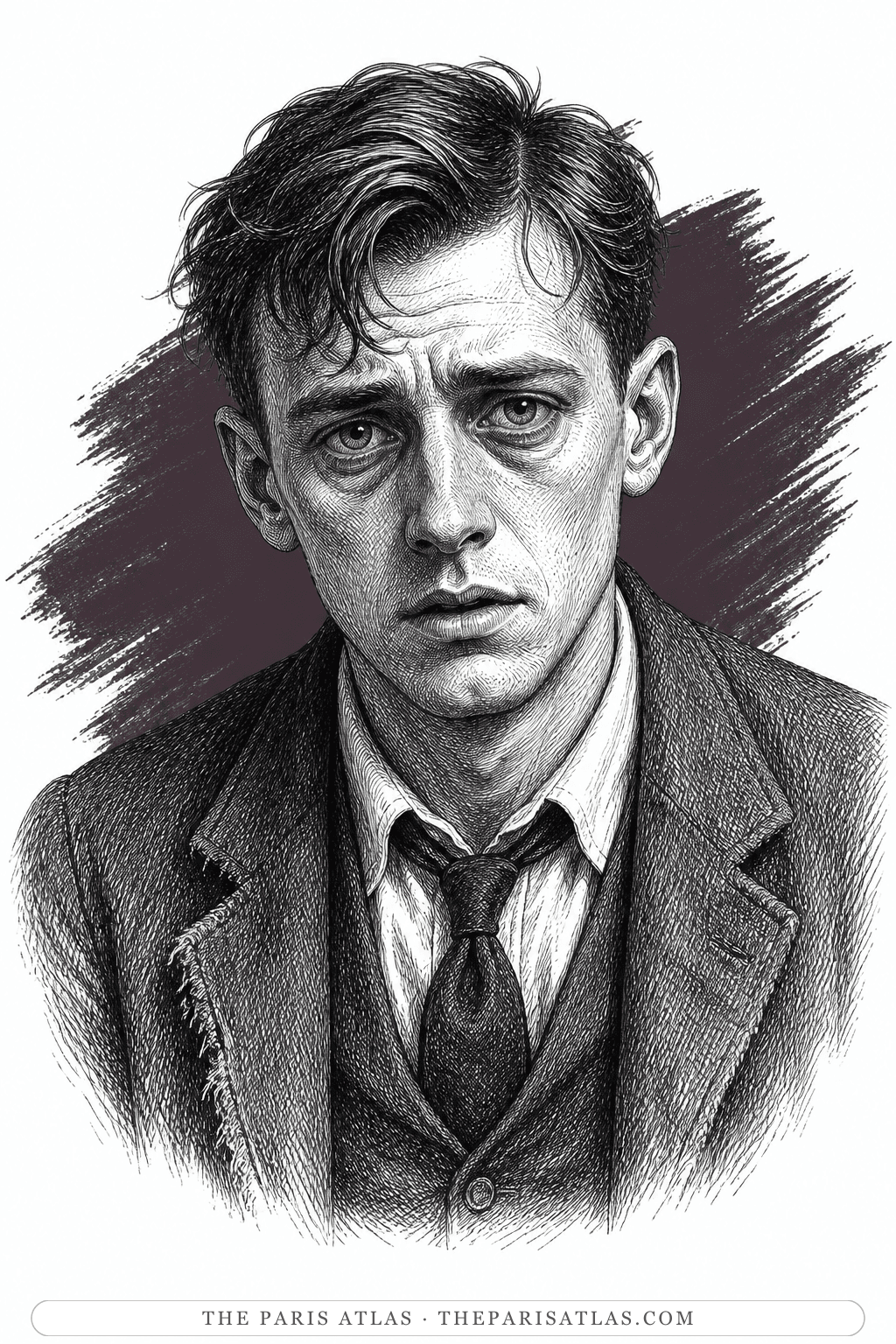
Gordon Sterrett
The central figure of "May Day": a twenty-four-year-old back from the war in France, out of work, out of money, and asking a rich former classmate for a loan he will not get.
Three hundred dollars, and enough rest to start drawing again. He puts the request to Philip Dean in one sentence: "I want you to lend me three hundred dollars." What he offers as security is the one claim he still believes about himself: "I can draw like a streak, and you know it."
The book

At a glance
- The central character of "May Day", the third of the eleven pieces
- About twenty-four; from Harrisburg, Pennsylvania
- Yale, class of the year before the war — Philip Dean's classmate, and once roomed with him
- Served in France; came home in February 1919
- Fired by an export company the day before the story opens. He wants to draw for magazines
- Two hundred dollars to Jewel Hudson, who holds letters he wrote her drunk
Who they are in the book
Spoiler-freeGordon Sterrett is the main character of "May Day", the longest story in Tales of the Jazz Age, which F. Scott Fitzgerald published in the Smart Set in July 1920 and set on 1 and 2 May 1919. He is twenty-four, from Harrisburg, Pennsylvania, and a Yale graduate of the class before the war. He came home from France in February, spent a month at his parents' house, and moved to New York to find work. He found some, at an export company, and was fired the day before the story opens.
The story begins with him telephoning a former classmate, Philip Dean, at the Biltmore Hotel at nine in the morning. What he wants is three hundred dollars. What Fitzgerald shows first is smaller: Gordon picks up one of Dean's dozen silk shirts, then looks at his own cuffs, which "were ragged and linty at the edges and soiled to a faint gray", and works them up his sleeves out of sight. Three years earlier he had been voted one of the best-dressed men in his class.
He believes he is an artist. He wanted to draw for magazines and thinks he could still do it with a few weeks' rest and some money for materials. He is also being pressed for two hundred dollars by a woman named Jewel Hudson, who has letters he wrote her while drunk. Fitzgerald wrote the story about the spring of 1919, when he was himself living in a single room in New York writing advertising copy and being turned down by editors — though the character is not him, and does not do what he did.
How Gordon Sterrett Is Portrayed
- The cuffsFitzgerald introduces him through clothing rather than dialogue. In Dean's hotel room he examines one of nearly a dozen heavy silk shirts, yellow with a pale blue stripe, then holds his own coat sleeves down and works his frayed cuffs up until they cannot be seen.
- How he asksHe rehearses being frank, gets frank, and cannot stop. "I'm all in," he says twice. He tells Dean he has bled his family until he is ashamed to ask for another nickel, and admits that he would probably have killed himself if he had not heard Dean was coming east.
- What Dean sees in himDean, who is not a cruel man so much as an untroubled one, tries to name what has changed and gets closer than he means to: "There's a regular aura about you that I don't understand." Then: "It's a sort of evil." Gordon answers that it is worry, poverty and sleepless nights.
- Coming apart, described from insideOn the stairs at Delmonico's he tries to explain himself to Edith Bradin and produces the story's best line about himself: "Things have been snapping inside me for four months like little hooks on a dress, and it's about to come off when a few more hooks go." Then, plainly: "I'm very gradually going loony."
- The way he is with EdithHe had loved to draw her at college and could do her profile with his eyes shut. When he finally gets a dance he is shaking, his eyes are bloodshot, and he tells her the sensible thing: "Best thing you can do is to pretend not to know me." She agrees with him before the night is over.
- Jewel HudsonHe owes her two hundred dollars and cannot get rid of her. He describes her to Dean as someone who used to be respectable, whose people are dead, who lives with an old aunt, and who is not, as he puts it, at all the flabby sort of person you would expect. At the end of the night she comes to Delmonico's, bribes a waiter a dollar to fetch him out, and takes him away.
- The two moments the story turns onBoth are silent. When Dean finally hands over eighty dollars instead of three hundred, the two men look at each other and Fitzgerald writes: "For in that instant they quite suddenly and definitely hated each other." Later, blinded by tears, Gordon stumbles down the Biltmore steps with the money in his fist.
He never gets the three hundred dollars. Dean gives him eighty and goes off to the barber, and the two of them meet again only in fragments — at the Gamma Psi dance, where Gordon sits on the stairs with his palm to his head, and at Childs' restaurant on Fifty-ninth Street at dawn, where Dean, by then very drunk and calling himself Mr. Out, stands over the table wagging a finger and saying he told him so.
The last section is four sentences long. Gordon wakes in a small hotel off Sixth Avenue with the windows shut and his clothes on the floor, and takes about a minute to understand what has happened: "he realized that he was irrevocably married to Jewel Hudson." He goes out half an hour later, buys a revolver at a sporting goods store, takes a taxi to his room on East Twenty-seventh Street, leans across the table that holds his drawing materials, and shoots himself in the head behind the temple. Fitzgerald gives it no commentary at all, and ends the story there.
If you like Tales of the Jazz Age


If you like F. Scott Fitzgerald
Explore authors with a similar voice, perspective, and influence.

Ernest Hemingway
Fitzgerald vouched for him to Scribner's before they had met, then edited him better than he edited himself; the friendship's five rounds are chronicled in our journal.
View author
Henry Miller
The Brooklyn dropout who arrived in Paris broke at thirty-eight and wrote the exuberant, banned books that ended American censorship.
View author
Louis-Ferdinand Céline
The doctor of the Paris slums who wrote the century's blackest, funniest novel — and changed the sound of French prose.
View author