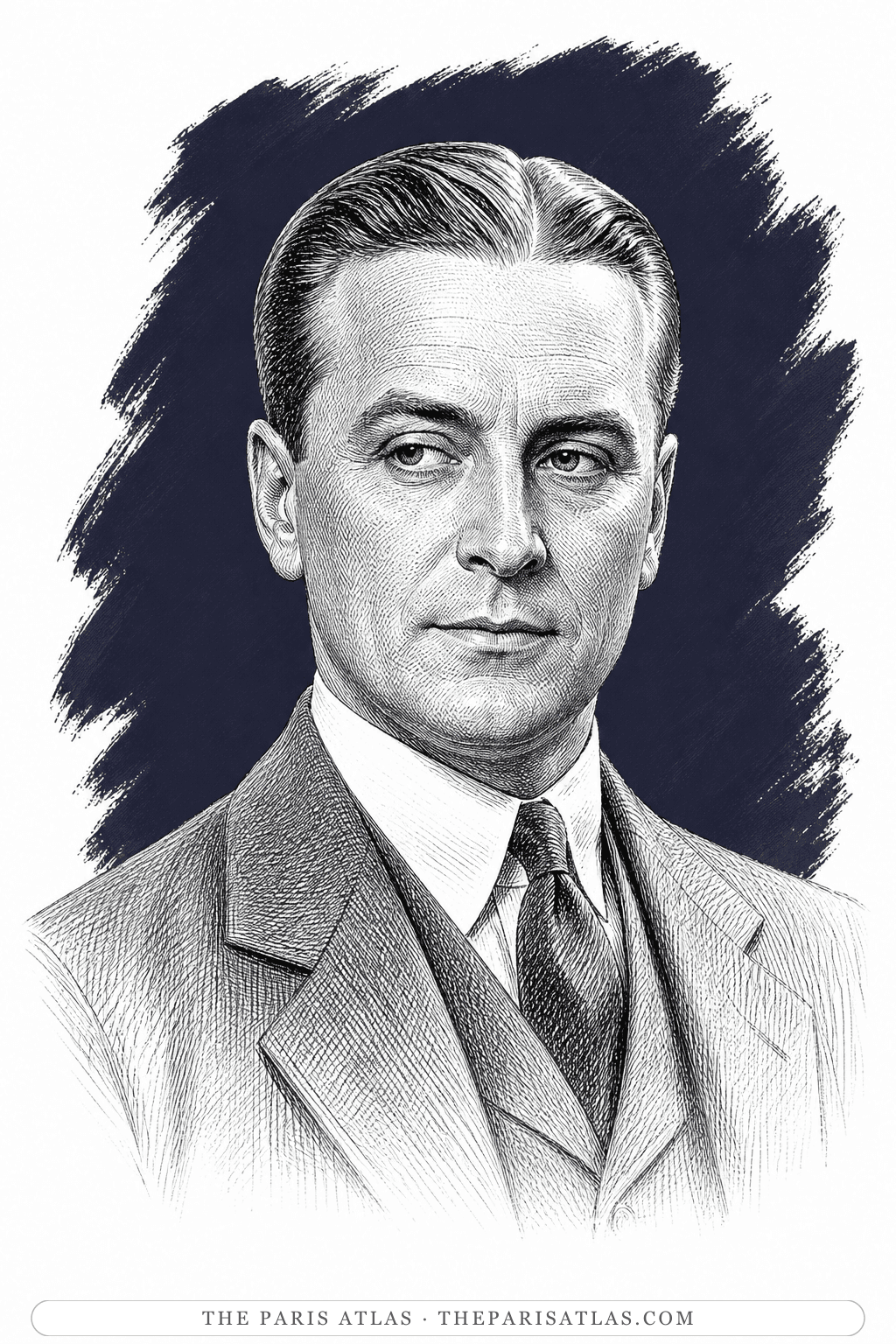
Braddock Washington
The owner of the diamond mountain in "The Diamond as Big as the Ritz": the richest man in the world, who keeps the secret by imprisoning the airmen who find him and murdering the guests who leave.
For nothing to change. On the mountain at dawn he asks God for one thing, and it is the smallness of the request that defines him: that matters should be as they were yesterday at this hour, and should so remain. Fitzgerald adds the sentence that explains the whole man: "There was no one else with whom he had ever needed to treat or bargain."
The book

At a glance
- The antagonist of "The Diamond as Big as the Ritz", the fifth of the eleven pieces
- About forty
- Five square miles of Montana that have never been surveyed, and a mountain that is one diamond, one cubic mile without a flaw
- Son of Fitz-Norman Culpepper Washington; married to a Spanish wife; father of Percy, Jasmine and Kismine
- Half a dozen anti-aircraft guns, doctored survey instruments, a diverted river and a fake village
- About two hundred and fifty people in slavery, told that the Confederacy won the Civil War
Who they are in the book
Spoiler-freeBraddock Tarleton Washington owns the mountain in "The Diamond as Big as the Ritz", the story F. Scott Fitzgerald published in the Smart Set in June 1922. He is about forty, good-looking and vacuous in the face, with intelligent eyes and a walking stick of gray birch topped with an opal. He smells of horses in the mornings. He is, by a distance nobody can measure, the richest man alive.
Where the money comes from is the premise of the story, not a detail of it. His father, Fitz-Norman Culpepper Washington, was a Confederate colonel who went west after the Civil War taking two dozen people he held in slavery, and found a mountain that turned out to be a single flawless diamond about a cubic mile in size. They dug it out for him. He told them it was a rhinestone mine, and to make sure none of them ever left he read them a proclamation announcing that the Southern armies had reorganised and beaten the North in a pitched battle. Because the diamond could not be sold openly without destroying the gem market and the gold standard together, he sold it in secret to the courts of Europe and converted the proceeds into radium banked under false names in a thousand cities. Every dollar the Washingtons have was dug by people who were told the Confederacy won, and the fortune exists only for as long as they never find out.
Braddock inherited that arrangement and did the one thing left to do with it: "He sealed up the mine." What he inherited along with it was the labour force: about two hundred and fifty men, women and children by the time John T. Unger arrives, the descendants of his father's two dozen, still held, still lied to, sixty years after abolition. The estate's whole security apparatus exists to keep the secret they are the living evidence of.
Everything else he does follows from that one problem. He has bribed a government survey department, doctored the official maps of the United States, and had a river diverted and a village built on its banks to send surveyors ten miles up the wrong valley. He keeps anti-aircraft guns for aeroplanes and a glass-sided pit for the airmen who come down alive. And he has his daughters' houseguests drugged in their sleep on the way out, and their families told they died of scarlet fever in Butte.
How Braddock Washington Is Portrayed
- How he talks about the pitHe draws up a garden chair at the edge of a covered hole full of imprisoned airmen and asks them genially how they are. He has offered, he tells them, to have any or all of them painlessly executed, to have their wives and mothers kidnapped and brought out, and to enlarge the hole and feed them for life. He says he bears them no ill-will.
- His one piece of philosophyA prisoner tries to argue him toward pity and gets three flat answers in succession. Unnecessary: "Not to me." Cruel: "Cruelty doesn't exist where self-preservation is involved." Stupid: he concedes that one, and asks the man to try another.
- The joke he makes about fairnessInvited to be fair-minded, he asks how a man of his position could be, and compares the idea to a Spaniard being fair-minded toward a piece of steak. The prisoners' faces fall. He carries on talking.
- The people he holdsTwo hundred and fifty men, women and children, descendants of the two dozen his father took north. He shows John the marble quarters and explains that he once gave every room a tiled bath during a period he now describes as absurd idealism, that several of them caught cold and died, and that he stopped the baths because water is not good for certain races except as a beverage. He says all of it in the tone of a man describing a golf course, which is where he walks next.
- The people he kidnapped to decorate itA landscape gardener, an architect, a stage designer and a French poet, taken and set loose with unlimited materials. The poet complained about missing the boulevards in spring; the rest could only think in conventions; and all four went mad in a single night arguing over where to put a fountain, and are now in an asylum in Westport, Connecticut. The rooms John admires were designed by a moving-picture man who could not read or write.
- The bribeAt dawn, with the mountain being bombed, he climbs to a saddle of rock, has two of his slaves carry an enormous cut diamond up behind him, and addresses God directly. He offers the greatest diamond ever made, set in a dome of beaten gold with an altar of radium, and asks in exchange only that yesterday be restored. Fitzgerald notes that Washington's whole posture was antithetical to prayer, and that he doubted only whether the bribe was big enough.
- The answerThe sky darkens for an instant, there is a sound like far-off trumpets and a mutter of thunder over the mountain, and then the day resumes. Fitzgerald gives the verdict in six words: "God had refused to accept the bribe."
The Italian tutor he let out of the pit to teach his daughter gets away, survives being shot at in fourteen cities, and comes back with a dozen aeroplanes. The guns are knocked out one by one through the night. At dawn Washington climbs the mountain and makes his offer to God, and it is refused. He then walks back down, collects his wife and his son Percy, and goes through a trap-door in the side of the mountain with two of the men he enslaved carrying the diamond.
He had wired the mountain. It goes up in a burning yellow glow that leaves a black waste and no trace of the aviators climbing it or the five people underneath. The château detonates into the lake, and a powdery dust of marble drifts over the ruin. The last thing he does is the same thing he has done all his life: he refuses to let anyone else have it. His two daughters, who are on the far slope, inherit nothing, because the bank-books burned with him.
If you like Tales of the Jazz Age


If you like F. Scott Fitzgerald
Explore authors with a similar voice, perspective, and influence.
Ernest Hemingway
Fitzgerald vouched for him to Scribner's before they had met, then edited him better than he edited himself; the friendship's five rounds are chronicled in our journal.
View author
Henry Miller
The Brooklyn dropout who arrived in Paris broke at thirty-eight and wrote the exuberant, banned books that ended American censorship.
View author
Louis-Ferdinand Céline
The doctor of the Paris slums who wrote the century's blackest, funniest novel — and changed the sound of French prose.
View author