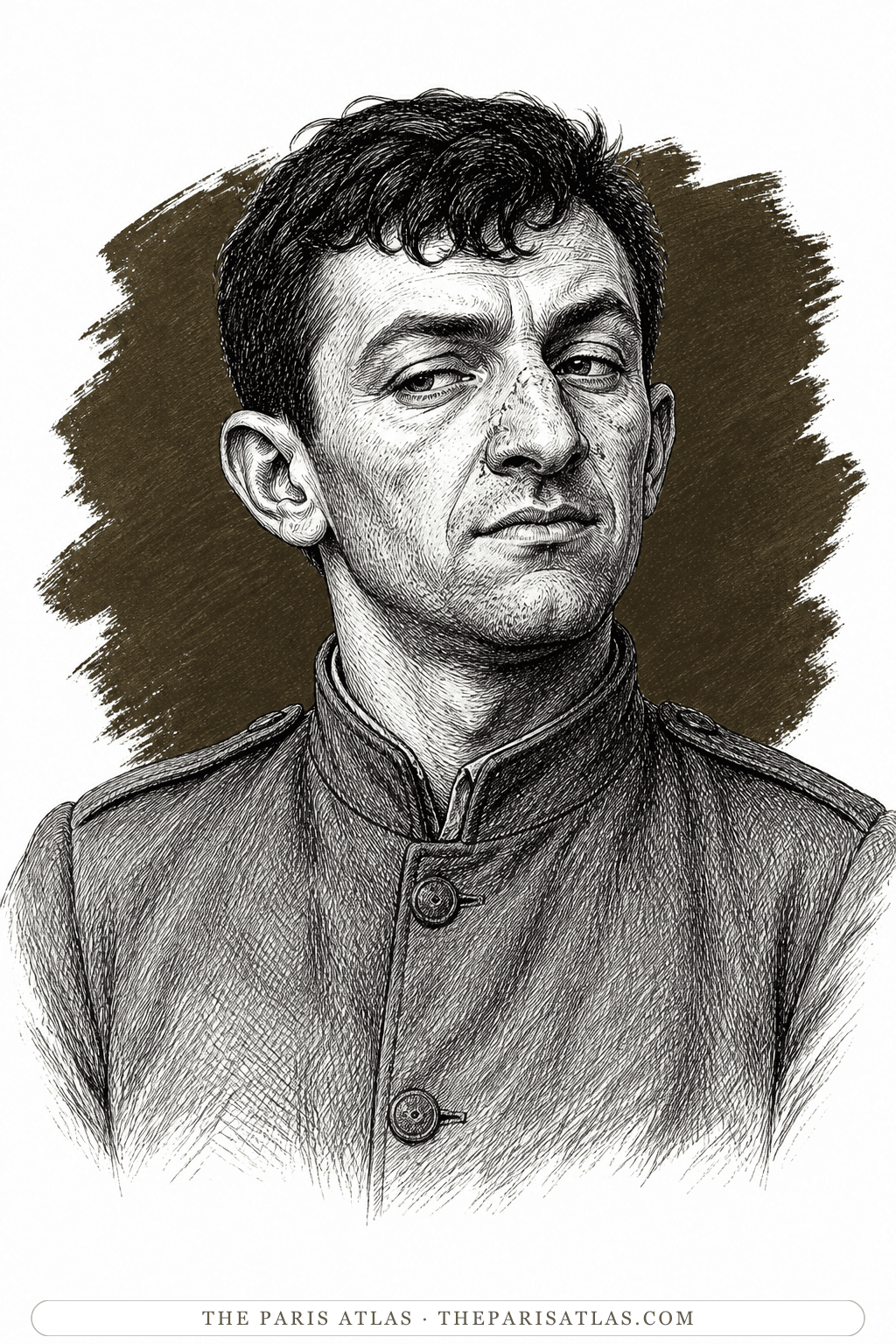
Gus Rose
The second of the two privates in "May Day": Carrol Key's companion for the whole night, and the only one of the pair still standing in the morning.
To go wherever Key is going, and to get a drink when they arrive. Fitzgerald establishes the whole relationship in his first line: "Where to?" asked Rose, in a tone which implied that he would not be surprised if Key suggested the South Sea Islands.
The book

At a glance
- In "May Day", the third of the eleven pieces
- A drafted division from New Jersey, landed in New York three days earlier
- Private Carrol Key, the taller of the two, for every scene but the last
- Less than five dollars
- "Oh, boy!" — including on the last page
- Sixth Avenue, the mob, a Delmonico's store room, the newspaper office, Childs' at dawn, and the Biltmore lobby
Who they are in the book
Spoiler-freeGus Rose is one of the two demobilised soldiers whose thread runs alongside the Yale men through "May Day", F. Scott Fitzgerald's story of New York on 1 and 2 May 1919. He and Carrol Key come out of a cheap Sixth Avenue restaurant at nine in the evening wearing the insignia of a drafted New Jersey division that landed three days before, with less than five dollars between them, and they are together for every scene either of them appears in until the last two.
Fitzgerald describes him in a single hard sentence and then spends the rest of the night complicating it. He is short, swart and bandy-legged, with rat-eyes and a much-broken hooked nose, and his defiant manner is explicitly identified as a bluff, a weapon of protection borrowed from that world of snarl and snap in which he had always lived. The story is equally direct about what has just happened to both men: they are between masters, uncertain and resentful, and "they would have felt more at home in a prison than in this new-found and unquestionable freedom".
He is the follower of the pair. Key has the ideas: a brother who might get them liquor, a plan for waiting until the bottles are opened — and Rose supplies the enthusiasm, the second opinion, and most of the appetite. What separates him from Key in the end is nothing either of them chooses. He is standing a few feet to one side when it happens.
How Gus Rose Is Portrayed
- How he is introduced"His companion was swart and bandy-legged, with rat-eyes and a much-broken hooked nose." Fitzgerald then explains the manner rather than leaving it as a caricature: the defiant air is a pretense, a weapon of protection borrowed from a world of physical bluff and physical menace that is the only one he has known.
- What the two of them talk aboutGetting out of uniform tomorrow and buying regular clothes, which Fitzgerald prices immediately: with under five dollars between them, the intention "can be taken largely as a pleasant game of words, harmless and consoling". They reinforce it with chuckling and repeated cries of "Oh, boy!" and "I'll say so!"
- "I been through the delouser"Told by Key's brother George, a Delmonico's waiter, that he cannot sit down because the room is set for a midnight banquet, he takes it as an insult about his person rather than the furniture and says he has been through the delouser. It is the only time all night he answers back to anybody.
- He is the one who takes the bottleKey argues for caution — wait until the bottles are opened and a college man will be blamed. Rose does not wait. The moment George's footsteps recede he darts into the room of spirits and comes back with a bottle in his hand, and adds the commercial refinement: "And if we want to we can sell it to sojers any time we want to."
- "We're Americuns"Drinking Peter Himmel's whiskey, told the story of a fight with a Bolshevik, he offers the evening's entire political position in two words. Fitzgerald glosses it without comment: "We're Americuns," said Rose, implying a sturdy, defiant patriotism. Himmel toasts it and pours another round.
- The morning afterAt Childs' on Fifty-ninth Street at dawn, among débutantes eating buckwheat cakes, he is "sober but a little dazed" and classed by the narration as one of the drab figures, the exact word the story used for him and Key on Sixth Avenue nine hours earlier. He orders coffee and doughnuts and thinks about his friend.
- The last thing he doesRecognising the two undergraduates who bought him drinks, he starts over to speak to them, is met with glances of withering unrecognition, and falls in behind them instead, following at about forty paces, chuckling to himself and saying "Oh, boy!" over and over in delighted, anticipatory tones. He is doing this when Edith Bradin points at him.
He lives, and he is arrested for it. In the dark of the fight in the newspaper office Carrol Key goes out of the back window and is killed; Edith Bradin notices that the short dark soldier has disappeared from the front of the crowd before she registers what has happened to the tall one. Rose gets himself uptown afterwards with two or three others, loses them somewhere around Columbus Circle, and ends up at Childs'.
His grief is four words long and he says them twice: "He was a darn good guy, o'right." Fitzgerald puts the plain fact of the death in Rose's head rather than in the riot scene — "He had fallen thirty-five feet and split his skull like a cracked cocoa-nut" — which makes Rose the only person in the story who properly registers that anyone died. A few hours later, in the Biltmore lobby, Edith stops, points and says there is the soldier who broke her brother's leg. A stout man springs at him and the lobby closes round the group. He never gets to say which of them he was, or that his friend is dead.
If you like Tales of the Jazz Age


If you like F. Scott Fitzgerald
Explore authors with a similar voice, perspective, and influence.
Ernest Hemingway
Fitzgerald vouched for him to Scribner's before they had met, then edited him better than he edited himself; the friendship's five rounds are chronicled in our journal.
View author
Henry Miller
The Brooklyn dropout who arrived in Paris broke at thirty-eight and wrote the exuberant, banned books that ended American censorship.
View author
Louis-Ferdinand Céline
The doctor of the Paris slums who wrote the century's blackest, funniest novel — and changed the sound of French prose.
View author