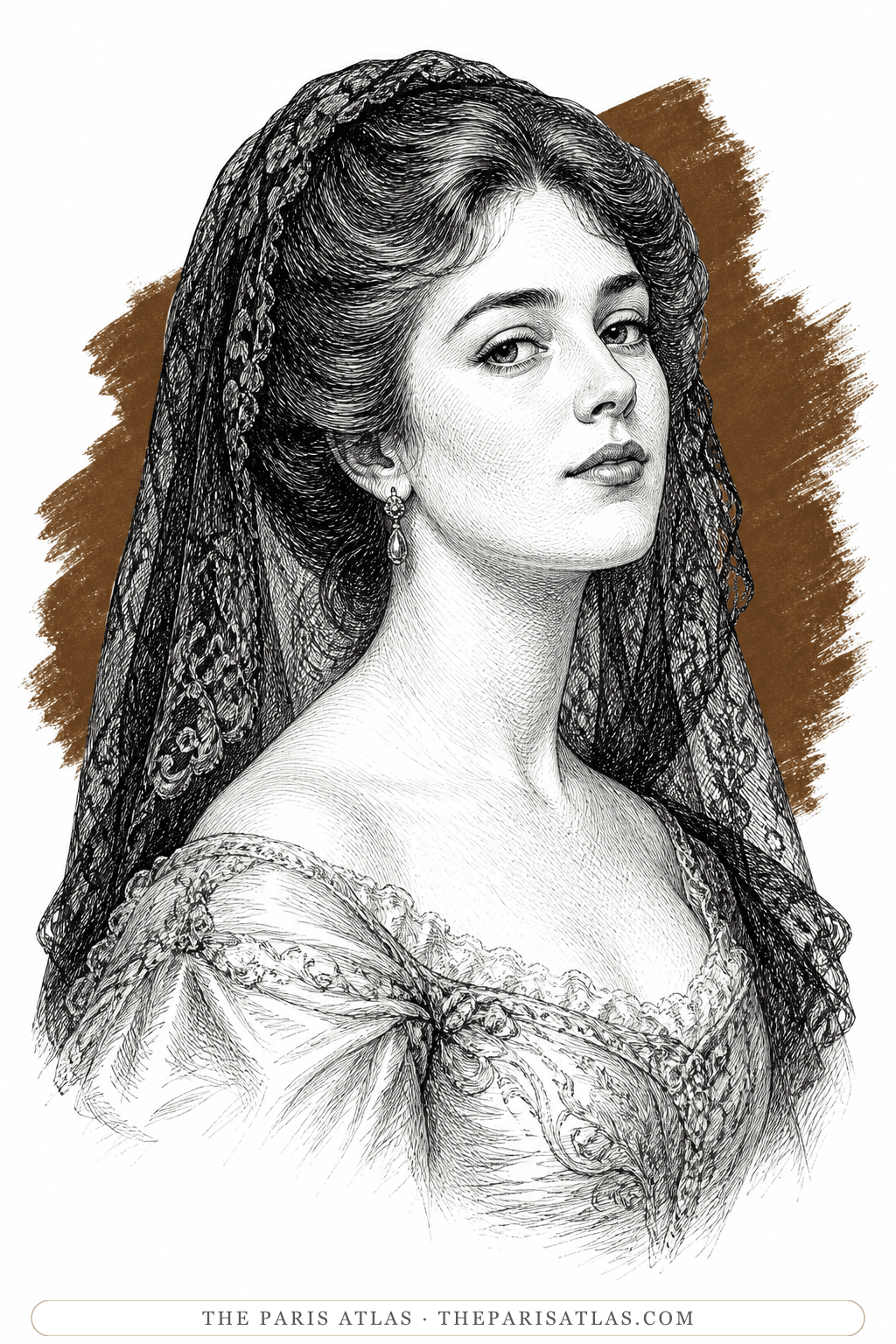
Hildegarde Moncrief
In "The Curious Case of Benjamin Button": the general's daughter who marries Benjamin because she prefers older men, and never forgives him for stopping being one.
To be looked after by a man old enough to know how. She lays it out at their first meeting: "I like men of your age," Hildegarde told him. And a moment later, that she would rather marry a man of fifty and be taken care of than marry a man of thirty and take care of him.
The book

At a glance
- In "The Curious Case of Benjamin Button", the sixth of the eleven pieces
- Daughter of General Moncrief, of Baltimore
- Benjamin Button in 1880; their son Roscoe was born the following year
- At a dance at the Shevlins' country house outside Baltimore, in a yellow Spanish mantilla
- Living in Italy
Who they are in the book
Spoiler-freeHildegarde Moncrief is the woman Benjamin Button marries in "The Curious Case of Benjamin Button", F. Scott Fitzgerald's 1922 story about a man who ages backwards. Benjamin sees her for the first time at a dance at the Shevlins' country house outside Baltimore in August 1880, getting out of a brougham in a Spanish mantilla of soft yellow butterflied in black. He is twenty years old and looks about fifty. She is the daughter of General Moncrief, and she likes that.
The comedy of their courtship is that she believes she is marrying a mature man and he believes he is getting away with something. She tells him within one dance exactly what she thinks about age, and it is the most quotable speech in the story. They are engaged six months later, over her father's furious objection and against a wave of Baltimore gossip that Benjamin is a fraud, an escaped convict, or John Wilkes Booth in disguise.
She is not a fool and she is not a villain. Fitzgerald simply gives her the one attitude that cannot survive her husband's condition, and then makes her live with it for thirty years.
How Hildegarde Moncrief Is Portrayed
- The speech about agesTwenty-five is too worldly-wise, thirty is apt to be pale from overwork, forty is the age of long stories that take a whole cigar to tell, and sixty is too near seventy. Fifty, she concludes, is the mellow age. "I love fifty." Benjamin, who is twenty and looks fifty, longs passionately to be fifty.
- Her father's objectionGeneral Moncrief declared he would rather fall upon his sword than announce the engagement, warned her about the high mortality among men of fifty, and told her the wholesale hardware business was unstable. He was reconciled some years later when Benjamin paid to bring out his twenty-volume History of the Civil War, which nine publishers had refused.
- Why she married him anywayBecause the true story was buried in an avalanche of false ones. Fitzgerald puts it in one sentence: "So many of the stories about her fiancé were false that Hildegarde refused stubbornly to believe even the true one." Roger Button printed his son's birth certificate in large type in a Baltimore paper and nobody believed that either.
- How she takes it when he starts looking youngerAs bad manners. She sniffs, tells him she does not think it is anything to boast about, and then says the line the marriage never recovers from: "I should think you'd have enough pride to stop it." Told he cannot help it, she says he is simply being stubborn and asks what the world would be like if everybody looked at things the way he does.
- How the story describes her ageingEntirely through Benjamin's eyes, and unkindly. Her honey-coloured hair becomes an unexciting brown, the blue enamel of her eyes takes on the aspect of cheap crockery, and she sits among the chaperons at parties following him with reproachful eyes while he dances with débutantes. Fitzgerald allows one flat sentence of the plain fact underneath: there was only one thing that worried Benjamin Button, and it was that his wife had ceased to attract him.
- What people say about themIn 1880 Baltimore thought it criminal for a lovely girl to throw herself at a man of fifty. By 1905 the same city was saying what a pity it was to see a young fellow tied to a woman of forty-five. Fitzgerald notes that people had forgotten, as people do, that their mothers and fathers had said the opposite about the same couple.
The marriage does not break so much as thin out. Benjamin joins the army for the Spanish-American War in 1898 largely to be somewhere else, comes back looking thirty, and finds her forty with the first gray in her hair. From then on Fitzgerald tracks the gap in one direction only. Benjamin dances at every party in Baltimore; she sits with the chaperons.
By 1914, when Benjamin comes home from Harvard with a diploma and the appearance of a boy of twenty, she is not in the house. Fitzgerald disposes of her in half a sentence: Hildegarde was now residing in Italy. She never appears again, and the story does not say whether they were divorced, separated or simply finished. She is the only person in it who was told the truth at the start and chose not to believe it.
If you like Tales of the Jazz Age


If you like F. Scott Fitzgerald
Explore authors with a similar voice, perspective, and influence.

Ernest Hemingway
Fitzgerald vouched for him to Scribner's before they had met, then edited him better than he edited himself; the friendship's five rounds are chronicled in our journal.
View author
Henry Miller
The Brooklyn dropout who arrived in Paris broke at thirty-eight and wrote the exuberant, banned books that ended American censorship.
View author
Louis-Ferdinand Céline
The doctor of the Paris slums who wrote the century's blackest, funniest novel — and changed the sound of French prose.
View author