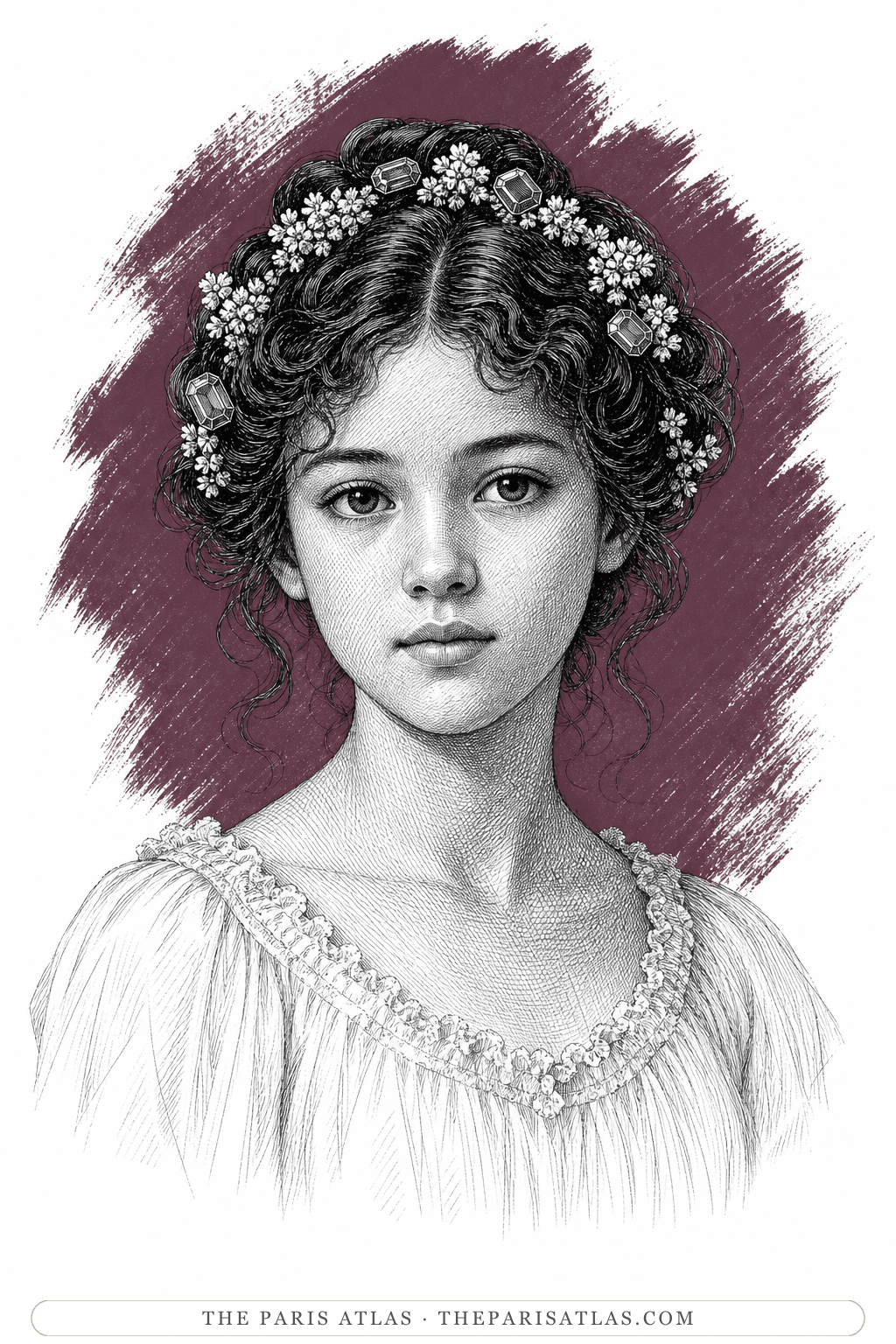
Kismine Washington
The younger daughter of the diamond mountain in "The Diamond as Big as the Ritz": sixteen, never punished in her life, and genuinely sorry about the guests her father has killed.
To be somebody's first love, which she has never been allowed to be. She tells John so on the first morning: "I'm absolutely fresh ground." Then, in case he has missed it: "I've never had a boy in love with me in all my life."
The book

At a glance
- One of the two Washington daughters in "The Diamond as Big as the Ritz", the fifth of the eleven pieces
- Sixteen — younger than John T. Unger, and younger than her sister Jasmine
- Daughter of Braddock Tarleton Washington and his Spanish wife; sister of Percy and Jasmine
- Going east to Miss Bulge's school in New York, and living at the family's New York house on weekends
- John's gold school football on a platinum chain, next to her skin
- Poetry, and nothing else, by her own account
Who they are in the book
Spoiler-freeKismine Washington is the younger of the two daughters in "The Diamond as Big as the Ritz", F. Scott Fitzgerald's 1922 story about a hidden Montana estate built on a mountain of solid diamond. She is sixteen. She has spent every summer of her life inside the estate, has never been alone with a boy other than her brother, and is going east to school in the autumn. John T. Unger, her brother's school friend, meets her barefoot on the grass on his first morning and is finished inside a page.
She is charming, and Fitzgerald writes her charm without softening what is underneath it. She protests at length that she is not sophisticated: "I never smoke, or drink, or read anything except poetry" — and she means it. She has also known since she was small that her father drugs the family's houseguests in their sleep and tells their families they died of scarlet fever in Butte, and she has decided that this is sad but not a reason to have no visitors.
That combination is the point of her. She is not a monster and she is not a hypocrite. She is a child who has been raised inside an absolute fortune with no law over it, and she has simply absorbed the arithmetic her father lives by. The story is fond of her, and never once pretends she is innocent.
How Kismine Washington Is Portrayed
- How she introduces herselfBarefoot on the wet grass in a white gown to the knee, with a wreath of mignonettes and blue slices of sapphire in her hair. She announces her name, explains she missed dinner because she was ill, and adds — in the eye-line rather than the dialogue, which is Fitzgerald's trick throughout the scene — that when she is sick she is sweet, and when she is well she is sweeter.
- The house rules"None of us has ever been punished." And: "Father said we never should be." Her evidence is that her sister Jasmine once pushed their father down the stairs and he got up and limped away without a word.
- The guestsShe cries when it comes out, and what she is crying about is that she had grown attached to some of them. Her explanation is entirely practical: it is done in August or early September, so nobody has to sit through a farewell scene, and "It's only natural for us to get all the pleasure out of them that we can first." She adds that she never invited any of them. Jasmine did.
- "It was done very nicely"Asked directly whether her father had them murdered, she nods and gives the details in the same voice she uses for the weather: they were drugged in their sleep, and their families were told they had died of scarlet fever in Butte.
- During the bombingShe blows the château's fuse with a penny, takes John up to the roof garden to watch, and claps her hands with pleasure until the bombs start falling. When the quarters of the enslaved workers are blown apart she calls out the loss in dollars at pre-war prices and adds: "So few Americans have any respect for property."
- Being poorThe prospect delights her. "We'll be poor, won't we? Like people in books. And I'll be an orphan and utterly free." Then: "Free and poor! What fun!" She stops on the path to kiss him about it.
- The wrong drawerTold to fill her pockets from her jewel box, she brings out two handfuls of rhinestones. She had swapped them years before with a visiting girl who owned a dress covered in them, because she had never seen anything but precious stones and wanted some. Her only regret is not having them in a better setting: "I think I like these better. I'm a little tired of diamonds."
- The last thing she saysLying under the stars with nothing left, she looks up and finds she has never actually looked at them before. "I always thought of them as great big diamonds that belonged to some one. Now they frighten me."
She survives, and is the only member of her family besides Jasmine to do so. Her father, her mother and her brother Percy go through a trap-door in the side of the mountain with two of the men they enslaved, and Braddock Washington detonates the whole thing; the aviators on the slope are consumed with them, and the château explodes into the lake. Kismine and Jasmine watch it from a wooded spot halfway up with John.
She takes the ruin lightly, which is the most disconcerting thing about her. She asks whether her father will be in Hades, and John has to tell her that her father is dead and that she has confused Hades with somewhere else. The rhinestones turn out to be worthless, Jasmine volunteers to support them all by taking in washing, and Kismine's last speech is about the stars, which she has spent sixteen years assuming were diamonds belonging to somebody. Fitzgerald leaves her alive, penniless, sixteen, and frightened for what looks like the first time.
If you like Tales of the Jazz Age


If you like F. Scott Fitzgerald
Explore authors with a similar voice, perspective, and influence.

Ernest Hemingway
Fitzgerald vouched for him to Scribner's before they had met, then edited him better than he edited himself; the friendship's five rounds are chronicled in our journal.
View author
Henry Miller
The Brooklyn dropout who arrived in Paris broke at thirty-eight and wrote the exuberant, banned books that ended American censorship.
View author
Louis-Ferdinand Céline
The doctor of the Paris slums who wrote the century's blackest, funniest novel — and changed the sound of French prose.
View author