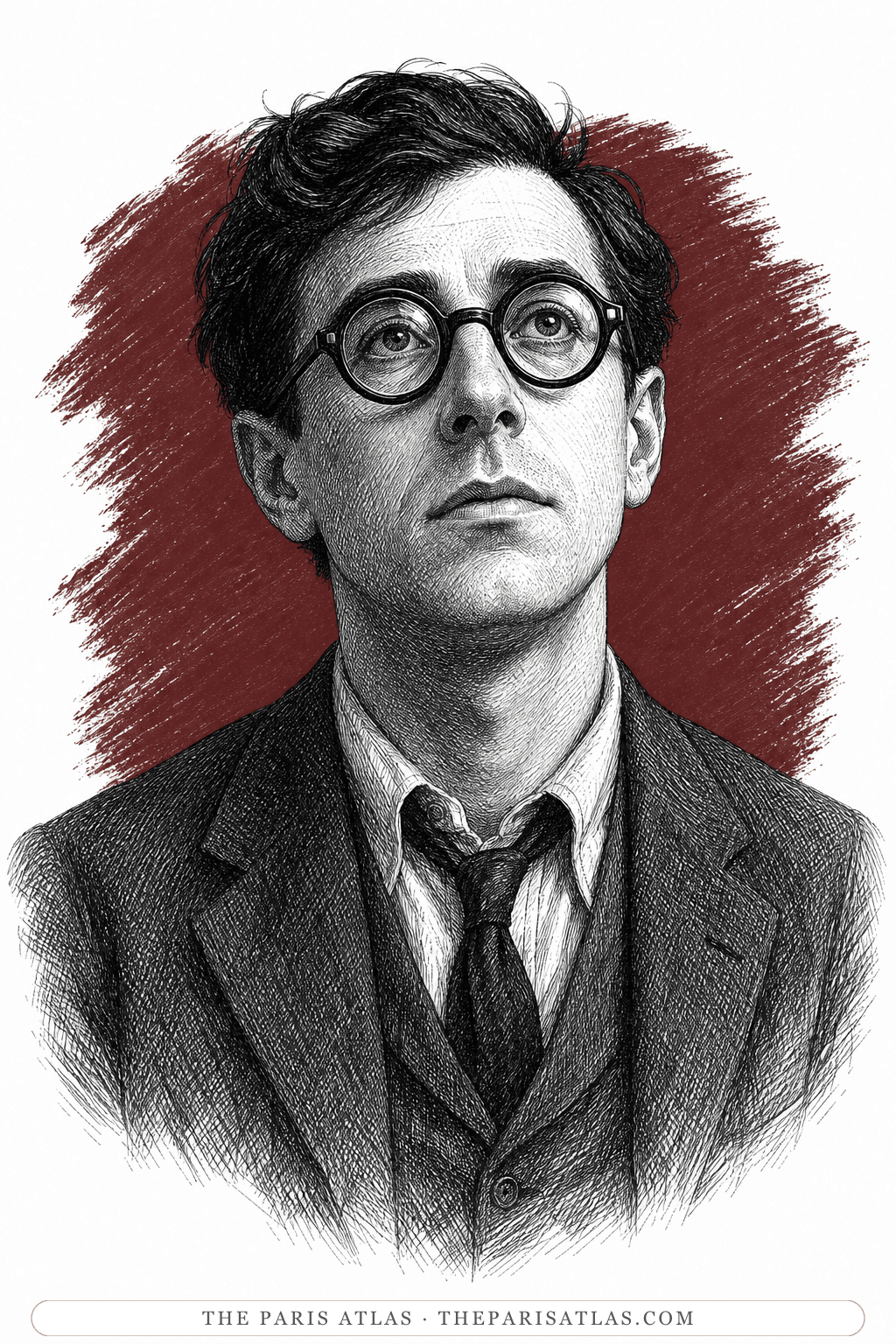
Henry Bradin
Edith Bradin's brother in "May Day": a former Cornell economics instructor writing for a radical weekly, working late on the night a mob comes up his stairs.
To finish the night's work and be left alone to do it. When his sister presses him on whether he is on the right track, he does not argue the politics; he changes the subject to her stockings and asks whether she is trying to make him out as criticising her.
The book

At a glance
- In "May Day", the third of the eleven pieces
- Harrisburg, Pennsylvania — Edith Bradin's brother
- An instructor in economics at Cornell
- Writing for a radical weekly, the New York Trumpet, on Forty-fourth Street, until after 1.30 every night
- A loosely fat colleague called Bartholomew, who looks like a Midwestern farmer on a Sunday afternoon
Who they are in the book
Spoiler-freeHenry Bradin appears in one section of "May Day", but the story is arranged so that everything else converges on his office. He is Edith Bradin's older brother, from Harrisburg, Pennsylvania. He was an instructor in economics at Cornell and left it to come to New York and write for a radical weekly newspaper, which Fitzgerald calls the New York Trumpet. He is tall, lean and dark, with black eyes behind very thick glasses.
Fitzgerald's one physical detail about him is a good one: he has "far-away eyes that seemed always fixed just over the head of the person to whom he was talking". He works until after half past one every night. He is patient with his sister, deflects her worry about him by remarking on her stockings, and tells her without any bitterness that she should go and have a good time while she is young.
He is also the only person in the story who understands what is happening outside. Asked whether the soldiers are set against the socialists, he gives an explanation that has nothing to do with politics and everything to do with crowds — and then a crowd comes up the stairs and breaks his leg.
How Henry Bradin Is Portrayed
- The eyesFitzgerald gives him one image and repeats it. His gaze is always fixed slightly above whoever he is talking to, and when he stands up to address the mob it is still doing that — he speaks with his far-away eyes fixed over the heads of the crowd.
- How he explains the riotNot as politics. He tells Edith that most people are throw-backs, and that "the soldiers don't know what they want, or what they hate, or what they like", and that being used to acting in large bodies they need to make demonstrations, so it happens to be against him. It is the most level thing anyone says all night, and it is said twenty minutes before he is hurt.
- What he tells her about the earlier crowdHe is scornful about it. About twenty-five of them stopped in the street at nine o'clock and began to bellow at the moon. He calls it a serenade, and notes that they had nobody with much initiative leading them, or they would have come in and smashed things up. Later they get a leader.
- "Friends!"When the room fills he steps forward, raises a hand and starts with the word. He asks the crowd, in all fairness, whether he looks like a rich man or a German. The clamour drops for a second and then somebody finds a copy of the paper and shouts that they wanted the Germans to win the war.
- What he says afterwardsFound on the floor by his sister after the police clear the room, eyes shut, he opens them and answers her question with the only complaint he makes in the whole story: "They broke my leg. My God, the fools!"
His leg is broken in the fight, and a soldier goes out of the back window behind him and is killed on the pavement. The police captain who clears the room announces it in the same voice he uses to clear it. Henry is left sitting on the floor by a desk, disgusted rather than frightened, and the last thing Fitzgerald gives him is the word "fools".
The office was drawn from a real one. On 1 May 1919 a crowd of roughly a hundred soldiers, sailors and marines wrecked the offices of the New York Call, a socialist daily on Fourth Avenue, injuring at least twelve people while the police did very little; on the same day a socialist march in Cleveland was broken up with two dead and more than a hundred arrested. Fitzgerald moved the office to Forty-fourth Street so that it would sit across the road from Delmonico's, which is the only real liberty the story takes with the night.
If you like Tales of the Jazz Age


If you like F. Scott Fitzgerald
Explore authors with a similar voice, perspective, and influence.
Ernest Hemingway
Fitzgerald vouched for him to Scribner's before they had met, then edited him better than he edited himself; the friendship's five rounds are chronicled in our journal.
View author
Henry Miller
The Brooklyn dropout who arrived in Paris broke at thirty-eight and wrote the exuberant, banned books that ended American censorship.
View author
Louis-Ferdinand Céline
The doctor of the Paris slums who wrote the century's blackest, funniest novel — and changed the sound of French prose.
View author