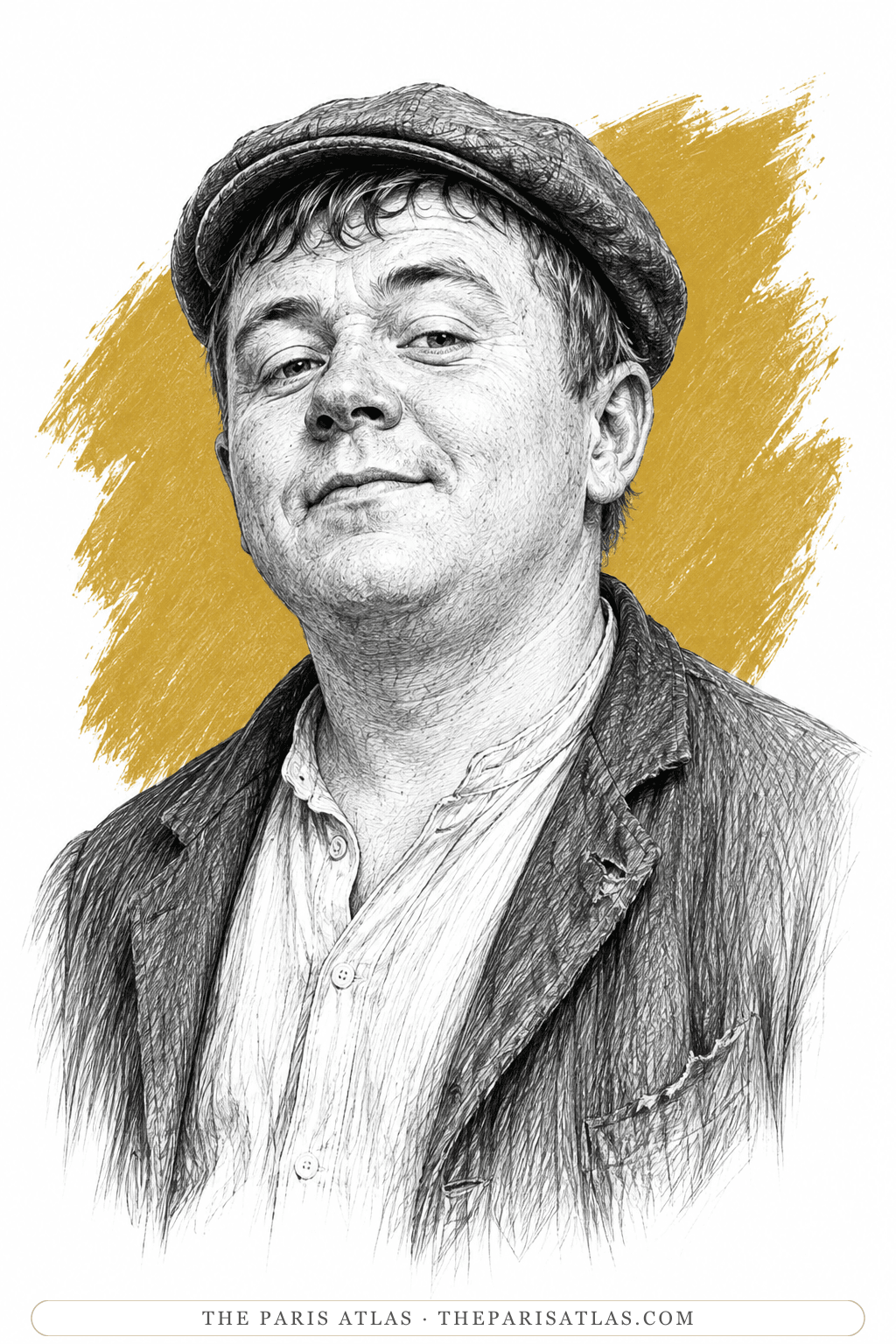
Joe
An unemployed man drawing relief, lodging at the Brookers' on fifteen shillings a week. Forty-three years old and taken by Orwell for twenty-eight, he spent almost his whole day in the public library and was proud of never having married.
In Orwell's account he wants to be thought shrewd. He repeats his line about matrimonial chains as though it settles something, and treats not having married as the one piece of foresight he can point to.
The book

At a glance
- Unemployed lodger at the Brookers', drawing relief
- Forty-three
- Joe; the book gives him no surname and says so
- Fifteen shillings a week
- Spent almost entirely in the public library
- Part One, chapter 1
Who they are in the book
Spoiler-freeJoe is one of the permanent lodgers in the tripe shop, and George Orwell introduces him as the kind of person who has no surname. He was on the Public Assistance Committee's books, which is to say drawing relief, with a total income of fifteen shillings a week, six or seven of which went to the Brookers for his bed.
Orwell describes him as derelict-looking and frankly ragged, with a round, almost childish face wearing a naively naughty expression — more like a neglected little boy than a grown man. He took him for about twenty-eight and was amazed to learn he was forty-three, and puts the discrepancy down to a complete lack of responsibility, which he says makes many of these men look younger than their ages.
He filled the day by reading. Almost all of it went in the public library, which was warm and free. He liked resounding phrases and was very proud of the astuteness with which he had avoided getting married; his line on it, delivered to Orwell more than once with evident satisfaction, was that matrimonial chains is a big item. For food he made himself tea over the kitchen fire and ate outside, mostly bread and margarine and packets of fish and chips.
How Joe Is Portrayed
- Younger than he isOrwell put him at about twenty-eight and was amazed to learn he was forty-three. He reads the years off the face rather than the record: a round childish face, a naughty expression, a neglected little boy rather than a man.
- RaggedOrwell's two words for him are derelict-looking and frankly ragged. The book names no garment beyond that, and nothing of his hair or colouring.
- The public libraryWhere he spent almost his entire day. Orwell notes elsewhere that keeping warm is almost the sole preoccupation of a single unemployed man in winter, and that the library and the cheap cinema are where it is done.
- Fifteen shillingsHis whole income. Six or seven went on his bed. He made tea over the kitchen fire and got his meals out of doors, bread and margarine and fish and chips.
- The phrase"Matrimonial chains is a big item." He said it to Orwell often, and Orwell says he evidently felt it to be a very subtle and portentous remark.
- A category, not a lodgerBeing on relief, he counted with the Brookers as the same sort of nuisance as the old-age pensioners: someone in the house who was not paying enough for it.
If you like The Road to Wigan Pier


If you like George Orwell
Explore authors with a similar voice, perspective, and influence.

Henry Miller
The Brooklyn dropout who arrived in Paris broke at thirty-eight and wrote the exuberant, banned books that ended American censorship.
View author
Louis-Ferdinand Céline
The doctor of the Paris slums who wrote the century's blackest, funniest novel — and changed the sound of French prose.
View author
Simone de Beauvoir
French writer and philosopher whose novels, memoirs, and social analysis examined freedom, gender, responsibility, aging, and the material conditions that shape a life.
View author