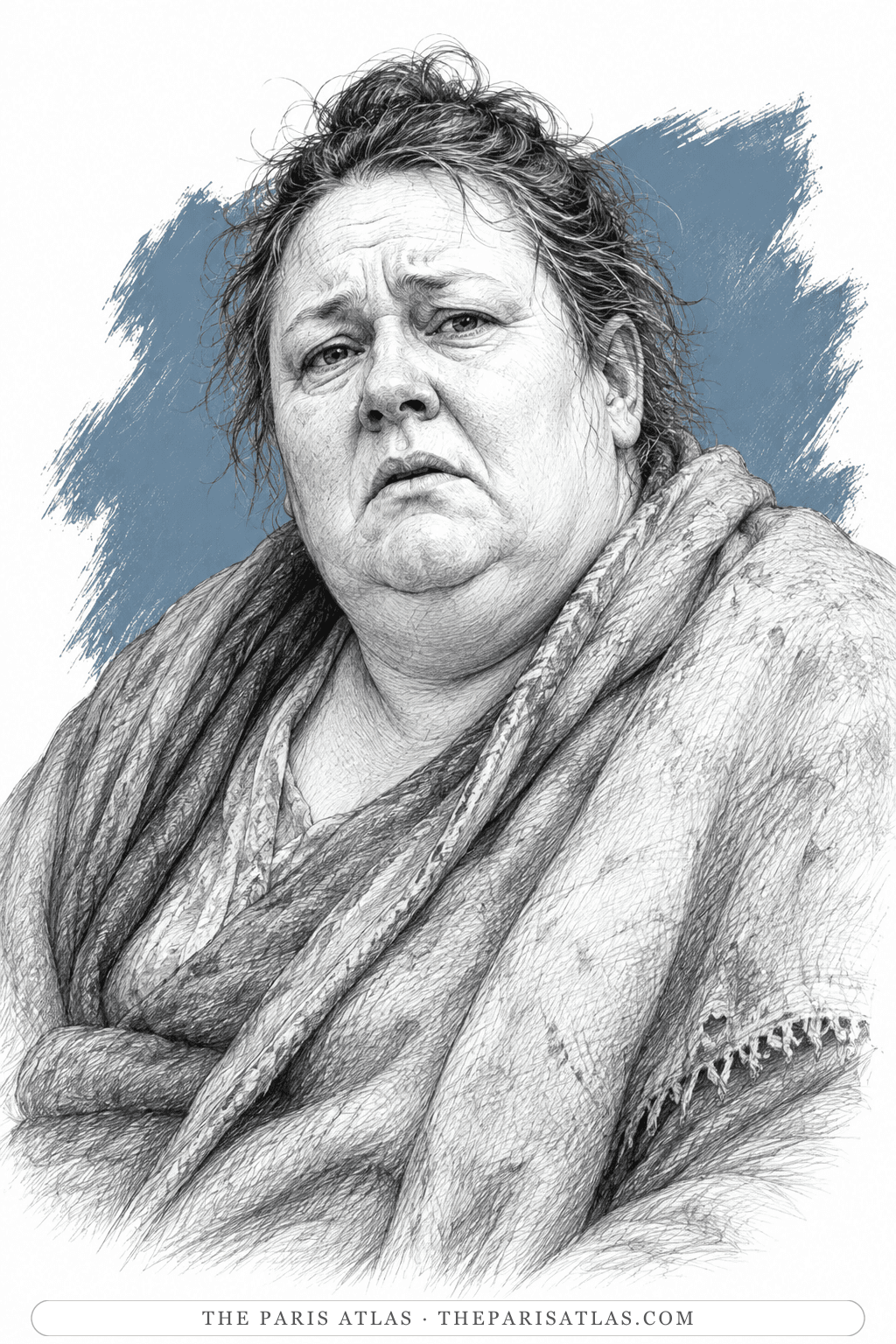
Mrs Brooker
The landlady, who lies permanently ill on a sofa in the kitchen, festooned in grimy blankets, and whose laments all finish the same way: "It does seem 'ard, don't it now?"
In Orwell's account she wants to be pitied, and to be listened to while she is. The grievances are the point rather than any remedy for them, and she repeats them to whoever is in the kitchen.
The book

At a glance
- Landlady of the lodging house in chapter 1
- A sofa in the kitchen, day and night
- A big, pale yellow, anxious face
- Permanently ill; no diagnosis is given in the book
- Her husband runs the shop and the lodgers; a daughter-in-law-to-be does the rest
- Part One, chapter 1
Who they are in the book
Spoiler-freeGeorge Orwell found her where she stayed. The sofa was in the kitchen living-room, partly blocking the larder door, and she spent the night on it as well as the day, under grimy blankets, with a big pale yellow anxious face. Nobody knew for certain what was wrong with her. Orwell's own suspicion, offered in one line, was that her only real trouble was over-eating.
She could not do the work, so her husband did it. What she did was talk. She lamented by the hour to whoever was in the kitchen, always about the same things and always in the same order — the shop had no customers, the tripe was lying there day after day, such beautiful tripe it was too — and every lament ended with the same sentence. Orwell compares the repetition to the refrain of a ballade, and says it revolted him more than anything else in the house, including her habit of wiping her mouth on her bedding.
She kept her own accounts of time and food. She dated events by consignments of frozen tripe. She ate separately but took snacks from any meal that happened to be passing, and manoeuvred with real skill for what she called the bottom of the pot, meaning the strongest cup of tea. She had appropriated her absent son's fiancée as a daughter-in-law and nagged her in the watchful, loving way invalids have, although Orwell gathered that the marriage was constantly postponed and would probably never happen.
How Mrs Brooker Is Portrayed
- Her faceBig, pale yellow and anxious. That is the whole of what Orwell says about it. Of the rest of her he gives only a phrase, a soft mound of fat and self-pity on the sofa, which is his judgement of her as much as a description.
- The sofaShapeless, partly blocking the larder door, and occupied day and night. No one knew what was wrong with her. Orwell's guess, given in a single sentence, was over-eating.
- The refrain"It does seem 'ard, don't it now?" Every complaint arrived at it, and Orwell says the tremulous whine of it worked on him more than the dirt did.
- Dating by tripeFresh consignments came at long intervals, and she used them as a calendar: "Let me see now, I've had in three lots of froze since that happened." The Brookers never ate the tripe themselves, Orwell noticed.
- At the tableShe had her meals separately but took snacks from any meal that was going, and worked skilfully for what she called the bottom of the pot, the strongest cup of tea in the pot.
- The blanket, then the newspaperShe wiped her mouth on one of her blankets. Towards the end of Orwell's stay she switched to tearing strips off a newspaper, and the floor was littered in the morning with crumpled balls of it that lay there for hours.
- EmmieThe fiancée of a son in London, a mill girl on a starvation wage who spent her evenings working in the Brookers' house. Mrs Brooker had already claimed her as a daughter-in-law and nagged her accordingly.
- The insuranceThe Brookers had insured the lives of both old-age pensioners with one of the tanner-a-week companies. It was said locally that they had been overheard asking the insurance tout how long people live when they have got cancer.
If you like The Road to Wigan Pier


If you like George Orwell
Explore authors with a similar voice, perspective, and influence.

Henry Miller
The Brooklyn dropout who arrived in Paris broke at thirty-eight and wrote the exuberant, banned books that ended American censorship.
View author
Louis-Ferdinand Céline
The doctor of the Paris slums who wrote the century's blackest, funniest novel — and changed the sound of French prose.
View author
Simone de Beauvoir
French writer and philosopher whose novels, memoirs, and social analysis examined freedom, gender, responsibility, aging, and the material conditions that shape a life.
View author