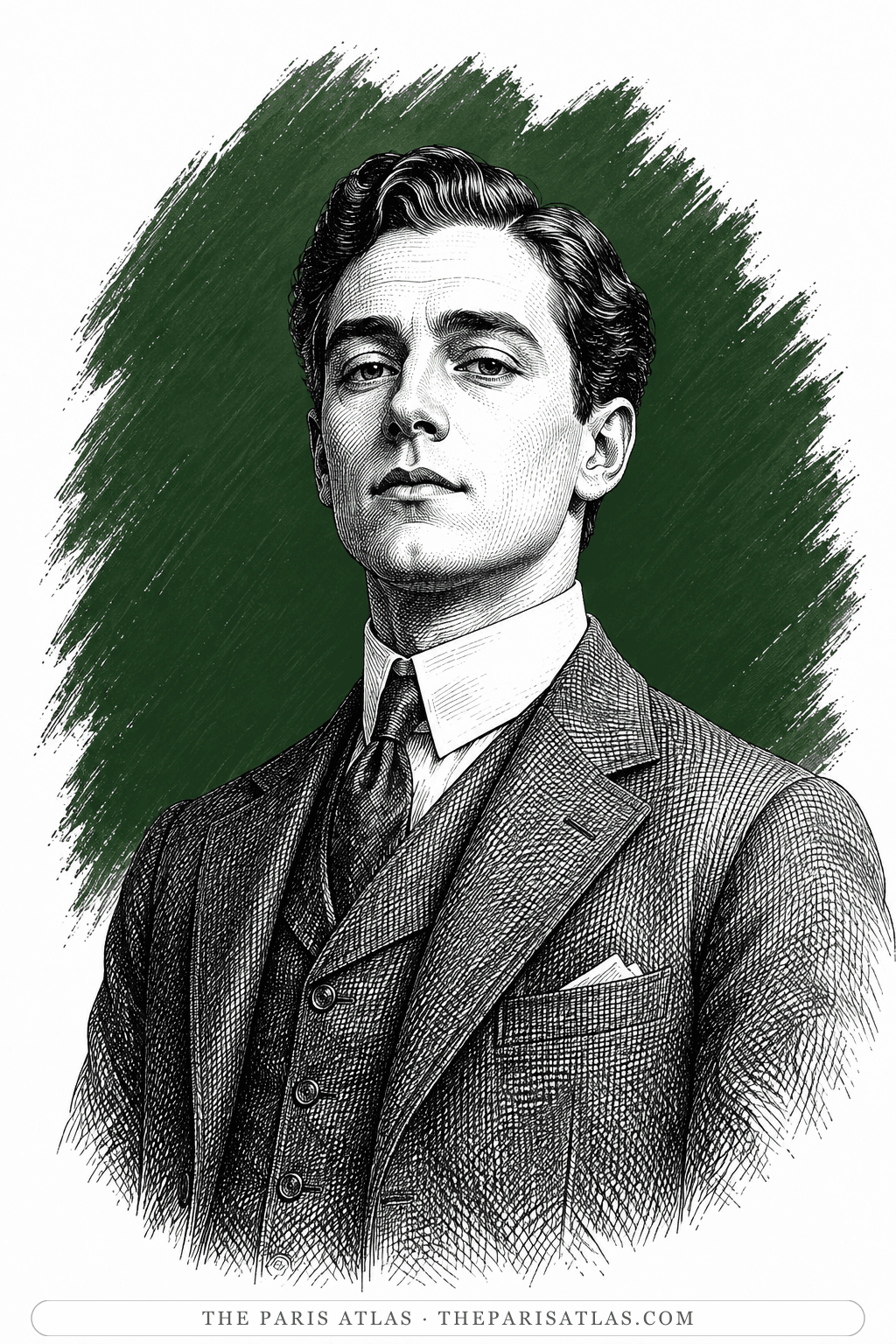
Anson Hunter
The eldest son of a New York family with fifteen million dollars, in the story “The Rich Boy.” A friend from his days in the navy tells his story.
To be at the centre of every room he walks into, and to keep Paula Legendre without ever having to hurry. On a moonlit beach he decides that holding her is enough and that he need not commit their destinies to a practical enigma, because he can bide his own time — for another year, or forever.
The book

At a glance
- Anson Hunter, the rich boy of the title — invented by F. Scott Fitzgerald
- Eldest of six children who will one day divide fifteen million dollars
- A house on 71st Street, New York, and a summer estate in northern Connecticut
- Yale from eighteen; he had shifted the centre of his life to New York long before he graduated
- Naval aviation, trained at Pensacola from 1917; his plane went down in the North Sea in August 1918 and he was pulled onto a destroyer after a night in the water
- A Wall Street brokerage house — a partnership, then a seat on the Stock Exchange and twenty-five thousand a year by twenty-eight
- An unnamed narrator, a fellow officer from Pensacola who later lunches with him at the Yale Club
Who they are in the book
Spoiler-freeAnson Hunter is the central figure of “The Rich Boy,” the longest story in All the Sad Young Men, the 1926 collection by the American writer F. Scott Fitzgerald. He is invented. He is the eldest of six children who will one day divide a fortune of fifteen million dollars, and he grows up in a house on 71st Street in New York, with summers on a big family estate in northern Connecticut.
The story is told by an unnamed narrator, a fellow officer from the naval aviation camp at Pensacola in 1917, who says at the start that the only way he can describe Anson is to approach him as if he were a foreigner. Anson goes from Yale into a Wall Street brokerage house, becomes the man all his friends bring their troubles to, and falls in love once, with a girl named Paula Legendre. The rest is what he does with the years after that.
How Anson Hunter Is Portrayed
- Fifteen million dollars, divided six waysHe is the eldest of six children who will one day split a fortune of fifteen million. There is a house on 71st Street and a big estate in northern Connecticut, which is deliberately not a fashionable locality: his father wanted to delay as long as possible what his sons learned about that side of life.
- The accentHe and his brother were brought up by an English governess who spoke very clearly and crisply, so their words and sentences come out crisp and clear and not run together. It is not quite an English accent, the narrator says, but one peculiar to fashionable people in the city of New York.
- What he looks likeAt eighteen, going up to Yale: tall and thick-set, with a clear complexion and a healthy colour, yellow hair that grows in a funny way on his head, and a beaked nose. The last two keep him from being handsome. By thirty he is dignified, impressive and rather stout, and the narrator says he could have been cast for a pillar of something.
- The night at the RitzDrunk before a dinner party and unable to control his voice, he takes the unusual refuge of telling Paula's cousin that he is French and cannot speak English. Later that evening he talks boisterously at the table for fifteen minutes and then slides silently under it, and his uncle and two other men carry him upstairs. He told the part about being French for years afterwards, laughing.
- Wall StreetHe joins a brokerage house after the war and puts in a thorough eight hours however little he has slept. By 1920 his salary and commissions pass twelve thousand dollars; at twenty-eight he has a seat on the Stock Exchange and an earned income of twenty-five thousand a year.
- Sunday schoolEvery Sunday morning he teaches at a fashionable Episcopal Sunday school. A cold shower and a quick change into a cutaway coat are all that separate him from the wild night before.
- The man everybody brings their trouble toA younger brother in difficulty at Yale, a quarrel to be patched up between a friend and his wife, a job to be found, an investment to be placed. His specialty is young married couples: he knows the story of their love affair, advises them where to live and how, and remembers their babies' names.
- The drawer of necktiesHe has been best man or usher more times than he can count, and there is a drawer at home bulging with the official neckties of those wedding parties. They stand for romances that did not last a year, and for couples who have passed completely out of his life.
- What he says about marriage“Life,” he would explain sometimes, “has made a cynic of me.” By life he means Paula. And on marrying: “I'll never marry,” he came to say; “I've seen too much of it, and I know a happy marriage is a very rare thing. Besides, I'm too old.” He is not yet thirty when he says it.
Anson's one intervention in somebody else's marriage is the story's turn. He hears that his aunt Edna, his uncle Robert's wife, is carrying on with a hard-drinking young man named Cary Sloane, and decides to stop it himself rather than let his uncle be hurt. He gets Edna to the Plaza for lunch, sits silent while she appeals to his chivalry, his pity and his sophistication, and keeps her there until she agrees to meet him again at five. That evening and half the night he wears the pair of them down, then gives them his terms: Sloane out of town for six months within forty-eight hours, and no resumption. Anson never blames himself, and he is never welcome in his uncle's house again.
The rest is loss without any drama in it. Paula Legendre marries, divorces, remarries, and turns up once by accident in the lobby of the Plaza, pregnant and happy; , and for the first time in their friendship he tells the narrator nothing at all about how he feels. What the last pages show instead is a Friday afternoon with nothing in it. The Yale Club is empty, two households have gone to the country without telling him, and Anson shuts himself in a telephone booth at the Plaza working through an address book of people who have moved away or gone abroad — one exchange no longer exists. On the ship he finds a girl in a red tam within the hour. The narrator's closing thought is that Anson was never happy unless somebody was in love with him.
If you like All the Sad Young Men


If you like F. Scott Fitzgerald
Explore authors with a similar voice, perspective, and influence.
Ernest Hemingway
Fitzgerald vouched for him to Scribner's before they had met, then edited him better than he edited himself; the friendship's five rounds are chronicled in our journal.
View author
Henry Miller
The Brooklyn dropout who arrived in Paris broke at thirty-eight and wrote the exuberant, banned books that ended American censorship.
View author
Louis-Ferdinand Céline
The doctor of the Paris slums who wrote the century's blackest, funniest novel — and changed the sound of French prose.
View author