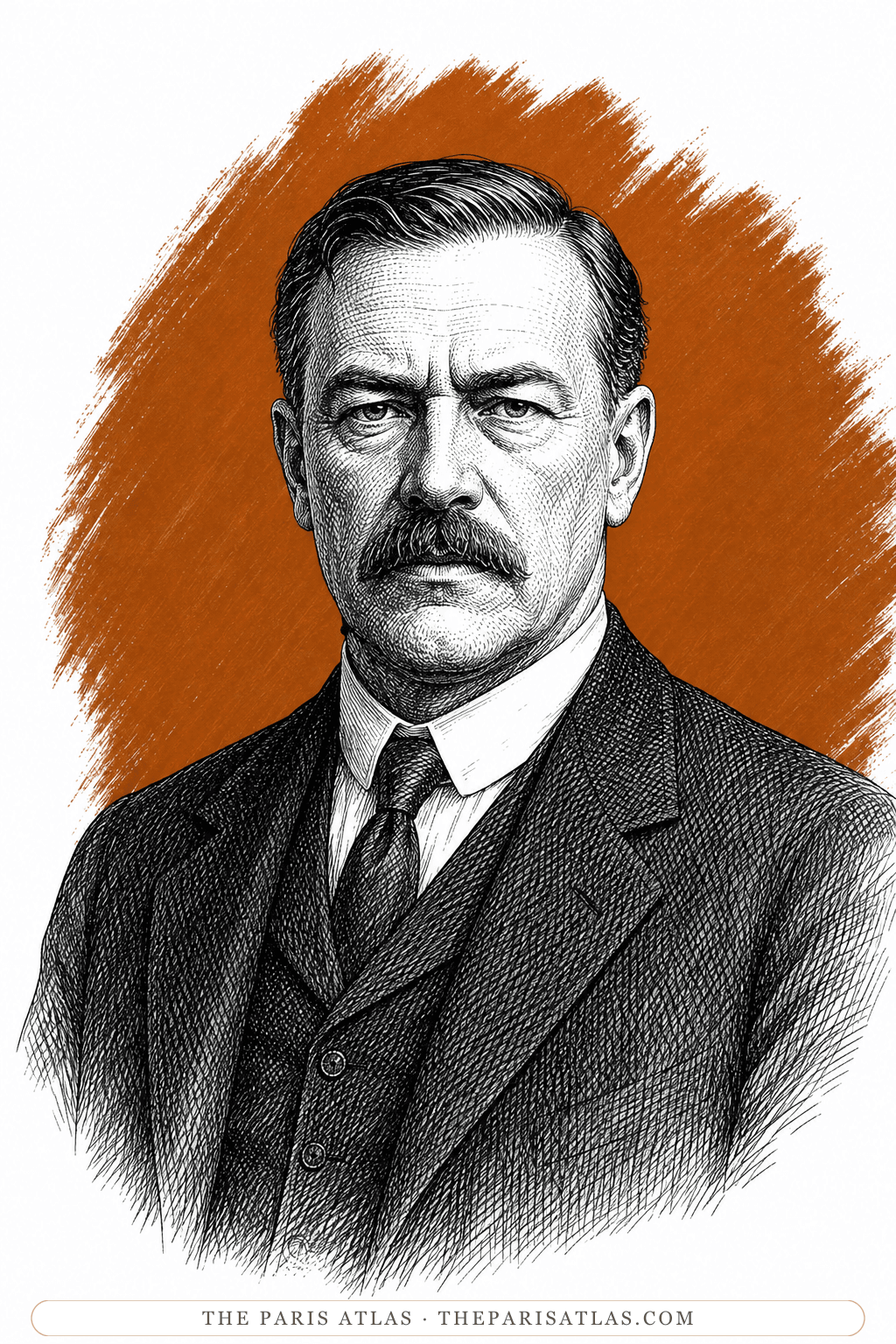
Carl Miller
Rudolph Miller's father in “Absolution,” the freight agent of a small Dakota town. He is most of what is wrong in his son's life, and he does not know it.
A son who does not neglect his religion. He sends the boy back into the confessional a second time in two days, and tells him that when they get to church, before he goes to communion, he had better kneel down and ask God to forgive him for his carelessness.
The book

At a glance
- Carl Miller — invented by F. Scott Fitzgerald
- The local freight agent
- Ludwig, a small town in the Dakota wheat country of the Red River valley
- The second wave of German and Irish stock into the Minnesota–Dakota country
- The Roman Catholic Church, and the railway builder James J. Hill
- A wife who sleeps nervously in the other bedroom, and a son on a cot behind a screen in the hall
- Rudolph Miller, eleven
Who they are in the book
Spoiler-freeCarl Miller is the father in “Absolution,” the story the American writer F. Scott Fitzgerald wrote as the opening chapter of The Great Gatsby and then cut. He is invented. He came to the Minnesota–Dakota country with the second wave of German and Irish stock, and he is the local freight agent in a small town called Ludwig, in the Dakota wheat country.
The story is his son Rudolph's, and Carl Miller is the pressure it is written against. He orders the boy to confession, catches him at the kitchen sink on Sunday morning trying to disqualify himself from communion, beats him for it, and then kneels beside him at Mass and prays for both of them. He is a devout, disappointed and frightening man, and the story is unusually fair to him.
How Carl Miller Is Portrayed
- The job he cannot hold on toTheoretically, great opportunities lay ahead of a young man of energy in that day and place. Carl Miller never managed to establish, with his superiors or his subordinates, the reputation for approximate immutability that the story says is essential to success in a hierarchic industry. Being unable to take fundamental relationships for granted has made him suspicious, unrestful and continually dismayed.
- The two things he holds toHis two bonds with the colourful life are his faith in the Roman Catholic Church and his mystical worship of the Empire Builder, James J. Hill. Hill has the thing Miller lacks — the sense of things, the feel of things, the hint of rain in the wind on the cheek. Miller's mind works late on other men's old decisions, and he has never once felt the balance of any single thing in his hands. For twenty years he has lived alone with Hill's name and God.
- Sunday morning at sixHe wakes in the dustless quiet, kneels by the side of the bed and prays for several minutes with his yellow-grey hair and the full dapple bangs of his moustache pressed into the pillow. Then he draws off his night-shirt — like the rest of his generation he had never been able to endure pajamas — and puts woollen underwear on his thin, white, hairless body. Then he shaves, and hears something in the kitchen below.
- At the sinkHe comes down and finds his son barefoot with one hand on the dripping faucet and a full glass of water in the other. “Pour it out,” commanded his father, “that water!” Then the questions — whether he went to confession yesterday, why he was going to drink water, whether he cares more about being a little thirsty than about his religion — and then the threat: “First you begin to neglect your religion,” cried his father, fanning his own fierceness, “the next thing you'll begin to lie and steal, and the next thing is the reform school!”
- What the boy is actually afraid ofRudolph's choice is between telling everything and taking a ferocious beating, or receiving communion with sacrilege on his soul, and he finds the first more terrible. It is not the beating he dreads. It is the savage ferocity behind it, which the story names exactly: the outlet of the ineffectual man.
- The beatingThe boy dashes the tumbler into the sink and his father utters a strained, husky sound and springs for him. It lasts less than a minute — a dull impact of a fist against the side of the head, glancing blows on the upper body, the boy dodging round the kitchen table and laughing hysterically several times — and it leaves a long, shallow scratch on the boy's neck from his father's fingernail. Then he half drags, half threatens him upstairs to dress.
- The other person in the houseHis wife lies nervously asleep in the other bedroom through all of it and appears at the door afterwards in a wrapper, her wrinkled face compressing and opening into new series of wrinkles. She tries to touch her son's neck with witch-hazel and he avoids her rudely, despising her nervous ineffectuality. She has no other part in the story.
- What he prays for at MassKneeling beside his son he prays that God will forgive Rudolph, and asks also that his own outbreak of temper be pardoned. He glances sideways, is relieved to see that the strained, wild look has gone and that the boy has stopped sobbing, and reckons that the Grace of God inherent in the Sacrament will do the rest. He is proud of Rudolph in his heart, and beginning to be truly as well as formally sorry for what he has done.
Carl Miller never finds out any of it. At the church door he orders his son back into the confessional; the boy goes in, says he accuses himself of missing his morning prayers, and comes out. His father takes that as the matter settled.
The one answer the boy ever gives him back is said quickly at the church door, when he is ordered inside a second time: “You lost your temper, too!” His father takes a step toward him and the boy moves cautiously backward, and that is the end of the argument.
If you like All the Sad Young Men


If you like F. Scott Fitzgerald
Explore authors with a similar voice, perspective, and influence.

Ernest Hemingway
Fitzgerald vouched for him to Scribner's before they had met, then edited him better than he edited himself; the friendship's five rounds are chronicled in our journal.
View author
Henry Miller
The Brooklyn dropout who arrived in Paris broke at thirty-eight and wrote the exuberant, banned books that ended American censorship.
View author
Louis-Ferdinand Céline
The doctor of the Paris slums who wrote the century's blackest, funniest novel — and changed the sound of French prose.
View author