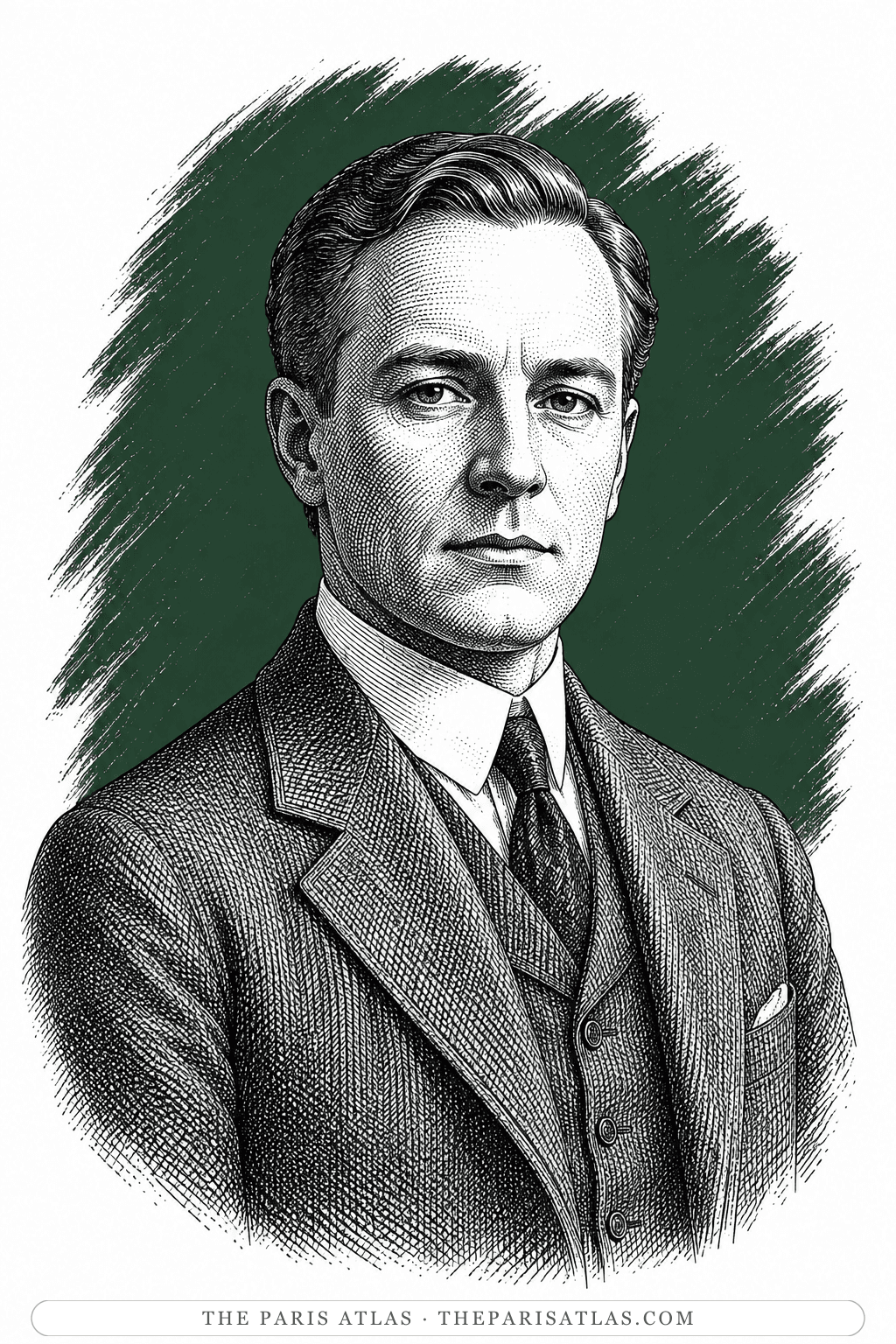
John M. Chestnut
The man who has been in love with Rags Martin-Jones for five years, in “Rags Martin-Jones and the Pr-nce of W-les.” She thinks he has no imagination.
To be the one man who does something for her that nobody else would think of. Told he has no imagination, he asks her once more, in a matter-of-fact tone: “For the last time—will you come along with me to-night and see what you will see?”
The book

At a glance
- John M. Chestnut — invented by F. Scott Fitzgerald
- The story of his own success, in the American Magazine
- Hopelessly in love with Rags Martin-Jones for five years, since she was sixteen
- Not as rich as she is
- Love
Who they are in the book
Spoiler-freeJohn M. Chestnut is a character in “Rags Martin-Jones and the Pr-nce of W-les,” a story by the American writer F. Scott Fitzgerald, first printed in McCall's in July 1924 and collected in All the Sad Young Men. He is invented. He is a flustered, handsome young man with an almost ferocious love-light burning in his eyes, and he is on the dock when Rags Martin-Jones comes home to New York after five years abroad.
He has already written the story of his own success for the American Magazine, which is the only thing the story says about how he made his money until the last page. What Rags tells him, within a few hours of landing, is that he is dull and uninspired and has no imagination, and that she is going back to Paris tomorrow. The rest of the story is his answer.
How John M. Chestnut Is Portrayed
- Five yearsHe has been hopelessly in love with her since she was sixteen — a wild, lovely child sitting up all night in restaurants with officers who were leaving for Brest the next day. She has been away five years. When she tells him it is the first time she has been excited in four years, he works out that this is one year less than he has loved her.
- On the pierShe walks straight past him and then looks at him blankly, as if she had never seen him before in this world. “John M. Chestnut?” she inquired, inspecting him with great interest. He is furious. When she remarks that she has a lot of junk to declare, he answers, “So have I,” said Chestnut anxiously, “and the first thing I want to declare is that I've loved you, Rags, every minute since you've been away.”
- The voice he cannot keep downShe tells him that young Americans on the boat have already made the subject a bore, and his voice rises to a carrying pitch: “My God!” cried Chestnut, “do you mean to say that you class my love with what was said to you on a boat?” Half the passengers stop to watch. She warns him twice. Then she takes a brisk step forward and he goes backwards off the thirty-foot dock into the Hudson River, and swims easily.
- What he has to offerAt the Ritz that afternoon she asks whether he is rich. “Not as rich as you.” She asks what he has to offer her, then. His answer is one word: “Love.” She disappears among the cushions and tells him what she thinks of the merchandise.
- His case for New YorkTold that nothing ever comes off here, he tries: “Loads of things come off,” he insisted. “Why, to-day there was an intellectual murder in Hoboken and a suicide by proxy in Maine.” He is starting on a bill before Congress when she cuts him off to say that she has no interest in humour but an almost archaic predilection for romance.
- The hintBefore he plays his last card he draws a long breath and looks cautiously around as if afraid of being overheard, and tells her in a low, worried tone that if everything were known, something pretty awful would be liable to happen to him. She laughs at him. She does not believe there is anything shady in his life, and tells him he will have his fun by plugging ahead on the beaten path.
- Where he takes herA roof garden called, for no particular reason, the Hole in the Sky: wide open to the April night with the true stars overhead and a lunar sliver of ice in the dark west, and warm as June, because of some new invention that keeps the warm air from rising. The orchestra is playing on a different roof altogether. He promises her the Prince of Wales, in New York incognito for a prize-fight and under one of his second-string names.
Halfway through the evening a deathly pale young man called Monte comes to the table and says they have picked up the trail. Chestnut goes white, lurches back into his chair, and tells Rags that a warrant has been out for him for over an hour. She asks what for, and the answer is barely audible: murder. She crosses the floor and begs two seats in the prince's car, and gets them by saying it is a runaway marriage. Then police come in at both doors, a plain-clothes man calls for John M. Chestnut by name, the aides draw revolvers, and the roof fills with smoke and shooting until Chestnut walks forward with his hands out in surrender.
If you like All the Sad Young Men


If you like F. Scott Fitzgerald
Explore authors with a similar voice, perspective, and influence.
Ernest Hemingway
Fitzgerald vouched for him to Scribner's before they had met, then edited him better than he edited himself; the friendship's five rounds are chronicled in our journal.
View author
Henry Miller
The Brooklyn dropout who arrived in Paris broke at thirty-eight and wrote the exuberant, banned books that ended American censorship.
View author
Louis-Ferdinand Céline
The doctor of the Paris slums who wrote the century's blackest, funniest novel — and changed the sound of French prose.
View author