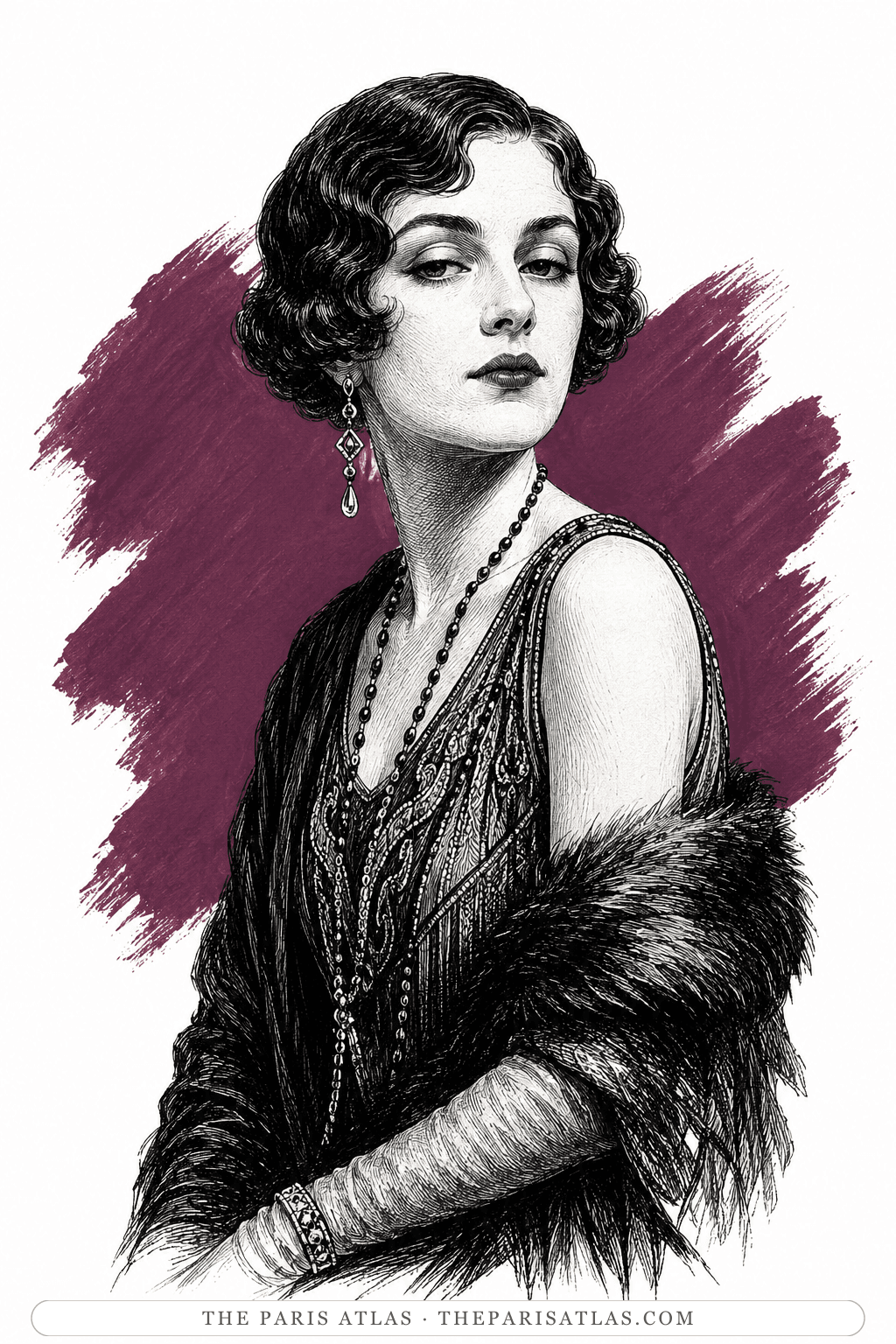
Paula Legendre
The woman Anson Hunter loves, and does not marry, in the story “The Rich Boy.” She is serious, rich in her own right, and not prepared to wait forever.
To be asked. She waits out an engagement, a broken engagement and three years of letters for Anson Hunter to say the sentence, and on a moonlit beach at Palm Beach her heart keeps crying, “Ask me—oh, Anson, dearest, ask me!” while he decides there is no hurry.
The book

At a glance
- Paula Legendre — invented by F. Scott Fitzgerald
- Somewhere in California; her family winters just outside Pensacola, Florida
- A personal fortune of nearly a million dollars, which she mentions the day after they agree to marry
- Late summer 1917, at the naval aviation camp at Pensacola
- A dark, serious beauty; prim, and enormously popular anyway
Who they are in the book
Spoiler-freePaula Legendre is a character in “The Rich Boy,” the long story that opens All the Sad Young Men, the 1926 collection by the American writer F. Scott Fitzgerald. She is invented. She meets Anson Hunter in 1917 at Pensacola, Florida, where he is training as a navy flyer and her family keeps a winter residence just outside town.
She is the only woman Anson ever loves, and the story is arranged around the several occasions when he could have married her and did not. Fitzgerald keeps her at one remove: the story is told by a friend of Anson's, so most of what we get is what Anson said about her afterwards. She is given the plainest speech in it, and she is right.
How Paula Legendre Is Portrayed
- How she is introduced“Her name was Paula Legendre, a dark, serious beauty from somewhere in California.” Her family keeps a winter residence just outside Pensacola, and in spite of her primness she is enormously popular.
- The word people used about herSincerity. The narrator says that was the thing to say about her, and admits he never understood what it offered a mind as keen and sardonic as Anson's.
- The dialogueTheir courtship is one conversation carried on for weeks: long, serious, low-keyed. Anson admitted long afterwards that it was not about anything in particular and was composed on both sides of immature and even meaningless statements; what filled it came out of its enormous seriousness rather than its words. Toward the end it began to be interrupted by passion, and that was the one interruption they did not resent.
- The million dollarsOne evening after a dance they agree to marry, and he writes a long letter about her to his mother. The next day she tells him something she has not mentioned: she is rich, with a personal fortune of nearly a million dollars.
- Two men in oneConfused by his mixture of solidity and self-indulgence, she comes to think of Anson as two alternating personalities. Alone with him, or at a formal party, she feels a tremendous pride in him. In other company the other face shows: gross, humorous, reckless of everything but pleasure.
- What she says about the drinkingAfter the night he slides under the dinner table she does not shout. In the car going home she says she had known he drank but never expected anything like this, that it seems to her they may not be suited to each other after all, and that their ideas about life are too different. Then she says she is not angry but terribly sorry, will not let him come into the hotel, and kisses him unhappily on the cheek.
- The lettersWhen the engagement is over the letters go on. “Dearest,” said their letters now, “Dearest, Dearest, when I wake up in the middle of the night and realize that after all it was not to be, I feel that I want to die.”
- Palm BeachIn February he follows her to Florida and finds her at the Everglades Club playing bridge with a Bostonian named Lowell Thayer. They walk out onto the moonlit beach and embrace, and she draws her face back so that his lips can say the thing she wants to hear. He says only her name, twice, and decides that her being moved is enough.
Paula breaks the engagement after Anson gets flagrantly drunk and misses an appointment with her. In April, without warning, a telegram reaches him from Bar Harbor: she is engaged to Lowell Thayer and they will be married immediately in Boston. Anson fills himself with whiskey that morning, goes to the office, works without a break, and then for three days keeps bending his head into his hands and crying like a child, in any place and any company.
Seven years later he meets her by chance in the lobby of the Plaza, obviously pregnant, waiting by the revolving door. She is Mrs. Peter Hagerty now: divorced in Paris a year earlier, remarried, three children by Lowell Thayer, and, she says, awfully happy. She takes him home to Rye for dinner, tells him she was infatuated with him and that they would not have been happy, and adds that she is in love now, at last. Her husband carries her upstairs to bed as a family joke and she asks Anson to watch. He answers “Yes” five times.
The narrator, crossing with him, records that for the first time in their friendship Anson told him not a word of how he felt, and that he showed no sign of emotion at all.
If you like All the Sad Young Men


If you like F. Scott Fitzgerald
Explore authors with a similar voice, perspective, and influence.
Ernest Hemingway
Fitzgerald vouched for him to Scribner's before they had met, then edited him better than he edited himself; the friendship's five rounds are chronicled in our journal.
View author
Henry Miller
The Brooklyn dropout who arrived in Paris broke at thirty-eight and wrote the exuberant, banned books that ended American censorship.
View author
Louis-Ferdinand Céline
The doctor of the Paris slums who wrote the century's blackest, funniest novel — and changed the sound of French prose.
View author