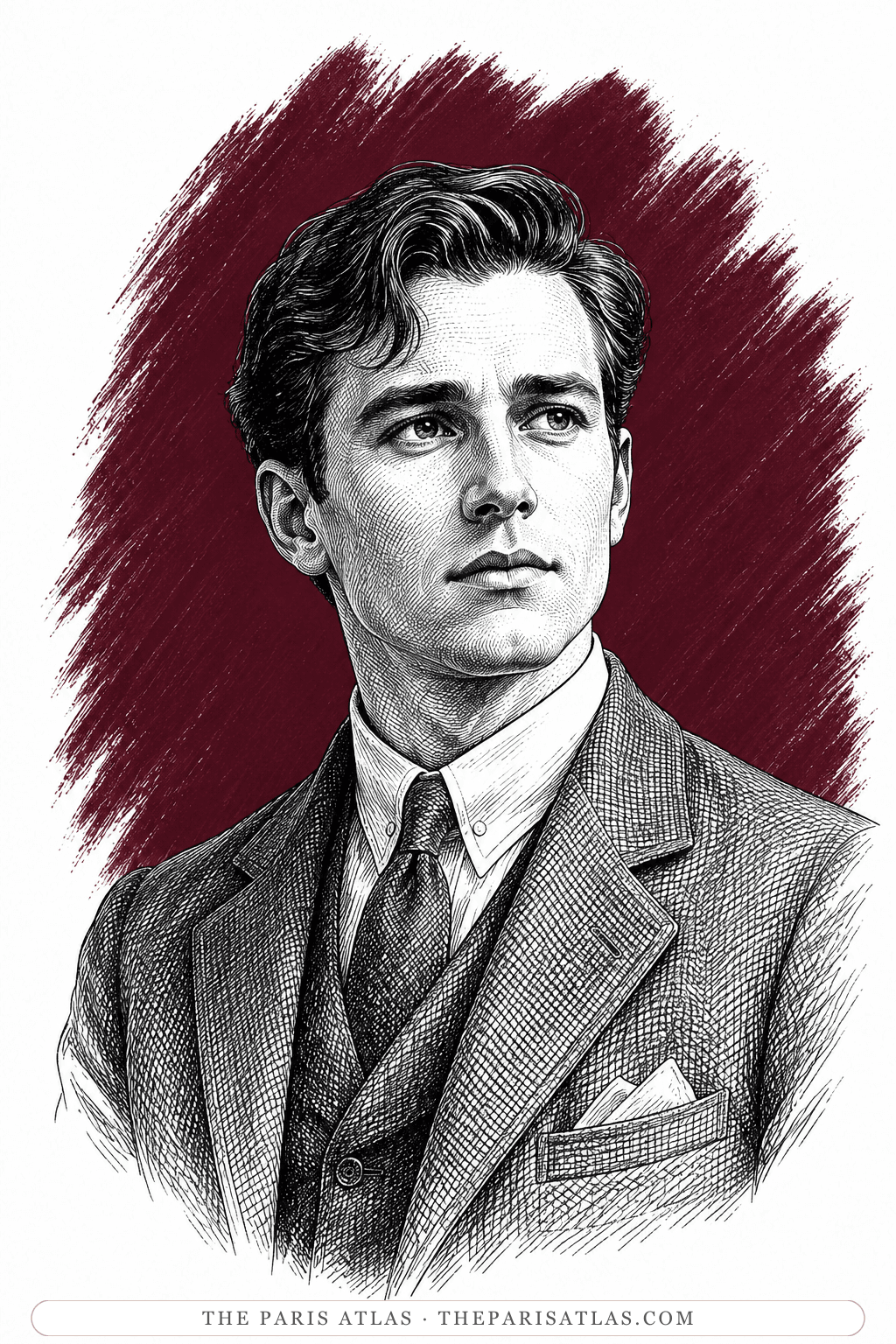
George O'Kelly
An engineer working as an insurance clerk at forty dollars a week, in “The Sensible Thing.” Fitzgerald built the story out of his own broken engagement.
To marry Jonquil Cary now, on forty dollars a week, rather than wait until he can afford her. He wires that her letter depressed him, that she has lost her nerve, that they can make it all right — and then adds, in handwriting he can barely recognise as his own, that he is coming tomorrow at six regardless.
The book

At a glance
- George O'Kelly — invented by F. Scott Fitzgerald
- Graduated with honours from the Massachusetts Institute of Technology
- Insurance clerk in New York, forty dollars a week
- Not quite one hundred dollars in the world
- Cuzco, Peru, as third assistant engineer on an expedition
- Fitzgerald's own engagement to Zelda Sayre, broken in 1919 over money
Who they are in the book
Spoiler-freeGeorge O'Kelly is the central figure of “The Sensible Thing,” a story by the American writer F. Scott Fitzgerald, first printed in Liberty on 15 July 1924 and collected in All the Sad Young Men. He is invented, but the situation is not. Zelda Sayre refused to marry Fitzgerald in 1919 because he had no money and no prospects; he wrote this story about it five years later, by then married to her.
George graduated with honours from the Massachusetts Institute of Technology and took a job with a firm of construction engineers in southern Tennessee. When the story opens he has given that up for an insurance office in New York at forty dollars a week, and a letter has arrived from the girl in Tennessee whose meaning he can read at a glance.
How George O'Kelly Is Portrayed
- The runHe leaves the office at the Great American Lunch Hour with an assumed air of interest, sets his teeth once he is out of the building, and runs. The run has become almost second nature and the story says it best expresses the tension he lives under: down into the subway, ninety-five blocks, out at 137th Street, and running again to one room in a high, horrible apartment house in the middle of nowhere.
- What he wanted to beAll his life he had thought in terms of tunnels and skyscrapers and great squat dams and tall three-towered bridges that were like dancers holding hands in a row. He loved steel, and there was always steel near him in his dreams — liquid steel, steel in bars and blocks and beams, waiting for him the way paint and canvas wait for a painter.
- Forty dollars a weekAt present he is an insurance clerk with his dream slipping fast behind him. He possesses in this world not quite one hundred dollars, and the round trip to Tennessee will take a large piece of it.
- Getting firedHe asks his manager for four days' leave a fortnight after taking four days' leave, will not say where beyond a place in Tennessee, and is told he need not come back. His face goes pink with pleasure. He thanks the manager warmly, explains that he could never have quit by himself, tells him to keep the three days' salary he is owed, and leaves. The manager rings for his stenographer to ask whether O'Kelly has seemed queer lately: he has fired many men and none of them ever thanked him.
- How he behaves when it goes wrongHe argues with Jonquil about an electric fan, demands to know when she will marry him, insists he is not nervous while getting up and sitting down again across the room, and later tries literally to kiss her into marrying him at once. When that fails he talks about himself at length and stops only when he can see he is making himself despicable in her sight.
- A year laterHe gets off a train with his face burned to a deep copper glow and registers at the best hotel in the city, with some satisfaction, as George O'Kelly, Cuzco, Peru. He has lost part of an eyebrow somewhere and still wears an elastic bandage on his knee. His clothes are frightful and he knows it — a Greek tailor in Lima made them in two days — and before he goes to see her he shaves and powders himself toward a somewhat more Caucasian hue, because vanity has beaten romance at the last minute.
- The lie at the endHe says he must stop in Washington on the way to New York because there is someone there who was very kind to him when he was down and out. There is nobody in Washington. He is watching her narrowly as he says it, and he is sure she winces.
Jonquil ends it in the heat of the second day, and George takes it so badly that he is ashamed of himself on the train home. What follows is the reversal he wanted. A poor fortnight in New York produces a job in a construction plant in Jersey City; that leads to an expedition to Peru where the chief dies of yellow fever ten days after they reach Cuzco; and that leads to a position of unlimited opportunity waiting for him in New York. Fifteen months after she sent him away he comes back to lay the spoils in front of her.
She is not married and not engaged, and when he asks whether she still loves him she says no. Then it turns without either of them explaining it: a silence in the gateway between two gardens full of chrysanthemums, a quiet walk home, and an evening in the room where the whole thing began and ended. She sits in his lap as she used to, interrupts his account of Peru twice, and says “Look.” The story refuses to celebrate it. April is over, and there are all kinds of love in the world but never the same love twice. Fitzgerald had married Zelda Sayre eight days after his first novel was published in 1920; in the story he kept the reunion and took the happiness out of it.
If you like All the Sad Young Men


If you like F. Scott Fitzgerald
Explore authors with a similar voice, perspective, and influence.
Ernest Hemingway
Fitzgerald vouched for him to Scribner's before they had met, then edited him better than he edited himself; the friendship's five rounds are chronicled in our journal.
View author
Henry Miller
The Brooklyn dropout who arrived in Paris broke at thirty-eight and wrote the exuberant, banned books that ended American censorship.
View author
Louis-Ferdinand Céline
The doctor of the Paris slums who wrote the century's blackest, funniest novel — and changed the sound of French prose.
View author