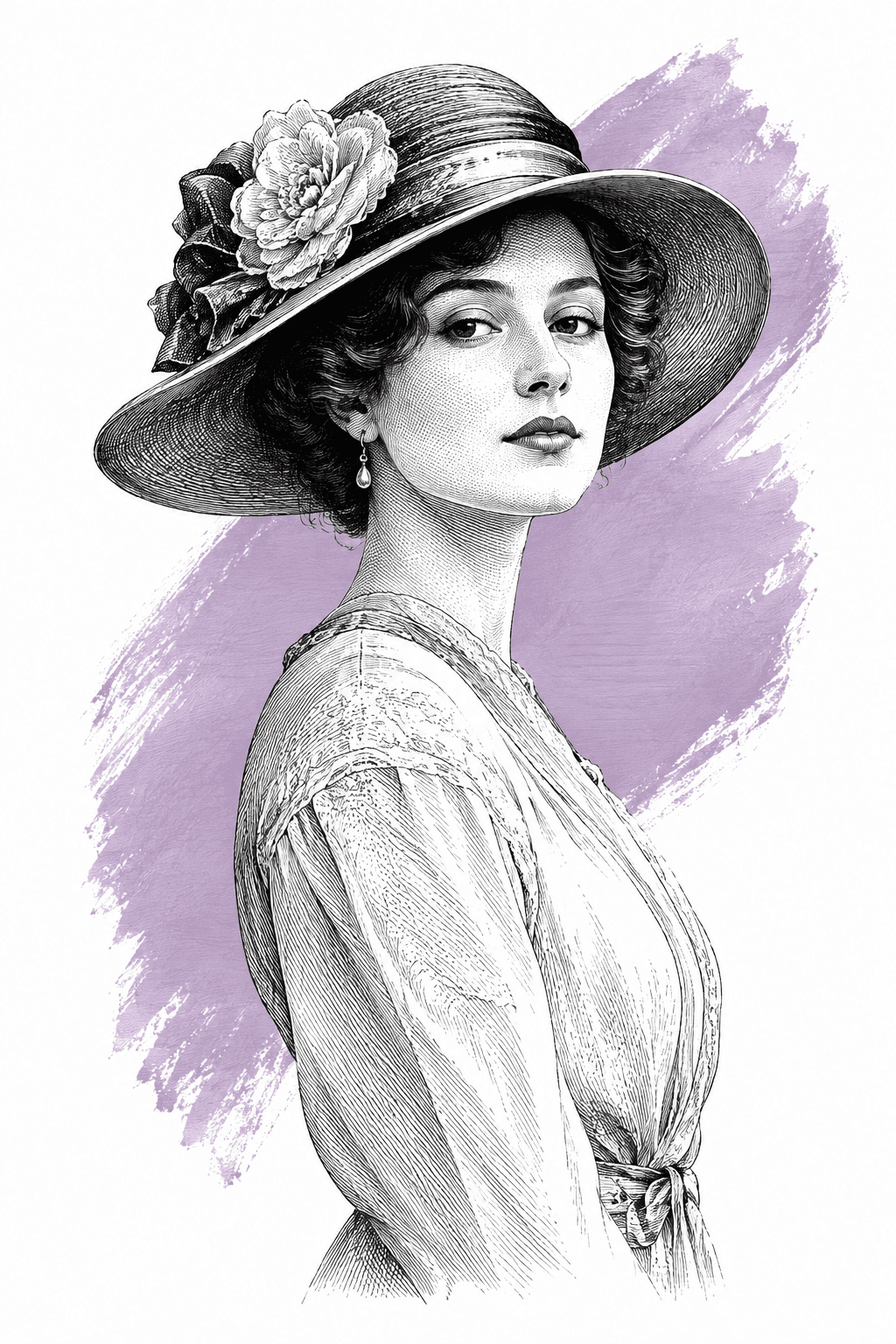
Cornelia Elliot
The wife in "Mr. and Mrs. Elliot" — forty years old, from an old Southern family, and the former proprietor of a Boston tea shop.
The book

At a glance
- "Mr. and Mrs. Elliot" only
- Forty; her husband is twenty-five
- Mrs. Elliot by the narration, Cornelia by her husband, Calutina as a family nickname, Honey by her friend
- Ran a tea shop in Boston, where Hubert Elliot knew her for a long time first
- Her friend from the tea shop, sent for from Boston, who types the poems
Who they are in the book
Spoiler-freeCornelia Elliot is the wife in Hemingway's four-page satire "Mr. and Mrs. Elliot." She ran a tea shop in Boston, where her future husband knew her for a long time before he kissed her one evening. She had seemed much younger to him — in fact she had seemed not to have any age at all. "In reality she was forty years old."
She taught him to call her Calutina, her family nickname in the South. Almost everything about her in the story is reported through the couple's failure to have a child and through her friend from the tea shop, whom she sends for once they reach France.
How Cornelia Elliot Is Portrayed
- The tryingThe story's first two sentences establish the entire marriage: "Mr. and Mrs. Elliot tried very hard to have a baby. They tried as often as Mrs. Elliot could stand it." They tried in Boston, on the boat, in Paris, in Dijon, and in the big hot bedroom in Touraine.
- The crossingShe was sick as Southern women are sick, the narration says, and elaborates that this means women from the Southern part of the United States. Passengers took her for her husband's mother; others, knowing they were married, assumed she was pregnant. Her years, the story says, had been precipitated suddenly when she started travelling.
- The declaration she likesTold how he had kept himself clean for her, she said, "You dear sweet boy," and held him closer than ever. Afterwards, when they had been kissing a long time, she would ask him to say it again. "The declaration always set her off again."
- The typing, and the cryingShe types her husband's very long poems and is made to redo whole pages over single mistakes. She is learning the touch system, and finds that while it increases her speed it produces more mistakes. Eventually her friend takes over practically all of the manuscripts, being neat and efficient and seeming to enjoy it.
- The girl friendShe prevails on her husband to send to Boston for her friend from the tea shop — several years older than Cornelia, from a very old Southern family, and given to calling her Honey. Mrs. Elliot becomes much brighter after she arrives, and they have many good cries together.
- How she ends upSharing the big medieval bed with her friend while her husband lives apart in his own room with the white wine and the night writing. The last sentence of the story has the three of them at dinner in the garden under a plane tree in the hot evening wind, making conversation, all quite happy.
If you like In Our Time


If you like Ernest Hemingway
Explore authors with a similar voice, perspective, and influence.

Louis-Ferdinand Céline
The other great stylist the Great War produced — where Hemingway cut the language down, Céline set it on fire. The same wound, opposite treatments.
View author
Henry Miller
Paris on no money a decade later, with the restraint removed. Miller called Hemingway's Paris a tourist's Paris; readers get to referee.
View author
Martha Gellhorn
War correspondent who covered the Spanish Civil War, D-Day, and conflicts across five more decades; Hemingway's third wife, 1940–1945.
View author