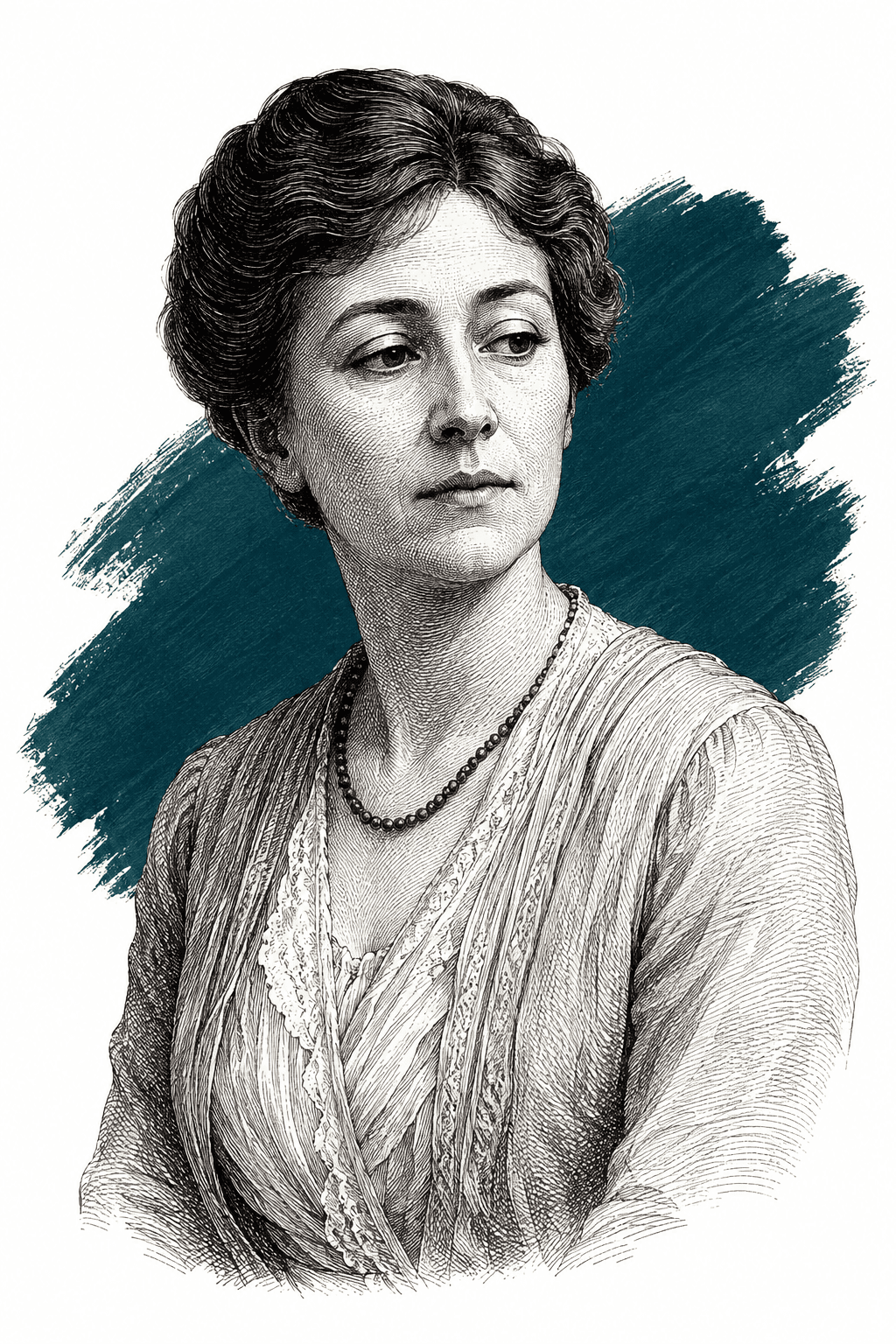
The doctor's wife
Nick Adams's mother, who spends the whole of "The Doctor and the Doctor's Wife" lying in a darkened room, asking her husband what the trouble was and then refusing to believe the answer.
To have the trouble explained to her, and then to have it not be true. She presses her husband four times for what the row was about, and when he tells her she answers: "Dear, I don't think, I really don't think that anyone would really do a thing like that."
The book

At a glance
- "The Doctor and the Doctor's Wife" only
- "The doctor's wife" and "his wife" by the narration; she calls her husband Henry
- Nick Adams's mother, and the wife of the country doctor in "Indian Camp"
- Christian Scientist — her Bible, her copy of Science and Health and her Quarterly are on the bedside table
- In bed with the blinds drawn, for the entire story
Who they are in the book
Spoiler-freeThe doctor's wife is Nick Adams's mother and half the title of the story she appears in, and she never once gets out of bed in it. She lies in a room with the blinds drawn while her husband has a humiliating row outside with a man he has hired, and everything she says reaches the reader as a voice through a wall or a window. She is a Christian Scientist, which the story states plainly and without comment.
She is in one story only, and she is the only person in it who tries to find out what happened. She asks four separate times. What makes the scene painful is what she does once she is told: she declines to believe it, twice, in the mildest possible language, and her husband stops talking. She is the mother Nick is sent to and does not go to.
How The doctor's wife Is Portrayed
- The darkened roomShe is lying down with the blinds drawn when the story reaches her, and she is still lying there when it leaves. Her husband talks to her from his own room, then from the doorway, then from outside her window. The reader never sees her.
- What is beside her bedThe story identifies her beliefs in one flat sentence and moves on: "Her Bible, her copy of Science and Health and her Quarterly were on a table beside her bed in the darkened room." Science and Health is the Christian Science textbook, and the Quarterly is its schedule of weekly readings.
- How she answers a quarrelTold that he has had a row with Dick Boulton, she says, "I hope you didn't lose your temper, Henry." It is the only time in the book anyone gives him a first name. Then she quotes scripture at him: "Remember, that he who ruleth his spirit is greater than he that taketh a city," said his wife. He does not answer.
- She asks four timesShe calls his name twice through the wall, pauses, and starts again. Did he say anything to Boulton to anger him? What was the trouble about? Told it was nothing much, she presses: "Tell me, Henry. Please don't try and keep anything from me. What was the trouble about?"
- And then declines the answerHe tells her the truth — that Boulton owes him a good deal of money for treating his wife through pneumonia, and picked the row so he would not have to work the debt off. She is silent, and then says she doesn't think anyone would really do a thing like that. When he does not argue, she says it again: "No. I can't really believe that anyone would do a thing of that sort intentionally."
- The screen doorHe puts the shotgun he has been cleaning behind the dresser and goes out onto the porch, and the screen door slams behind him. He hears her catch her breath at the sound. "Sorry," he says, standing outside her window with the blinds drawn, and she tells him it is all right.
- The one thing she asks forAs he is leaving, she asks him to tell Nick, if he sees him, that his mother wants to see him. It is the only request she makes in the story, and she puts it in the third person: not that she wants him, but that his mother does.
Nothing in the story says whether she is ill. She is in bed in the daytime with the blinds drawn, and Christian Science holds that sickness is corrected by prayer rather than medicine, which puts her in silent opposition to the man she is married to. Hemingway lays both facts down side by side and draws no conclusion from them at all.
If you like In Our Time


If you like Ernest Hemingway
Explore authors with a similar voice, perspective, and influence.

Louis-Ferdinand Céline
The other great stylist the Great War produced — where Hemingway cut the language down, Céline set it on fire. The same wound, opposite treatments.
View author
Henry Miller
Paris on no money a decade later, with the restraint removed. Miller called Hemingway's Paris a tourist's Paris; readers get to referee.
View author
Martha Gellhorn
War correspondent who covered the Spanish Civil War, D-Day, and conflicts across five more decades; Hemingway's third wife, 1940–1945.
View author